What's inside
As an Amazon Associate I earn from qualifying purchases. This post may contain affiliate links at no extra cost to you.
What we cover
First, check what kind of block you have
“Hollow block” covers several materials and shapes: lightweight concrete masonry, hollow clay tile, and concrete blocks with open cells are common examples. Their webs—the thin walls between the cavities—vary in thickness and strength. An anchor that holds well in a thick concrete face may spin or pull through a thin web. If you can, check the block type and wall thickness before choosing hardware.
Also distinguish a hole drilled into a hollow cell from one drilled into a solid web or grouted section. Anchors designed to expand in solid material may do little in an empty cavity. For a heavy or safety-critical load, use an anchor specifically rated for the block and installation condition, and follow its instructions. Generic load figures are not a substitute for a rating.
As an Amazon Associate we earn from qualifying purchases at no extra cost to you.


How plastic and metal anchors hold
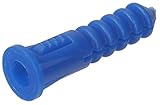
A standard plastic expansion plug grips by spreading against the sides of a drilled hole as a screw enters. It is inexpensive and can work for light loads, especially where the hole lands in sound material. In a hollow cell, however, there may be too little material around the plug for it to expand against. The plug can turn with the screw, loosen under repeated pulling, or come out when the load is bumped.
Metal hollow-wall anchors use a different method. A toggle or spring wing opens behind the wall, while a metal sleeve anchor designed for hollow masonry may grip a web or cavity in its own way. These types are not interchangeable: some require access behind the wall, while others are installed entirely from the front. Check the product’s specified substrates and required hole size rather than assuming any metal anchor suits hollow block.
Quick comparison
| Type | Best fit | Typical weakness in hollow block | Installation notes |
|---|---|---|---|
| Plastic expansion plug | Light, mostly static loads in a sound web | Can spin or pull out in an empty cell or thin face | Use the specified screw and drill size; avoid an oversized hole |
| Metal hollow-wall toggle | Loads that need a bearing point behind the face | May not fit where the cavity is shallow or obstructed | Needs the correct cavity depth and opening; follow the setting instructions |
| Hollow-masonry anchor | Block applications covered by its rating | Can fail if installed in the wrong block or hole condition | Match the anchor to the material, hole diameter, and embedment |
Choose by load and use
For a small picture frame or a light cable clip, a plastic plug may be a sensible low-cost choice if the fastener lands in a solid web and the load will not be tugged. Buy a size suited to the screw and the manufacturer’s stated substrate. Do not treat a plug’s package rating for solid concrete as a hollow-block rating.
For shelves, curtain hardware, or anything that will be pulled repeatedly, a properly selected metal anchor is usually the safer starting point. The right option depends on whether it bears behind the face, grips a masonry web, or is meant for a filled cell. A hollow-block masonry anchor selection can help you compare designs, but verify the listed substrate and installation method before buying.
For cabinets, handrails, heavy brackets, overhead loads, or anything that could injure someone if it falls, do not guess from anchor diameter alone. Find a rated fastening system intended for the actual block, or fasten into a verified solid or grouted section. Multiple anchors can share load only when the mounting surface and spacing allow it; adding more anchors does not fix a weak face.
Drilling and installation matter
Use a bit that matches the anchor instructions. A hole that is only slightly too large can let an anchor rotate; a hole that is too small can damage the anchor or prevent it from seating. Mark the required depth with tape or a depth stop. Keep the drill straight, and clear dust from the hole if the anchor instructions call for it.
For many hollow blocks, begin with a regular rotary-drill setting rather than hammer action. Hammering can chip a thin face or break a web, leaving a ragged hole that will not grip reliably. A cordless drill with a sharp masonry bit is often enough for small fasteners. Use a hammer drill only when the material and anchor instructions support it; start gently and stop if the block begins to crumble. A carbide-tipped masonry bit is the usual choice for block.
Set the anchor without forcing it. If a plastic plug spins as you drive the screw, stop: tightening harder usually enlarges the hole or strips the plug. If a toggle will not open or seat, check cavity depth and orientation instead of hammering it in. For a metal fastener that calls for a specific setting tool, use one; improvised tightening can leave the mechanism partly collapsed.
Common failures and what they mean
A loose anchor often points to a hole that is too wide, a broken web, or an anchor used in an unsupported cavity. A screw that turns without tightening may be too small for the plug or may have stripped its grip. Crumbling around the hole can mean the block face is too weak for that location. Move to a sound area, use a fastening method rated for the material, or seek a solid fixing point rather than filling the hole with glue and hoping it holds.
Before mounting the final item, test the fixing with a firm hand pull, not a sudden jerk. This is a basic check for obvious movement, not proof of a safe working load. If the item is valuable, heavy, or likely to be climbed on or grabbed, use rated hardware and the manufacturer’s installation guidance.