What's inside
As an Amazon Associate I earn from qualifying purchases. This post may contain affiliate links at no extra cost to you.
What we cover
What boring stud holes demands
For ordinary wiring and plumbing runs, a cordless drill is usually the right tool for holes through wood studs. The important choice is not simply maximum voltage or a high advertised torque number. You need enough low-speed control to keep a large bit cutting, a chuck that holds it securely, and a side handle to help manage the drill if the bit binds.
Hole size and frequency matter. A few holes under 1/2 inch are easy work for most 18V drills. Repeated holes around 3/4 to 1 inch call for a stronger drill and suitable wood-boring bits. For larger holes, or a long run of them, a drill designed for high-torque work is easier on your hands and battery. Check the drill’s manual for its limits and use the bit maker’s recommended speed; forcing a large bit at high speed can overheat the tool or catch hard enough to twist your wrist.
As an Amazon Associate we earn from qualifying purchases at no extra cost to you.


Choose the drill type for the material
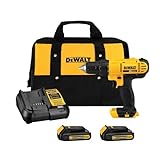
A standard drill-driver is the sensible choice for studs, cabinet framing and other wood. A hammer drill adds a hammering action for masonry, but that feature does not make it a better wood-boring drill. If you already own one, turn hammer mode off for wood. For frequent large-diameter holes, look at a high-torque drill with a side handle, or a dedicated stud-and-joist drill if its size and price make sense for your work.
An impact driver is not a substitute for a drill when you need clean, accurately sized holes. It can drive compatible hex-shank boring bits, but its impacts make it harder to control, and not every bit is rated for impact use. Use a drill for routine holes; reserve the impact driver for screws unless the bit manufacturer specifically approves it.
Browse 18V drill-drivers with a side handle if you want one tool for general home drilling and occasional stud holes. A side handle is especially useful with large bits, but it is not a guarantee against injury: keep a firm two-handed grip and stand where a sudden kickback will not pull you off balance.
What to buy for your workload
| Tool type | Best fit | Main trade-off |
|---|---|---|
| Compact 12V drill-driver | Small holes and occasional light work | Less reserve for repeated large holes |
| 18V drill-driver | Most home wiring and plumbing holes in studs | Can be bulky; performance varies by model |
| High-torque drill with side handle | Frequent, larger holes or demanding bit work | Heavier and often more expensive |
| Hammer drill | Wood holes when hammer mode is off; masonry with hammer mode on | Hammer function adds little for wood |
Battery platform is part of the buying decision. If you already own compatible batteries, a bare tool can be cheaper than starting a new system. For a first cordless tool, compare kit contents and battery capacity as well as the drill: a small battery may make a heavy boring job less convenient, while a large battery adds weight.
Match the bit to the hole
For clean, moderate-size holes, a brad-point bit starts accurately in wood. Spade bits are inexpensive and fast for rough utility holes, though they can splinter the exit face. Auger bits clear chips well in deeper holes but need a drill with enough control and power. Self-feed bits are useful for larger, repeated holes in framing, but their aggressive cutters can grab; use a compatible high-torque drill and side handle. Do not assume every bit fits every chuck: large bits may have reduced shanks, and some are intended for a 1/2-inch chuck.
Check the bit’s maximum recommended speed and the drill’s chuck capacity. A 3/8-inch chuck may suit routine small work but limits which large-shank bits it can hold. For repeated holes above roughly 1 inch, compare high-torque cordless drills with side handles rather than buying solely on an advertised torque figure. Actual performance depends on gearing, bit type, wood, battery and the operator’s feed pressure.
Bore safely and avoid common failures
Before drilling, confirm the stud location and check for wiring and plumbing. A stud finder can help, but it does not prove that the path is clear. Review plans where available, use appropriate detection tools, and be especially cautious around outlets, switches, sinks and bathrooms. Do not drill blindly through a wall cavity just because the stud is wood.
Mark the hole and keep it centered in the stud where practical. Framing codes and project requirements limit how much material can be removed; consult the applicable local rules before making large or repeated holes. Drill level when the run needs to pass through several studs, and use a depth stop or a piece of tape on the bit when you need to limit depth.
Start slowly so the bit does not skate. Let sharp teeth cut rather than leaning hard on the drill. If chips stop clearing, withdraw the bit with the drill running slowly or pause to clear the hole; packed chips create heat and increase the chance of binding. Stop if the bit catches, the drill slows sharply, or the body twists. Do not hold the work by hand near the bit, and wear eye protection. A dull bit, excessive speed, a poor grip or a knot in the wood can turn a routine bore into a kickback.
When a basic drill is enough
If you are making only a handful of small holes, a standard 18V drill-driver—or a capable 12V model for lighter work—is generally adequate. A premium high-torque drill is hard to justify for one cable run through ordinary studs. Spend first on a sharp, correctly sized bit and a secure grip. Upgrade when large holes bind, the motor repeatedly stalls, batteries run down before the job is done, or you are boring framing every week.
For an occasional masonry anchor, use a masonry bit and a hammer drill; for wood studs, use a wood bit with hammer mode off. A cordless hammer-drill kit is worth considering if you also drill brick or concrete. If your work is almost entirely wood, pay for a better chuck, useful gearing and a comfortable side handle before paying extra for hammer action you will not use.