What's inside
As an Amazon Associate I earn from qualifying purchases. This post may contain affiliate links at no extra cost to you.
A cordless hammer drill can bore clean holes in brick and concrete, but the bit matters as much as the drill. A basic set may be fine for hanging a few shelves in brick; frequent work in concrete calls for tougher tips, a useful size range, and bits that match the drill’s chuck. Choose for the holes you actually make, not the biggest set on the shelf.
As an Amazon Associate we earn from qualifying purchases at no extra cost to you.


What we cover
Match the bit to the drill
Most cordless hammer drills have a three-jaw chuck and take round-shank bits. These are widely available and convenient for general DIY work. Rotary hammers use an SDS-Plus or SDS-Max connection instead; SDS bits do not fit a standard three-jaw chuck. Don’t confuse a hammer drill’s chuck with an SDS tool’s bit holder.
For a cordless hammer drill, look for carbide-tipped masonry bits labeled for hammer-drill use and with a shank your chuck can grip. A bit marked for rotary hammers or SDS-only use is the wrong choice unless your tool has that matching holder. Check the drill’s manual, too: some compact models restrict bit diameter, and the stated maximum capacity is not necessarily a sensible size for sustained masonry drilling.
What to look for in a set
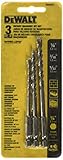
For common wall plugs and light anchors, a practical set covers roughly 3/16, 1/4, 5/16, and 3/8 inch (about 5, 6, 8, and 10 mm). Match the hole to the anchor maker’s instructions; a bit that is too large leaves an anchor loose, while one that is too small can prevent it from seating. A deep or long bit is useful for thicker walls, but length alone does not make a bit durable.
Carbide tip shape and bit construction affect how well a bit survives repeated impact. A basic, single-cutter carbide tip is adequate for occasional holes in brick or mortar. More robust multi-cutter designs are generally a better bet for regular work and harder concrete, but can cost more. Sets with many tiny increments may look versatile but are poor value if they omit the sizes your anchors require.
For a few household jobs, a carbide-tipped round-shank masonry bit set is usually the economical choice. If you drill into concrete often, compare the cost of better individual bits or a more durable set rather than buying a large assortment of unknown quality.
Set types compared
| Type | Best for | Trade-off |
|---|---|---|
| Basic carbide-tipped set | Occasional anchor holes in brick, block, or light concrete | Lower cost; tips can wear or overheat faster in hard concrete |
| Upgraded multi-cutter set | Repeated drilling and harder masonry | Higher price; unnecessary for a handful of small holes |
| Long masonry bits | Deep holes or thicker masonry | More flex and wobble; need careful alignment and a drill with enough capacity |
Brick, concrete, and mortar are not the same
Brick is often easier to drill than poured concrete, though dense or glazed brick can still be demanding. Concrete with hard aggregate can slow a cordless drill sharply and wear a cheap bit quickly. Mortar is softer and easier to drill, but it may not provide the holding strength needed for every anchor or load. Choose the fixing location according to the anchor instructions and the wall’s condition, not just whichever spot is easiest to reach.
When appearance or brick integrity matters, avoid drilling close to an edge. As a practical starting point, keep a hole at least 1 inch from a brick edge when the layout allows; brittle brick may chip even farther from the edge. For heavy loads, use a fixing system rated for the material and load rather than relying on a generic plastic plug.
Drill without burning through bits
Mark the hole and start slowly with the drill square to the wall. Once the tip has a purchase, use hammer mode and steady pressure. Let the bit cut; leaning hard on the drill can overheat the carbide, stall the motor, or make a hole wander. Pull the bit out every few seconds in deeper holes to clear dust. Packed dust raises friction and can bind the bit.
Use a side handle if your drill has one, especially with larger bits. A bit catching in masonry can twist the drill suddenly. Wear eye protection and a suitable dust mask, and check for wiring or pipes before drilling. If progress stops despite a sharp bit and sensible pressure, you may have hit hard aggregate or another obstruction. Don’t force the drill until it overheats; reposition if safe, or use a rotary hammer for repeated holes in hard concrete.
When to upgrade
Keep the cheaper set if you need only a few small holes in ordinary brick or block and can accept slower progress. Replace a bit when its tip is chipped, rounded, or no longer cuts cleanly; a dull bit makes the drill work harder and increases heat. If you routinely install larger anchors or drill into poured concrete, consider a rotary hammer with SDS-Plus masonry bits. It is a more capable setup for demanding work, but overkill for occasional shelf brackets.
For most homeowners, the best set is a small, clearly sized assortment that fits the drill and the anchors on hand. Spend extra where repeated concrete drilling justifies it; otherwise, a basic carbide set and careful technique are enough.