What's inside
As an Amazon Associate I earn from qualifying purchases. This post may contain affiliate links at no extra cost to you.
The best benchtop planer with a helical cutterhead for most woodworkers in 2026 is the Jet JWP-13BT helical version, which pairs a 13-inch capacity with 48 four-sided carbide inserts, but the right pick depends on your width needs, budget, and whether you’ll ever want to swap cutterheads yourself.
As an Amazon Associate we earn from qualifying purchases at no extra cost to you.
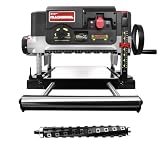

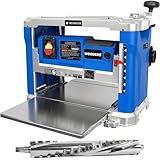
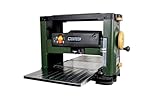
What we cover
Why the Cutterhead Design Matters More Than the Motor
Every benchtop planer removes material the same way; what changes the result is how the knives do it. A helical (spiral-indexed) cutterhead mounts dozens of small square carbide inserts in rows set at a slight skew, so each insert shears the wood rather than chopping straight across it. The practical consequences:
- Quieter operation: the cut loads gradually instead of three straight knives slamming the surface each rotation. Expect roughly 5–10 dB less perceived noise than a comparable straight-knife machine.
- Better finish on figured and reversing grain: shear cutting dramatically reduces tear-out on curly maple, bird’s-eye, and end-grain-adjacent areas.
- Segmented wear: a chipped insert is a 20-cent problem; a nicked straight knife means sharpening or replacing the full set and re-setting knife height.
- Trade-off: a helical head takes a hair more feeding force and leaves faint rows of tiny scallops you can feel but rarely see after one light sanding pass.
Straight-knife machines like the DeWalt DW735X still produce an excellent glass-smooth finish on straight-grained stock and cost considerably less up front — a helical head is worth the premium if you regularly run hardwoods, reclaimed lumber, or anything with swirling grain.
The Main Contenders Compared
These are the benchtop and near-benchtop machines that dominate the helical-cutterhead category in 2026. All specs are manufacturer-published figures.
| Model | Max Width | Max Cut Depth | Inserts | Feed Speed | Motor | Weight | Street Price Range |
|---|---|---|---|---|---|---|---|
| Wen PL1326 | 13 in | 3/32 in | 26 | 26 FPM | 15 A | ~55 lb | $350–450 |
| Cutech 40200HC-CT | 13 in | 1/8 in | 26 (spiral) | 26 FPM | 15 A | ~60 lb | $450–550 |
| Jet JWP-13BT helical | 13 in | 3/32 in | 48 | 18 FPM | 15 A | ~67 lb | $650–800 |
| Grizzly G0490X (with stand) | 15 in | 1/8 in | 74 | 16 & 20 FPM | 3 HP, 220V | ~185 lb | $1,600–1,900 |
| Jet JWP-15BHH | 15 in | 1/8 in | 48 | 16 FPM | 3 HP, 220V | ~175 lb | $1,800–2,100 |
| DeWalt DW735X (straight knives, reference) | 13 in | 1/8 in | 3 knives | 96 & 179 CPI | 15 A | ~92 lb | $600–700 |
Reading the insert-count column
Insert count drives cut quality and longevity more than most buyers realize. The Jet’s 48 inserts overlap tighter than the Wen or Cutech’s 26, which means finer scallops and less visible ridging between passes — one reason the Jet consistently leaves a surface closer to finish-ready. The two-speed feed on the DW735 (96 vs. 179 cuts per inch) is the reason straight-knife loyalists defend it: on its finishing speed it genuinely rivals a helical head on straight-grained stock.
Ownership Costs: The Part Listings Don’t Tell You
Helical heads win long-term economics on hard use, but only if you rotate inserts instead of swapping them. Each carbide insert has four usable edges.
Worked example — a hobbyist running ~50 board feet of hardwood per month:
- Replacement carbide inserts typically cost $2–4 each in bulk packs of 10. Expect to rotate a full head once a year and fully replace all inserts every 4–5 years. Annualized cost: roughly $30–60.
- A straight-knife planer needs knife changes or resharpening at roughly the same interval on hardwoods — a replacement knife set runs $40–80, plus the fiddly job of setting knife height with a gauge.
The difference: an insert rotation takes about 45 minutes with a Torx driver and no height calibration at all. A nicked insert mid-project is a 2-minute fix — rotate it 90 degrees and keep working. That uptime is the real helical advantage.
What wears first: on budget 13-inch machines, the rubber feed rollers harden and lose grip before the inserts give out — keep them clean with a rubber conditioner, not solvent. On all machines, pitch buildup on the bed is the top cause of “snipe that appeared out of nowhere.”
Snipe: What Helical Heads Do and Don’t Fix
A helical cutterhead does not eliminate snipe — snipe is a feed-mechanism problem, not a cutterhead problem. It happens when only one feed roller is gripping the board as it enters or exits. Helical heads reduce visible snipe because the shearing cut leaves shallower divots, but the mechanical fixes still apply:
- Lift the board’s trailing end slightly as it enters, and the leading end as it exits.
- Plane with sacrificial boards butted nose-to-tail on through-cuts.
- Set bed rollers (if adjustable) to just kiss the stock — a turn too high is the classic cause of two-inch entry snipe.
- Keep the bed waxed; drag exaggerates any pressure imbalance.
Matching the Machine to Your Situation
| Your situation | Best fit | Why |
|---|---|---|
| Budget under $500, occasional weekend use | Wen PL1326 | Cheapest true helical head; 26 inserts is fewer, but finish still beats straight knives on figured grain |
| Serious hobbyist, mixed hardwoods, garage shop | Jet JWP-13BT helical | 48 inserts, proven cast-iron construction, segmented head swappable to straight knives if ever needed |
| Wide boards, glue-ups, small cabinet shop | Grizzly G0490X or Jet JWP-15BHH | A 15 inch planer with helical cutterhead handles 14.5-in glue-up panels; requires 220V circuit and a permanent home |
| Jobsite portability, mostly dimensional softwood | DeWalt DW735X | Lighter, faster feed, straight knives are cheaper to maintain at low volume |
| Reclaimed lumber with hidden fasteners | Any helical — insert advantage is decisive | One nail = 3 rotated inserts (~$0 if spares rotated) vs. a full knife set |
What About a Helical Cutterhead for a Hercules Planer?
This is a common follow-up: Harbor Freight’s Hercules benchtop planer ships with straight knives, and owners ask about upgrading. As of 2026 there is no factory helical cutterhead for the Hercules planer — and aftermarket conversion heads (which do exist for some 12.5-inch machines, typically in the $250–350 range) rarely make sense here. A conversion kit costs nearly as much as a complete Wen PL1326, and installation requires precise bearing and sprocket transfers. If you own a Hercules and want helical cutting, selling and stepping up to a machine built around a helical head is the better-value path. The same logic applies to most budget straight-knife machines: helical conversions are only economical on higher-end planers where the head costs a fraction of the machine.
Quick FAQ
Do helical inserts ever need sharpening?
No — carbide inserts aren’t resharpenable. You rotate each square insert to a fresh edge, and replace it once all four edges are dull or chipped.
Is 13 inches enough width?
For most furniture work, yes — 12.5 to 13 inches covers typical S4S lumber and most panel glue-ups get edge-joined anyway. Go to a 15 inch planer with helical cutterhead only if you regularly flatten wide slabs or large panels, and confirm you have a 220V outlet first.
Can I add a helical head to a DeWalt DW735?
Aftermarket helical heads for the DW735 exist and are a popular upgrade, but at $400+ for the kit, do the math against buying a dedicated helical machine if you’re starting fresh.