What's inside
- Hand drill stand comparison: what the numbers mean
- Base stability comes before plunge travel
- Plunge travel: match it to the hole, not the brochure
- Drill fit: 43 mm is common, but not universal
- Clamping options and the workpieces they suit
- Which hand drill stand fits your situation?
- Setup procedure for accurate holes
- Durability and ownership costs
- Bottom line
- Hand drill stand comparison: what the numbers mean
- Base stability comes before plunge travel
- Plunge travel: match it to the hole, not the brochure
- Drill fit: 43 mm is common, but not universal
- Clamping options and the workpieces they suit
- Which hand drill stand fits your situation?
- Setup procedure for accurate holes
- Durability and ownership costs
- Bottom line
As an Amazon Associate I earn from qualifying purchases. This post may contain affiliate links at no extra cost to you.
For most occasional woodworking, choose a cast-metal drill stand with a base of at least 150 × 150 mm, 50–60 mm of plunge travel, a 43 mm collar, and a clamp or V-groove for round work; choose a larger column stand when you need repeated, deep, or wide-hole drilling.
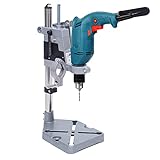
A drill stand for hand converts a portable electric or cordless drill into a guided drill press. It can improve hole position and perpendicularity, but the stand is only as accurate as its column, spindle guide, drill fit, and workholding. The right choice depends less on maximum advertised travel than on whether the base stays planted and the drill is held on its centerline.
As an Amazon Associate we earn from qualifying purchases at no extra cost to you.



What we cover
- Hand drill stand comparison: what the numbers mean
- Base stability comes before plunge travel
- Plunge travel: match it to the hole, not the brochure
- Drill fit: 43 mm is common, but not universal
- Clamping options and the workpieces they suit
- Which hand drill stand fits your situation?
- Setup procedure for accurate holes
- Durability and ownership costs
- Bottom line
Hand drill stand comparison: what the numbers mean
| Stand type | Typical base | Plunge travel | Drill fit | Best use | Main limitation |
|---|---|---|---|---|---|
| Compact plastic or light alloy guide | 110–140 × 110–140 mm | 35–45 mm | 43 mm collar or universal strap | Small repairs, dowel holes, occasional shelves | More flex and less resistance to twisting |
| Benchtop metal drill stand | 150–200 × 150–200 mm | 50–60 mm | 43 mm collar; some accept 38–43 mm bodies | Accurate general woodworking and metal drilling | Limited throat depth and modest workpiece height |
| Large cast-base hand-drill stand | 200–250 × 180–250 mm | 60–80 mm | Collar mount, clamp, or adjustable cradle | Frequent use, larger bits, dense hardwood | Heavier, less portable, and usually more expensive |
| Router-style plunge guide | 150–220 mm footprint | 40–70 mm | Usually not compatible with a normal hand drill | Specialized boring or template work | Drill mounting and bit clearance may be unsuitable |
These are useful comparison ranges rather than a guarantee for every model. Always check the manufacturer’s dimensional drawing before buying, particularly when the drill has a large battery, side handle, keyless chuck, or nonstandard body.
Base stability comes before plunge travel
A broad base helps prevent rocking, but area alone does not determine stability. A thin stamped base can flex while a smaller cast-iron base may remain rigid. Look for a flat underside, four usable mounting holes, a V-groove for round stock, and enough clearance for the chuck and bit.
As a practical rule, a 150 × 150 mm base offers 22,500 square millimetres of support area. Increasing it to 200 × 200 mm raises that to 40,000 square millimetres—about 78% more area. That extra footprint matters when a large Forstner bit creates torque or when the workpiece cannot be clamped close to the column.
Rubber feet reduce sliding but can make a stand feel less precise if they compress unevenly. For repeatable work, bolt the stand to a bench or clamp the base through its mounting holes. A portable base is convenient; a fixed base is usually more accurate.
Plunge travel: match it to the hole, not the brochure
Plunge travel is the distance the drill can move downward while mounted. It is not the same as maximum drilling depth. A 60 mm stroke may produce a 45–50 mm practical hole once chuck clearance, bit length, and the stand’s stop arrangement are considered.
For common woodworking tasks:
- 35–45 mm is adequate for pilot holes, hinge screws, shelf-pin holes, and small dowel work.
- 50–60 mm is the useful middle ground for general furniture work and many Forstner-bit operations.
- 70–80 mm is preferable for deep holes, thick joinery, and repeated boring, provided the column remains rigid.
Check whether the travel is controlled by a rack-and-pinion lever or by sliding the drill body by hand. Rack-and-pinion movement is easier to repeat. A depth stop is also important: a loose collar can drift under vibration, while a threaded stop or positive shoulder gives more reliable results.
Drill fit: 43 mm is common, but not universal
Many drill stands use a 43 mm European-style mounting collar, sometimes called a spindle or neck collar. A drill with a matching collar is the simplest fit. However, some compact cordless drills have no cylindrical mounting neck, and their battery, belt hook, or side handle can interfere with the cradle.
Before ordering, measure:
- the diameter and length of the drill’s mounting neck;
- the distance from the neck to the front of the chuck;
- the widest point of the body and battery;
- the chuck’s maximum opening and the bit length you intend to use.
A clamp or adjustable cradle can accept more drill shapes than a fixed collar, but it may introduce alignment error if the drill is not seated against a square reference. A collar mount is generally more rigid; a universal strap is more adaptable but less suitable for high-torque boring.
Clamping options and the workpieces they suit
Do not confuse a clamp that holds the drill with a clamp that holds the material. For accurate holes, you need both the tool secured and the workpiece prevented from turning or shifting.
| Workholding feature | Useful for | What to check |
|---|---|---|
| V-groove in base | Dowels, legs, pipe, and other round stock | Groove depth and whether the bit can reach its center |
| Slots for bolts or clamps | Boards and repeatable bench work | Slot length, access for washers, and base rigidity |
| Adjustable material fence | Repeated holes from an edge | Fence squareness and whether it locks without movement |
| Integrated drill clamp | Drills with nonstandard bodies | Padding, tightening range, and clearance around the trigger |
A stand without a fence can still work well with a separate straightedge, toggle clamp, or shop-made jig. Avoid holding a small workpiece by hand beneath a large bit. The bit can catch, rotate the stock, or pull it upward as it exits.
Which hand drill stand fits your situation?
- Small workshop and occasional use: choose a compact metal stand with a 150 mm or larger base, 43 mm collar, and at least 45 mm travel. Spend more on rigidity than on accessories.
- Apartment or mobile setup: choose a lighter stand with folding or removable components, but plan to clamp it to a sacrificial board. A small base used loose on a bench is rarely stable enough for large bits.
- Frequent furniture making: choose a cast base, rack-and-pinion feed, positive depth stop, and a fence or mounting slots. A 50–60 mm stroke is normally more useful than an oversized maximum diameter claim.
- Large Forstner bits or hardwood: choose the heaviest compatible stand, a broad base, and a drill with a side handle or auxiliary grip. Confirm that the stand can withstand the drill’s torque without the body twisting in its clamp.
- Several drills: choose a stand with a generous adjustable cradle, or buy interchangeable collars if available. A fixed 43 mm mount is less flexible when your cordless drill has a shaped neck.
Setup procedure for accurate holes
- Place the stand on a flat surface and clean dust from the underside. A single shaving can tilt a small base.
- Install the drill without a bit and check that the chuck is centered over the stand’s opening.
- Fit the bit and rotate the chuck by hand. If the bit’s tip traces a circle, inspect the chuck, bit shank, and mount before drilling.
- Mark the hole and use a brad-point bit, center punch, or shallow starter recess to stop the tip wandering.
- Clamp the workpiece and, where possible, clamp or bolt the stand too.
- Set the depth stop with the bit just touching the surface, then add the desired drilling depth.
- Feed steadily. Withdraw occasionally on deep holes to clear chips, especially in hardwood.
For a through-hole, place scrap beneath the workpiece and reduce pressure as the point approaches the bottom face. This limits breakout and reduces the sudden catch that can shift a lightweight stand.
Durability and ownership costs
The first parts to show wear are usually the plastic guide bushings, clamp threads, depth-stop hardware, and rubber feet—not the base itself. Play in the guide becomes visible as a hole that starts square but leans under pressure. Periodically tighten fasteners, clean sawdust from the column, and apply a light dry lubricant if the manufacturer permits it. Avoid oily residue near unfinished wood.
Bits remain the main consumable. A dull Forstner bit demands more feed pressure and exposes weaknesses in a light stand. Replacing or sharpening the bit can improve accuracy more than upgrading from a 45 mm to a 60 mm travel model.
As a simple buying calculation, suppose a basic stand costs $35–$60 and a heavier metal version costs $80–$150. If the heavier stand prevents only six ruined hardwood parts valued at $15 each, it has recovered its additional $50–$90 cost before considering saved setup time. For occasional softwood drilling, that premium may not be worthwhile; for repeated joinery, it often is.
Bottom line
Choose the largest, stiffest base that your workspace can accommodate, then confirm drill compatibility and useful travel. A stable 150–200 mm metal base with a secure 43 mm collar, 50–60 mm plunge, depth stop, and proper workholding is the best all-round hand drill stand for many woodworkers. Go lighter only when portability dominates, and go heavier when large bits, hardwood, or repeated accuracy make flex the deciding problem.