What's inside
As an Amazon Associate I earn from qualifying purchases. This post may contain affiliate links at no extra cost to you.
What we cover
Variable-Speed Drill Presses: Compare Speed Range, Capacity, and Value
Choose a variable speed drill press by matching its usable RPM range and speed-adjustment method to your bits and materials, then confirm that its swing and chuck capacity will handle your work. For most home shops, a 12- to 16-inch floor or benchtop model with roughly 300–3,000 RPM and a 5/8-inch chuck is a flexible starting point; larger work or frequent metal drilling may call for more low-speed torque and capacity.
What matters more than the number of speeds?
A 16 speed drill press offers fixed pulley settings, not 16 equally useful choices. Changing speed usually means opening the belt cover, loosening the motor, moving the belt among pulley steps, and retensioning it. That is reliable and economical, but inconvenient if you switch often between small bits in wood and large bits in metal.
As an Amazon Associate we earn from qualifying purchases at no extra cost to you.
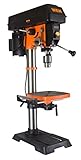
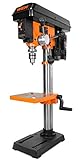
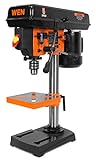

A variable-speed drill press changes RPM through a dial, lever, or electronic control, depending on its design. Adjustment is quicker, but “variable” does not guarantee a broad range, strong torque at low speed, or precise RPM under load. Check the published minimum and maximum speeds, and look for a clear adjustment method and a speed readout. Some machines use mechanical variable pulleys; others use electronic speed control. These systems are not interchangeable, and neither removes the need to use the right speed for a bit and material.
Compare capacity and adjustment systems
The figures below describe common machine classes, not specifications for every model. Verify the individual manufacturer’s manual before buying; motor power, speed range, and capacity vary within each class.
| Drill press type | Typical swing | Typical chuck capacity | Typical speed range | Adjustment | Best fit |
|---|---|---|---|---|---|
| Compact benchtop | 8–10 in. | 1/2 in. | About 500–3,000 RPM | Stepped pulleys or electronic control | Small parts, light woodworking, limited space |
| General-purpose benchtop | 12–13 in. | 5/8 in. | About 250–3,000 RPM | Often stepped pulleys; some variable-speed designs | Furniture, shop fixtures, occasional metalwork |
| Floor model | 15–17 in. | 5/8 in. or larger | About 150–3,000 RPM | Pulley steps or mechanical variable speed | Larger stock, frequent use, more working room |
| Dedicated low-speed model | Varies | Varies | May start below 200 RPM | Model-dependent | Large bits, hole saws, or demanding metal drilling |
Swing is twice the distance from the spindle center to the column. A 12-inch swing can reach the center of a board up to 12 inches wide when the board is positioned appropriately; it does not mean the table or throat is 12 inches deep. Chuck capacity is the largest shank diameter the chuck can grip, not the largest hole the machine can drill. A 5/8-inch chuck accepts larger-shank accessories than a 1/2-inch chuck, but actual drilling capacity depends on the bit, material, motor, and machine rigidity.
Match RPM to the job, not just the label
A high speed drill press is useful for small-diameter bits in wood and other appropriate materials, but high maximum RPM is not a substitute for a low minimum. Larger bits need slower speeds. A broad speed range is especially valuable if one machine will handle both fine pilot holes and large Forstner bits or hole saws.
As a rough starting point, small bits in wood commonly run faster than large bits; metal generally calls for slower cutting speeds than wood. Exact RPM depends on the bit material and geometry, workpiece, and manufacturer’s guidance. If you need a calculation, cutting speed in feet per minute (SFM) can be converted approximately with:
RPM = (SFM × 3.82) ÷ bit diameter in inches.
For example, at a hypothetical 100 SFM with a 1-inch cutter, the result is about 382 RPM. At the same cutting speed with a 1/4-inch bit, it is about 1,528 RPM. Treat this as a planning estimate, not a universal setting: consult the bit maker’s recommendations, secure the work, and use cutting fluid when appropriate for metal.
Which type suits your shop?
| Your situation | Practical choice | Why |
|---|---|---|
| Occasional woodworking; tight budget | Benchtop, 10–13 in. swing, pulley speeds | Costs less and has a simple, serviceable speed system; accept the time needed to change belts. |
| Frequent changes between bit sizes and materials | Variable-speed model with a readout and broad usable range | Faster adjustments are worthwhile when speed changes are routine. Check that the low end suits your largest cutters. |
| Large panels or stock, with floor space available | Floor model around 15–17 in. swing | More reach and working height help with larger pieces; allow room for the table and long workpieces. |
| Mostly small holes in wood | Compact model with adequate maximum RPM | High top speed and a small footprint may matter more than a very low minimum. |
| Large bits or regular metal drilling | Rigid machine with low minimum RPM and suitable capacity | Low-speed control and stability matter more than an impressive maximum speed. |
Where WEN models fit
WEN sells drill presses in both variable-speed and fixed-speed configurations, so compare the exact model rather than relying on the brand name. A WEN variable speed drill press may appeal to a mixed-use home shop that values quick changes; confirm its range, swing, chuck size, and speed display in the current specification sheet. A WEN 5 speed drill press is a different proposition: five preset speeds mean belt changes, but the simpler arrangement can be a sensible value if you tend to repeat the same operations. Do not assume that a five-speed model has the same capacity or adjustment features as a variable-speed one.
Across the market, compact benchtop presses often fall in the low hundreds of dollars, while larger floor models and more capable variable-speed machines can cost several hundred dollars or more. Prices vary by capacity, motor, construction, and included features. Compare warranty and parts support as well as the initial price; a variable-speed mechanism is useful only if the manufacturer can support its wear parts over time.
Ownership details that affect value
Belts, bearings, chuck jaws, and adjustment mechanisms are likely wear points over long use. Keep the belt area free of dust, check belt tension and alignment according to the manual, and avoid forcing the feed when a bit binds. A pulley press is mechanically straightforward, but repeated belt changes can wear belts or make users settle for an unsuitable speed. A variable-speed mechanism avoids frequent belt repositioning, yet it still needs clean, unobstructed movement and correct maintenance.
Before drilling, clamp the workpiece rather than holding it by hand, set the table square when accuracy matters, and confirm the bit is seated securely. A drill press does not make an undersized or poorly secured setup safe. Also check throat clearance, table travel, and headroom against your actual work—not just swing and chuck size. These practical limits can matter more than a headline motor rating.
Bottom line: Buy pulley speeds for lower cost and simplicity when your operations are predictable. Choose variable speed when you regularly move between materials or bit diameters and will use the adjustment often. In either case, prioritize a suitable low RPM, adequate swing, and a chuck that accepts your accessories over maximum speed alone.