What's inside
As an Amazon Associate I earn from qualifying purchases. This post may contain affiliate links at no extra cost to you.
What we cover
Best Yankee Screwdrivers for Fast, Controlled Driving
The best Yankee screwdriver for most woodworkers is a well-made, three-position spiral-ratchet model with a return stroke, a comfortable handle, and bits that match the screws you use most. Choose a shorter, lighter model for cabinets and furniture; pick a longer-stroke version for repetitive work where speed matters more than compactness.
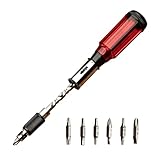
“Yankee screwdriver” commonly refers to a push-action spiral ratchet: pressing the handle forward turns the bit, while the spiral shaft retracts for another stroke. Unlike a powered driver, it needs no battery and gives you direct feedback—but the right choice depends on stroke length, ratchet settings, and whether its bit system suits your screws.
As an Amazon Associate we earn from qualifying purchases at no extra cost to you.


Compare the main choices
Vintage Stanley Yankee models are common on the used market, but their condition and specifications vary. The figures below are practical measurements to use when comparing listings or inspecting a tool, not specifications for every model. Check the individual tool: model numbers, repairs, and replacement parts can change what you receive.
| Type | Approx. tool length | Useful stroke range | Bit fit | Best for |
|---|---|---|---|---|
| Compact vintage push screwdriver | About 8–10 in. closed | About 2–3 in. | Often proprietary or model-specific; verify before buying | Small repairs and tight work areas |
| Full-size vintage spiral-ratchet model | About 12–14 in. closed | About 3–4 in. | May use a dedicated bit holder or adapter | General furniture and shop assembly |
| Long-stroke push screwdriver | About 14–16 in. closed | About 4–5 in. | Depends on chuck and included adapter | Repeated driving with room to push |
| Modern manual ratcheting screwdriver | About 6–10 in., depending on handle | Hand rotation, not a push stroke | Commonly 1/4-in. hex bits | Standard bits, varied screw types, compact storage |
Length ranges are comparison guides, not universal standards. For a used Yankee, measure the actual travel from fully retracted to fully extended and confirm that the mechanism locks and returns smoothly.
Choose by project and screw size
| Your situation | What to prioritize | Good fit |
|---|---|---|
| Occasional household repairs; limited budget | Sound mechanism, complete bit holder, low purchase cost | A clean used model, provided its bits are available |
| Furniture assembly with #6–#8 screws | Correctly fitting slotted or Phillips bit, controllable ratchet | A full-size tool with a short-to-medium stroke |
| Repeated driving into softwood | Longer stroke, smooth return, sturdy handle and shaft | A long-stroke model with the correct bit installed |
| Cabinet interiors or confined spaces | Short overall length and room for the handle to travel | A compact model—or a conventional stubby driver if a push stroke will not fit |
| Frequent use with many screw-head types | Easy access to standard bits and replaceable components | A modern 1/4-in. hex ratcheting screwdriver may be more practical |
For wood screws, match the bit to the head rather than choosing by screw length alone. A loose Phillips bit cams out more readily under a push stroke; a properly fitted slotted bit should fill the slot without rocking. Many Yankee tools were designed around particular bit shapes or holders, so do not assume a standard 1/4-in. hex bit will fit. Check the chuck or adapter before purchase, and include replacement-bit availability in the decision.
Spiral ratchet, stroke, and control
Ratchet settings
Many classic spiral screwdrivers offer settings for driving, reverse, and a locked position. The drive setting turns the bit on the forward push and allows the shaft to return; reverse changes the direction for loosening. A lock setting can hold the shaft for conventional twisting, though the exact controls vary by model. Test every setting before buying a used tool. A selector that slips or a ratchet that skips under light pressure can make the tool frustrating and may damage screw heads.
Stroke length is not the same as speed
A longer stroke advances a screw farther per push, which helps during repetitive work when you have room to use the tool. It is less helpful for short screws, delicate fittings, or cramped spaces: a full stroke can drive too far before you can reassess. For furniture and cabinet work, a shorter stroke often makes it easier to approach the final seating depth in stages. For long runs of screws in softwood, a longer stroke can reduce the number of pushes.
As a rough planning example, a 3-in. stroke makes about one-third more travel per full push than a 2-in. stroke. That does not mean the screw advances by the same distance—the spiral mechanism converts the push into rotation, and the result depends on its design and the screw’s pitch. Treat the comparison as a measure of available travel, not a promised driving rate.
Control the last turns
Start the screw straight and use gentle, even pressure. Near the surface, shorten the push or switch to hand-twisting if the model allows it. Stop when the head seats; forcing more turns can strip the drive, crush soft wood, or sink the head below the surface. A Yankee is a manual driver, not a torque-limiting tool, so the user supplies the control.
What to inspect on a used Yankee screwdriver
- Spiral shaft: Look for bent sections, deep rust, or damaged grooves. The shaft should travel without binding.
- Return action: Compress and release it several times. It should return consistently, without sticking or a loose, rattling feel.
- Ratchet and selector: Check drive, reverse, and lock positions where present. Listen and feel for regular engagement rather than skipped teeth.
- Handle and end cap: Check for cracks, loose parts, or repairs that could fail under pushing force.
- Bit holder: Confirm that it is present, secure, and compatible with bits you can actually obtain.
On an older tool, the parts most likely to affect daily use are the ratchet components, return spring, bit holder, and handle. Dirt and dried lubricant can make the shaft sluggish; wear or damage inside the ratchet may require parts that are difficult to source. A low-cost tool missing its proprietary holder can become a poor value if replacement parts are unavailable.
Care and ownership costs
Wipe dust and pitch from the shaft after woodworking, and keep the spiral grooves clean. If the mechanism needs lubrication, use a small amount of light machine oil on the moving parts rather than flooding the tool; excess oil collects grit and can migrate onto wood. Follow any maker-specific care guidance when available. Store the screwdriver retracted and dry, and avoid using it as a punch, pry bar, or hammer.
Price varies widely with condition, completeness, and collectability, so compare local used-tool listings rather than paying a premium based on an old model name alone. A simple value check is: purchase cost plus needed bits or repairs ÷ expected uses. For example, a $30 tool needing $15 in parts costs $0.45 per use over 100 uses. That may be reasonable for a dependable shop tool, but not if the mechanism still sticks or the bit system does not suit your work.
Bottom line
For mixed furniture and home-shop tasks, look for a full-size spiral-ratchet screwdriver with a smooth return, reliable direction settings, and a bit holder you can support with available replacements. Choose a compact model for restricted spaces and a longer-stroke version for repeated driving with clear room to push. If standard 1/4-in. bits and many screw styles matter more than push-action speed, a conventional manual ratcheting screwdriver is likely the more versatile purchase.