As an Amazon Associate I earn from qualifying purchases. This post may contain affiliate links at no extra cost to you.
A headphone amp sits between your source and your headphones, and the wrong one introduces noise, limits dynamics, or simply fails to drive high-impedance cans to reference volume. The right one does none of those things—it adds power and transparency, and sometimes useful extras like digital-to-analog conversion or guitar modeling without coloring the signal. The problem for most buyers is that “headphone amp” spans from $30 dongles to $240 audiophile desktop units, and product names rarely tell you whether you are buying a preamp, a DAC, a guitar modeler, or a simple splitter.
We compared the best headphone amps available in 2026 by cross-referencing published specifications, checking how owners rate each unit in real use, and verifying whether the listed price matches the build and feature set you would expect at that tier. The eight products below cover guitar players who need a silent practice rig, gamers chasing low-latency wireless audio, and audiophiles who want a transparent analog stage.
As an Amazon Associate we earn from qualifying purchases at no extra cost to you. Product prices and availability are accurate as of the date shown and are subject to change.




Quick Picks
| Product | Best for | Price |
|---|---|---|
| Fender Mustang Micro Plus | Guitar practice and modeling | $123.49 |
| Fosi Audio K7 | Gaming and high-power desktop | $199.99 |
| Mackie HM-4 | Studio multi-listener distribution | $49.99 |
| Neoteck Portable | Budget high-impedance headphone boost | $29.99 |
| Fosi Audio Q4 | Desktop audio with speaker switching | $69.99 |
| Schiit Magni Unity | Audiophile desktop and preamp duties | $239 |
| Vox amPlug 3 AC30 | Compact guitar practice | $39.98 |
| FiiO K7 | Neutral desktop DAC and amp | $219.99 |
How We Picked
Three criteria separated this list from the broader market. First, power delivery relative to price: an amp that cannot reach reference levels with 80-ohm headphones is incomplete at any tier. Second, input versatility matched to real use cases—a gaming amp needs optical and low-latency Bluetooth, while an audiophile amp needs a clean analog stage and nothing else. Third, owner-reported noise floor and build consistency over a six-month-plus ownership window. A unit that reads well on a spec sheet but produces audible hiss on sensitive IEMs fails the practical test.
The 8 Best Headphone Amps in 2026
Fender Mustang Micro Plus
This targets guitarists who want a complete amp and effects experience through headphones with zero signal chain clutter. It plugs directly into your guitar’s output jack, so there is no cable between instrument and amp. Bluetooth streaming lets you jam along to phone tracks without a separate interface.
- Pros: 50 amp and effects models cover clean tweed through high-gain modern voicings. The 2-year warranty signals Fender’s confidence in the build, rare at this price.
- Con: Not a headphone amp for music or gaming; strictly a guitar tool.
Skip it if you need a DAC, balanced output, or anything beyond guitar modeling.
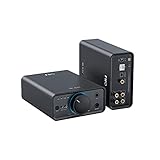
Fosi Audio K7
A desktop headphone amp and DAC aimed at gamers wanting one box that accepts USB-C, optical, coaxial, and Bluetooth aptX Low Latency without dongles. At 2100mW output it drives demanding headphones well past reference levels, and the 4.4mm balanced output pairs with current planar cans.
- Pros: The mic input lets you run a gaming headset microphone through the same unit. Optical and coaxial inputs cover consoles like the PS5 directly. PCM 384kHz/32bit gives headroom for hi-res sources.
- Con: The feature list makes the chassis larger than competitors in this price band, which matters on small desks.
Skip it if you already own a dedicated DAC and only need amplification.
Mackie HM-4
A 4-channel headphone distribution amplifier, not a traditional headphone amp. Its job is taking a single stereo source and feeding four pairs of headphones with independent volume control—essential for a tracking room where each player needs a personalized mix.
- Pros: Compact and rugged enough to live on a desk without a cable nest. Four independent volume controls let each player dial their level without affecting the main mix.
- Con: No DAC, no Bluetooth, and no guitar modeling; you need an external source feeding it a line-level signal.
Skip it if you are a single listener looking for one headphone amp rather than a distribution box.
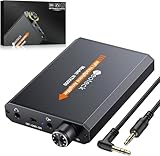
Neoteck Portable Headphone Amplifier
A budget entry for owners of high-impedance headphones (16 to 300 ohms) who want more volume from a phone or laptop without a full desktop rig. The 3.5mm pass-through keeps the chain simple: source in, headphone out, battery-powered boost in between.
- Pros: The impedance range covers most consumer and semi-pro headphones that struggle on phone jacks. At under $30 it is the lowest financial risk on this list.
- Con: Owner feedback points to a noticeable noise floor—hiss is audible on sensitive IEMs or during quiet passages, a known trade-off at this build quality.
Skip it if you listen to hi-res audio critically or need balanced output.
Fosi Audio Q4
The Q4 serves a specific niche: upgrading a desktop or small home stereo with a DAC, headphone amp, and RCA line outputs in one compact chassis. PC-USB, optical, and coaxial inputs feed both a 3.5mm headphone output and RCA outputs, so you switch between headphones and powered speakers without unplugging.
- Pros: Dual output design handles personal listening and speaker playback from one unit. Build quality and internal layout exceed expectations for $70.
- Con: No balanced output and no Bluetooth, so it is not ideal for users with 4.4mm cables or wireless headphones.
Skip it if you need console compatibility or the absolute lowest noise floor available.
Schiit Magni Unity
Schiit’s modular desktop amp: a headphone amplifier that also functions as a preamp, with an optional Mesh DAC card for digital sources. The analog stage is the focus—Schiit’s circuit design reputation is built on transparency and current delivery, and owners report a wide, detailed presentation without sonic coloration.
- Pros: Preamp mode with RCA outputs lets it replace a standalone preamp in a speaker system. Mesh DAC compatibility means you can start analog-only and add digital later.
- Con: The $239 price sits well above the feature-loaded Fosi and FiiO options, and the Mesh DAC is a separate purchase.
Skip it if you want every input and feature in one box out of the gate.
Vox amPlug 3 AC30
A compact headphone guitar amp that clips onto your strap or lives at the end of your cable. It models Vox’s AC30 voicing and includes stereo effects, tremolo, speaker emulation, and built-in rhythm tracks. The aux input lets you play along to recordings.
- Pros: Speaker emulation means headphone sound closely mimics an AC30 at stage volume rather than a dry DI signal. Built-in rhythms eliminate the need for a backing track app during practice.
- Con: Fewer amp and effect variations than the Fender Mustang Micro Plus.
Skip it if you want maximum tonal flexibility or plan to record through it.
FiiO K7
A desktop DAC and amplifier with balanced and single-ended headphone outputs alongside line-level output, making it a compact centerpiece for a small desk audio system. Owners praise its clean measurements and neutral tuning.
- Pros: Dual-op-amp architecture delivers substantial power without the noise penalty of cheaper designs. Price splits the difference between the Fosi Q4 and the Schiit Magni Unity on features.
- Con: Lacks the gaming-specific inputs—optical, coaxial, mic—that make the Fosi K7 a more versatile console companion.
Skip it if your primary use case is gaming or you need multiple digital input types.
Buying Guide
Impedance and Output Power
The single most important spec on a headphone amp datasheet is how many milliwatts it delivers into a given load. A 2100mW figure like the Fosi K7’s tells you it will drive 300-ohm planars without complaint, but mW numbers only matter if you know your headphones’ impedance. A 32-ohm IEM needs a fraction of the power a 250-ohm dynamic driver requires, and excess power into a low-impedance load amplifies the noise floor. Match the amp’s output stage to your headphones’ impedance range before considering anything else.
Input Types Determine Real-World Usability
A headphone amp with only a 3.5mm analog input cannot serve as a PC DAC or a gaming hub. If your source is a computer, console, or digital streamer, you need optical, coaxial, or USB input. Bluetooth adds convenience but introduces compression unless you get aptX HD or LDAC, and latency matters for gaming. The Fosi K7 covers every input type at its price point; the Schiit Magni Unity requires a separate DAC card for digital. Count your sources and verify the amp handles all of them before committing.
Guitar Modelers and Audio Amps Are Different Products
Products like the Fender Mustang Micro Plus and Vox amPlug 3 are headphone guitar amplifiers. They include internal signal processing—amp modeling, cabinet simulation, effects—and are not designed to transparently pass audio from a phone or DAC. You cannot use them to listen to music critically. Conversely, a transparent desktop amp like the FiiO K7 will not help your guitar tone. Decide which category you need before browsing specs.
Our Verdict
The Fosi Audio K7 is the top pick for most buyers in this roundup. It combines high output power, balanced and single-ended outputs, optical and coaxial inputs for consoles, Bluetooth aptX LL for wireless gaming, and a mic input—covering more use cases than any other unit under $200. The Neoteck at $29.99 is the budget pick if you simply need volume for high-impedance headphones on the go. And if you are a guitar player first, the Fender Mustang Micro Plus wins the entire category because it replaces an amp, a pedalboard, and an audio interface in a single device that costs less than most standalone headphone amps.
FAQ
Do I need a headphone amp for my headphones?
If your headphones are under 50 ohms and your source has a clean headphone jack, you likely do not need a dedicated amp. Above 80 ohms, or if you notice your volume ceiling is too low or the bass feels soft, an amp will make a meaningful difference.
What is the difference between a headphone amp and a DAC-amp?
A headphone amp takes an already-analog signal and adds power. A DAC-amp includes a digital-to-analog converter, so it can accept USB, optical, or coaxial digital inputs directly from a computer or console. If your source only has a 3.5mm headphone output, a simple amp is enough; if it outputs digital, you need a DAC-amp.
Can a headphone amp damage my headphones?
It is unlikely with modern designs that include reasonable output protection, but leaving volume cranked at maximum and then switching to sensitive in-ear monitors can cause a loud transient. Always start at low volume when changing headphones.
Is balanced output worth it over single-ended?
Balanced output (typically 4.4mm or XLR) provides more voltage swing and rejects common-mode noise, which helps with high-impedance or planar headphones. If you use standard 32-ohm dynamic headphones, the audible benefit is minimal unless your source has a poor grounding scheme that produces hum.