What's inside
- Best Torque Screwdrivers for Accurate Fastener Tightening
- Compare the main choices
- Choose by job, not by feature count
- What accuracy and adjustment increments really mean
- Is a torque screwdriver the best screwdriver torque wrench?
- Mechanical or digital?
- Set up and maintain it for consistent results
- Bottom line
- Best Torque Screwdrivers for Accurate Fastener Tightening
- Compare the main choices
- Choose by job, not by feature count
- What accuracy and adjustment increments really mean
- Is a torque screwdriver the best screwdriver torque wrench?
- Mechanical or digital?
- Set up and maintain it for consistent results
- Bottom line
As an Amazon Associate I earn from qualifying purchases. This post may contain affiliate links at no extra cost to you.
What we cover
- Best Torque Screwdrivers for Accurate Fastener Tightening
- Compare the main choices
- Choose by job, not by feature count
- What accuracy and adjustment increments really mean
- Is a torque screwdriver the best screwdriver torque wrench?
- Mechanical or digital?
- Set up and maintain it for consistent results
- Bottom line
Best Torque Screwdrivers for Accurate Fastener Tightening
For most repeatable bench work, choose a calibrated adjustable torque screwdriver whose range brackets your target torque near its middle; for delicate electronics, use a low-range model with fine increments, and for frequent production work, prioritize calibration support and a clear setting procedure over extra features.
There is no single best torque screwdriver for every fastener. A driver that tops out at 100 in-oz may be excellent for small assemblies but useless for a 30 in-lb terminal. Match the tool’s range and resolution to the joint, then check how its accuracy is specified and whether it can be recalibrated.
As an Amazon Associate we earn from qualifying purchases at no extra cost to you.

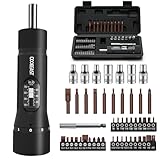


Compare the main choices
| Tool or example | Published torque range | Adjustment / indication | Best fit | Calibration consideration |
|---|---|---|---|---|
| Wera 7440 Kraftform adjustable torque screwdriver | 0.3–1.2 N·m (about 2.7–10.6 in-lb) | Adjustable; scale marked in N·m | Light assembly and small fasteners | Verify the current manual and arrange periodic calibration if traceability matters |
| Wera 7441 Kraftform adjustable torque screwdriver | 1.2–3.0 N·m (about 10.6–26.6 in-lb) | Adjustable; scale marked in N·m | General bench assembly in the middle torque range | Check calibration interval and service options with the supplier |
| Wera 7442 Kraftform adjustable torque screwdriver | 3.0–6.0 N·m (about 26.6–53.1 in-lb) | Adjustable; scale marked in N·m | Higher-torque machine and fixture fasteners | Confirm that the required torque is within the calibrated operating range |
| Mountz adjustable preset torque screwdriver, selected by range | Varies by model | Preset or adjustable options; model-dependent | Repeatable assembly where service and calibration records matter | Choose a specific model with a stated accuracy, calibration procedure, and service path |
| Digital torque screwdriver, selected by range | Varies by model | Digital display; some models add target alerts or data output | Changing settings, verification, or documented production work | Display features do not replace calibration; check the manufacturer’s certificate and interval |
The Wera 7440, 7441, and 7442 are examples of a useful three-tool range split. Their stated ranges overlap at the boundaries, but each is intended for a different torque band. Check the exact model documentation before buying: available versions, accuracy specifications, units, and calibration arrangements can differ by market or product revision.
Choose by job, not by feature count
For delicate electronics and small assemblies
Start with a low-range adjustable driver, such as the 7440’s 0.3–1.2 N·m range, only if that range covers the fastener specification. Fine adjustment matters here: a small change in torque can be significant on a small screw or a fragile component. If your work routinely falls below the tool’s minimum, don’t compensate by “being careful” with an unsuitable driver. Find a properly specified lower-range model.
Use the correct bit and keep it fully seated. A slipping bit can damage the screw head before the torque mechanism reaches its release point, making the tool’s setting irrelevant.
For electricians and panel work
The best torque screwdrivers for electricians are the ones that cover the torque values printed by the equipment maker—not simply the broadest-range tool on the shelf. Terminal requirements vary substantially between devices, so check each manufacturer’s instructions rather than applying one setting to every breaker, connector, or terminal block.
A driver in the middle range may suit many panel fasteners, while some terminals require a lower- or higher-range tool. Insulated handles and torque control are separate properties: confirm the tool’s electrical insulation rating and intended use if working near energized equipment. A torque screwdriver is not a substitute for safe isolation procedures.
For repeatable production work
Choose a model with a clear setting lock or preset procedure, a documented accuracy specification, and a practical calibration route. A digital tool can make settings easier to read and may support recording or alerts, but it is not automatically more accurate than a mechanical driver. The useful comparison is the manufacturer’s stated accuracy over the range you will actually use, plus the cost and turnaround time of recalibration.
For a fixed-torque station, a preset driver can reduce accidental setting changes. For several products or frequent changeovers, an adjustable model may be more flexible. In either case, document the setting, tool identification, and calibration status so operators can confirm they are using the right instrument.
What accuracy and adjustment increments really mean
Accuracy is commonly expressed as a percentage of the reading or of full scale. Those are not interchangeable. If a tool has an accuracy of ±6% of reading, a 1.0 N·m setting corresponds to a nominal error band of ±0.06 N·m. If the specification is instead tied to full scale, the possible error depends on the tool’s maximum capacity. Read the exact wording in the datasheet.
Adjustment increments describe how finely you can set the tool; they do not guarantee that it delivers torque to that same resolution. A scale marked in small steps is useful only when the tool’s accuracy and calibration support the required tolerance. As a rule of thumb, avoid operating at the very bottom or top of a tool’s range when a closer-range model is available.
Is a torque screwdriver the best screwdriver torque wrench?
For small fasteners, yes: a torque screwdriver is the hand tool designed for controlled, repeatable screw tightening. “Screwdriver torque wrench” is often used loosely in searches, but a conventional click torque wrench is usually intended for larger fasteners and may not resolve low screwdriver-level settings well. Select by the required torque range, drive style, and accuracy specification—not the name used in a listing.
Mechanical or digital?
- Mechanical adjustable: A practical choice for routine tightening, with no battery to manage. Protect the setting mechanism and follow the maker’s storage instructions.
- Preset: Useful when the same torque is applied repeatedly and you want fewer opportunities for setting errors. Confirm how the preset is changed and secured.
- Digital: Worth considering when settings change often, visibility is important, or records and alerts are useful. Budget for batteries and check whether the display, connectors, or electronics need special service.
If you need the best digital torque screwdriver, compare its range, stated accuracy, increment size, calibration certificate, and data features. A bright screen or audible alert is convenient, but those features should come after fit and measurement performance.
Set up and maintain it for consistent results
- Find the fastener specification. Use the equipment maker’s torque value and units. Convert units carefully if the tool uses a different scale.
- Choose the range. Prefer a driver that places the target comfortably inside its working range, rather than at an endpoint.
- Set and secure the value. Follow the manufacturer’s adjustment procedure and lock the setting if the design provides a lock.
- Tighten in line with the fastener. Use a suitable bit, maintain axial pressure, and stop when the tool signals or releases. Repeatedly turning after release can over-tighten the joint.
- Clean and store properly. Wipe off dust and oil; don’t immerse the mechanism or use solvents unless the manual permits them. Store at the manufacturer’s recommended setting—many torque tools should be returned to a low setting, but the correct procedure is model-specific.
- Track calibration. Follow the maker’s interval and recalibrate after suspected overload, impact, damage, or questionable results. Production or regulated work may require a documented schedule and traceable calibration.
The mechanism that signals the set torque is a wear item: repeated use, overload, drops, contamination, or careless adjustment can affect repeatability. Bits and holders wear too. Replace damaged bits, and don’t use a torque screwdriver as a general-purpose ratcheting driver or breaker tool.
Bottom line
For delicate work, buy a low-range driver with suitably fine adjustment; for electricians, match the tool to each terminal’s specified torque and verify electrical ratings separately; for production, prioritize documented accuracy, repeatable settings, and accessible calibration. Among the concrete examples above, the Wera 7440, 7441, and 7442 provide distinct low-, middle-, and higher-range options. The best torque screwdrivers are not necessarily the most feature-rich—they are the ones whose range, accuracy, and calibration support the fastener in front of you.