What's inside
- What a beginner actually needs
- Recommended starter sizes by project
- Choosing the right bit material and point
- Decision matrix: which set fits your situation?
- How to avoid paying for duplicates
- A simple sizing method that prevents mistakes
- Durability, maintenance, and common beginner mistakes
- Final buying recommendation
- Related Guides
- What a beginner actually needs
- Recommended starter sizes by project
- Choosing the right bit material and point
- Decision matrix: which set fits your situation?
- How to avoid paying for duplicates
- A simple sizing method that prevents mistakes
- Durability, maintenance, and common beginner mistakes
- Final buying recommendation
- Related Guides
As an Amazon Associate I earn from qualifying purchases. This post may contain affiliate links at no extra cost to you.
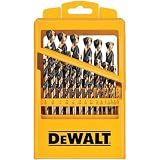
The best drill bit set for beginners is usually a 25- to 29-piece mixed set with brad-point bits for wood, high-speed-steel twist bits for metal and plastic, carbide-tipped masonry bits, and a practical size range from 1/16 to 1/2 inch—not a huge case full of duplicates.
For most starter projects, buy coverage before quantity. A compact set with the right bit types will handle shelves, furniture repairs, hardware installation, wall anchors, and basic metalwork more reliably than a 100-piece set containing several nearly identical screwdriver bits and accessories you may never use.
As an Amazon Associate we earn from qualifying purchases at no extra cost to you.


What we cover
- What a beginner actually needs
- Recommended starter sizes by project
- Choosing the right bit material and point
- Decision matrix: which set fits your situation?
- How to avoid paying for duplicates
- A simple sizing method that prevents mistakes
- Durability, maintenance, and common beginner mistakes
- Final buying recommendation
- Related Guides
What a beginner actually needs
A sensible starter collection has four groups:
- Wood bits: Brad-point bits from 1/8 to 1/2 inch, preferably in 1/16-inch increments where available.
- Metal and plastic bits: High-speed steel, or HSS, twist bits from 1/16 to 1/2 inch. Titanium nitride coating is useful, but it does not turn an ordinary bit into a heavy-duty metal-cutting tool.
- Masonry bits: Carbide-tipped bits, commonly 3/16, 1/4, 5/16, and 3/8 inch for wall plugs and light drilling in brick, block, or concrete.
- Accessories: A center punch, depth stop or tape flag, countersink, spare small bits, and a simple bit gauge or clearly marked case.
You do not need separate full-size sets for every material on day one. Start with the sizes you are most likely to use, then add specialty bits when a project demands them.
Recommended starter sizes by project
| Task | Useful sizes | Best bit type | Why it matters |
|---|---|---|---|
| Pilot holes for screws in wood | 1/16–1/8 in | Brad-point or HSS twist | Reduces splitting and makes screw driving easier |
| General wood drilling | 1/4–1/2 in | Brad-point | Clean entry holes and accurate positioning |
| Clearance holes for common wood screws | 1/8–1/4 in | Brad-point | Lets the screw pass through the top piece without binding |
| Thin sheet metal | 1/16–1/4 in | HSS twist, split-point preferred | Handles ordinary steel, aluminum, and brackets when lubricated |
| Plastic | 1/8–3/8 in | Sharp HSS twist or brad-point | Sharp edges reduce grabbing and cracking |
| Wall anchors | 3/16, 1/4, 5/16, 3/8 in | Carbide-tipped masonry | Matches common plastic plugs and light-duty anchors |
| Large cable or pipe openings | 1/2 in and larger | Spade, hole saw, or step bit | More efficient than forcing a standard twist bit |
Choosing the right bit material and point
Brad-point bits for wood
Brad-point bits have a center spur that starts the hole accurately and outer cutting spurs that score the wood fibers. They are the best default for plywood, softwood, hardwood, and most furniture panels. They usually leave a cleaner exit than general-purpose twist bits, especially when you support the back of the workpiece with scrap wood.
Do not use them on metal. The sharp wood-cutting geometry can be damaged quickly, and the bit may wander or overheat.
HSS twist bits for metal and plastic
HSS is the sensible general-purpose material for beginners. Look for a 118-degree point for ordinary drilling and a 135-degree split point if you expect to drill metal often. A split point starts more easily and wanders less, while a standard point is usually less expensive and works well after making a small indentation with a center punch.
For steel, use slow speed, firm pressure, and cutting oil. If the bit produces blue discoloration, you are generating too much heat. Let the bit cut rather than simply spinning against the surface. Aluminum and plastic generally require a sharper, cleaner bit and careful pressure because both materials can grab as the bit breaks through.
Coatings: useful, but not magic
Black oxide improves surface protection and can provide modest wear resistance. Titanium nitride, often shown as a gold-colored coating, can reduce friction and improve wear resistance in suitable applications. The coating is most useful when the underlying HSS is already good quality.
Once a coated bit is sharpened, its coating is removed at the cutting edge. For a beginner set, sharp geometry and a complete size range are more valuable than paying a large premium for a coating.
Carbide-tipped masonry bits
Masonry bits use a carbide tip to abrade brick, block, mortar, and some concrete. They are intended for slower, impact-style drilling when the drill and bit are rated for it. For hard concrete or frequent anchor installation, an SDS-plus rotary hammer and SDS-plus bits are substantially more effective than a standard cordless drill with a small masonry set.
Masonry bits are not substitutes for HSS bits, and they are not appropriate for clean wood holes. Their cutting action is different and tends to leave rougher openings.
Decision matrix: which set fits your situation?
| Your situation | Best starting choice | What to skip initially | Typical market range |
|---|---|---|---|
| Occasional household repairs and tight budget | 15–20 piece mixed set with 1/16–3/8 in coverage | Large hole-saw kits and specialty countersinks | $15–$30 |
| Furniture, shelving, and woodworking | Wood set with 1/8–1/2 in brad-points plus small HSS pilots | Oversized masonry assortment | $25–$50 |
| Apartment or limited storage | Compact 25-piece case with labeled slots and 1/4-inch hex accessories | 100-piece cases with repeated sizes | $20–$45 |
| Frequent metal brackets or repairs | HSS set with split points, 1/16–1/2 in, plus cutting oil | Wood-only sets and uncoated novelty assortments | $30–$70 |
| Regular drilling into concrete | SDS-plus masonry set matched to a rotary hammer | Relying on standard-drill masonry bits | $40–$100 for bits, excluding tool |
How to avoid paying for duplicates
Compare the actual size list, not the piece count printed on the package. A “100-piece” kit may count a driver handle, sockets, countersinks, depth stops, and multiple screwdriver tips. Another kit may count each bit individually while offering only 10 useful drilling sizes.
For a first purchase, look for a size progression such as 1/16, 3/32, 1/8, 5/32, 3/16, 1/4, 5/16, 3/8, 7/16, and 1/2 inch, with additional intermediate sizes if the set includes them. Metric sizes are useful if your hardware is metric; a basic metric set from 1.5 to 10 mm covers many household tasks. Avoid buying both imperial and metric sets immediately unless your projects require both.
Also check the shank. A 1/4-inch hex shank fits impact drivers, but many impact-rated accessories are optimized for fastening rather than repeated large-hole drilling. Round-shank bits fit ordinary drill chucks and are often available in a broader range of conventional sizes. If you own an impact driver only, choose accessories explicitly marked as impact-rated.
A simple sizing method that prevents mistakes
For a screw pilot hole in softwood, choose a bit approximately the same diameter as the screw’s solid central shaft, excluding the threads. In hardwood, use the same size or one increment larger if driving becomes difficult. For a clearance hole, match the bit to the screw’s outside thread diameter so the screw passes through the top board without gripping it.
For a wall plug, use the diameter printed on the plug packaging, not the screw diameter. For example, if the plug calls for a 1/4-inch hole, use a 1/4-inch masonry bit and drill slightly deeper than the plug length. A strip of masking tape around the bit provides a quick depth reference.
Durability, maintenance, and common beginner mistakes
- Heat wears bits first: Slow down on metal, clear chips frequently, and use cutting fluid where appropriate.
- Small bits break first: Keep the drill aligned, avoid sideways pressure, and do not use a tiny bit to enlarge a hole aggressively.
- Blunt bits cause poor results: Replace inexpensive small bits when they stop cutting cleanly; sharpen larger quality bits only if you have the correct sharpening method.
- Rust damages storage: Wipe metal bits dry before returning them to the case, particularly after using cutting oil or drilling outdoors.
- Breakout ruins wood: Reduce pressure near the exit and place scrap wood beneath the workpiece.
- Wrong mode causes problems: Use ordinary rotation for wood and metal. Use hammer mode only with a suitable masonry bit and drill.
- Loose chucks create wobble: Tighten a keyed or keyless chuck securely and check that the bit is seated straight.
A useful ownership calculation is simple: if a $30 mixed set gives you 12 genuinely useful drilling sizes, its initial cost is about $2.50 per useful size. A $70 oversized kit that gives you the same 12 sizes plus duplicates costs nearly $5.83 per useful size. The cheaper-looking price per piece is not the same as better value.
Final buying recommendation
Choose a clearly labeled mixed set containing brad-point wood bits, HSS twist bits, and a small group of carbide-tipped masonry bits. Prioritize 1/16- to 1/2-inch coverage, sharp points, a rigid storage case, and replacement availability over an impressive piece count. Add a step bit, hole saw, auger bit, or SDS-plus set only when your projects justify it.
That combination is the best drill bit set for beginners because it covers the materials and hole sizes encountered most often while leaving room to build a specialized collection based on actual work—not duplicates sitting unused in a crowded case.