What's inside
As an Amazon Associate I earn from qualifying purchases. This post may contain affiliate links at no extra cost to you.
The best 240mm AIO coolers for quiet PCs are the Arctic Liquid Freezer III 240 for maximum cooling per dollar, the be quiet! Pure Loop 2 240 for a restrained low-noise build, and the NZXT Kraken 240 when a compact display and polished software matter more than value.
As an Amazon Associate we earn from qualifying purchases at no extra cost to you.


What we cover
Quick recommendations
- Best overall: Arctic Liquid Freezer III 240. Its unusually thick radiator and strong pump give it excellent CPU-temperature headroom, although case clearance needs careful checking.
- Best for quiet, understated PCs: be quiet! Pure Loop 2 240. The fans are easy to tune, and the refill port improves long-term ownership.
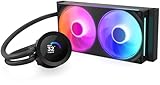
- Best display-equipped option: NZXT Kraken 240. It fits many compact builds more easily than the thickest 240mm units and adds a customizable pump-top screen.
- Best mainstream RGB choice: Corsair iCUE H100i RGB Elite. It has broad socket support and mature control software, but the controller and cable arrangement add complexity.
What “240mm” actually means
A 240mm cooler normally uses a radiator around 275–277mm long and 120mm wide with two 120mm fans. It does not mean the entire assembly is exactly 240mm. Radiator thickness varies substantially: a standard unit is about 27mm thick, while the Arctic Liquid Freezer III 240 is about 38mm thick before its fans are fitted.
That difference matters in a compact or mid-tower PC. A standard radiator with 25mm fans needs roughly 52mm of vertical or top-panel depth. The Arctic needs roughly 63mm, before allowing for motherboard heatsinks, RAM, and cable clearance. Measure the case’s published radiator limit rather than relying on the phrase “supports 240mm.”
240mm AIO comparison
| Cooler | Radiator and fan arrangement | Notable hardware | Socket support | Best fit |
|---|---|---|---|---|
| Arctic Liquid Freezer III 240 | Approximately 277 × 120 × 38mm radiator; 2 × 120mm fans | Integrated VRM fan; offset cold plate; comparatively thick radiator | AM4, AM5, LGA1700, LGA1851 and selected older Intel sockets | High sustained CPU loads and value-focused builds |
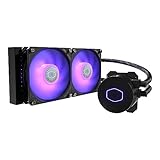
| be quiet! Pure Loop 2 240 | Approximately 277 × 120 × 27mm radiator; 2 × 120mm PWM fans | Decoupled pump; refill port; subtle lighting on some versions | AM4, AM5, LGA1200, LGA1700 and other supported Intel sockets | Quiet mid-tower systems and long ownership |
| NZXT Kraken 240 | Approximately 275 × 123 × 30mm radiator; 2 × 120mm fans | 1.54-inch LCD pump display; CAM software control | AM4, AM5, LGA1200, LGA1700 and supported current Intel sockets | Compact builds where appearance and monitoring matter |
| Corsair iCUE H100i RGB Elite | Approximately 277 × 120 × 27mm radiator; 2 × 120mm fans | RGB lighting; iCUE control; USB connection and controller requirements vary by package | AM4, AM5, LGA1200, LGA1700 and other listed Intel sockets | RGB systems already using Corsair peripherals |
Dimensions and socket bundles can change between regional revisions, so confirm the exact model number before buying. In particular, check whether an LGA1851 mounting kit is included for a new Intel build rather than assuming an older LGA1700 kit will be supplied.
Head-to-head: cooling performance and pump noise
Arctic Liquid Freezer III 240 versus standard-thickness models
The Arctic’s advantage is physical rather than mysterious: its approximately 38mm radiator provides more fin volume than a 27mm radiator, and its cold-plate design is optimized for modern AMD processors. Under sustained rendering or compiling, that extra capacity can keep the CPU at a lower temperature or allow a slower fan curve.
The trade-off is noise and clearance. Its small pump-mounted VRM fan can be useful around the CPU socket, but it introduces another moving part and another sound source. Set that fan to a low fixed speed or an appropriate motherboard-temperature curve if acoustic comfort is the priority. Also check that the thicker radiator does not collide with tall memory modules or the top edge of the motherboard.
Pure Loop 2 240 versus Kraken 240
The Pure Loop 2 240 is the quieter-looking choice because it avoids a display and uses a decoupled pump arrangement. The Kraken 240 has a slightly more complex pump top and software stack, but its display can show coolant temperature, CPU temperature, or a static image. For similar fan speeds, both are appropriate for mainstream CPUs, but neither should be expected to make a high-power processor silent under an all-core workload.
Pump noise is often more noticeable than fan noise because it is a steady tone. A cooler with a nominally low fan rating can still sound intrusive if the pump runs at maximum speed continuously. Use the manufacturer’s control software or motherboard header settings to test a reduced pump mode, provided CPU temperatures remain stable.
Decision matrix for compact and mid-tower PCs
| Your situation | Most suitable choice | Why | Watch out for |
|---|---|---|---|
| Small case with a tight top mount | NZXT Kraken 240 or another 27–30mm radiator model | More forgiving radiator depth and ordinary 120mm fans | RAM height, motherboard heatsinks, and front-panel tubing space |
| Mid-tower with a high-power CPU | Arctic Liquid Freezer III 240 | Thicker radiator and strong sustained-load capacity | Top clearance and the extra VRM-fan noise source |
| Quiet office or recording PC | be quiet! Pure Loop 2 240 | Simple appearance, adjustable PWM fans, decoupled pump | Keep the pump powered correctly; do not block its airflow path unnecessarily |
| Existing Corsair RGB ecosystem | Corsair iCUE H100i RGB Elite | Centralized lighting and fan management through iCUE | USB headers, controller space, and additional software cables |
| Lowest sensible cost | Standard 240mm AIO, especially on sale | Two 120mm fans and a 27mm radiator are sufficient for many CPUs | Shorter warranty, limited socket kit, or louder bundled fans |
How to check case fit before buying
- Find the exact radiator limit. Look for separate top, front, and side specifications. “240mm support” may only apply to the front.
- Add the fan thickness. A 27mm radiator plus 25mm fans requires about 52mm. A 38mm radiator plus 25mm fans requires about 63mm.
- Check component overlap. For a top mount, measure from the case roof to the top of the motherboard’s VRM heatsink and installed RAM. For a front mount, check GPU length after accounting for the radiator and fans.
- Confirm tubing direction. Front-mounted radiators are usually safest with the tubes at the bottom when the tubing reaches comfortably. Avoid placing the pump as the highest point in the loop.
- Check the socket and mounting kit. AM5, LGA1700, and LGA1851 mounting details differ. Confirm the box contents for the exact revision.
As a practical example, a case advertising 55mm of top radiator clearance can accept a standard 27mm radiator with 25mm fans, leaving about 3mm. It is not a safe match for the Arctic’s approximately 63mm assembled thickness; the fans would overlap the motherboard area by about 8mm before accounting for tolerances.
Ownership, maintenance, and common mistakes
An AIO is not maintenance-free. Dust on the radiator and fan blades raises temperatures and can force higher fan speeds. Clean the radiator every few months in a dusty room, using compressed air while preventing the fans from spinning freely. Do not bend the fins or spray liquid into the pump block.
The first parts likely to age are the fans and pump, not the coolant. Fan bearings may develop a rough sound, while a pump can develop a persistent buzz or intermittent grinding. A refill port, such as the one on the Pure Loop 2, can be useful after years of evaporation, but refilling is not a routine performance upgrade and must follow the manufacturer’s instructions.
Common installation errors include leaving protective film on the cold plate, overtightening the mounting screws, using an unsuitable thermal-paste pattern, and connecting the pump to a header that is configured to stop at low temperatures. Route the tubes without sharp kinks, secure the radiator before tightening the block, and check idle and load temperatures after installation.
Final verdict
Choose the Arctic Liquid Freezer III 240 when cooling capacity is the priority and your case has generous top clearance. Choose the be quiet! Pure Loop 2 240 for a quieter, simpler mid-tower build with useful long-term serviceability. Choose the NZXT Kraken 240 for a compact system where the LCD and software are worth the added cost. The Corsair iCUE H100i RGB Elite is most compelling when your PC already uses Corsair lighting and control hardware.
For most quiet PCs, the cooler is only half the answer: use a sensible CPU power limit, set a gradual fan curve, and prioritize a case with unobstructed intake and exhaust. Those choices often reduce noise more effectively than paying for a slightly larger pump.