What's inside
As an Amazon Associate I earn from qualifying purchases. This post may contain affiliate links at no extra cost to you.
Large wood auger bits ask more of a drill than ordinary twist bits do. A 1-inch bit is usually manageable in a good 18V drill; a 2- to 4-inch self-feed bit can grab hard, knotty lumber hard enough to twist the tool out of your hands. Choose for controlled torque, a strong side handle, and a chuck that holds securely—not just a big voltage number.
As an Amazon Associate we earn from qualifying purchases at no extra cost to you.



What we cover
What counts as high torque for auger bits
For holes up to about 1 inch in framing lumber, a quality cordless drill with a low-speed gear and a 1/2-inch chuck is often enough. As bit diameter and cutting depth increase, resistance rises quickly. A 2-inch bit may be workable in a powerful drill, but a 3- or 4-inch bit is a different job: knots, wet wood, and a crowded flute can cause a sudden bind.
Look for a two-speed drill with a low gear around 0–500 rpm, a side handle, and a clutch or electronic anti-rotation control. The handle matters: it gives you leverage if the bit catches. A drill advertised with high torque but lacking a usable auxiliary handle is a poor choice for large bits. For recurring holes with bits over 2 inches, consider a right-angle drill built for that work; its design is easier to control in tight framing, though it costs more and is less versatile for everyday drilling.
Compare the main options
| Tool type | Best fit | Trade-off |
|---|---|---|
| 18V/20V 1/2-inch drill | Bits up to roughly 1 inch; occasional larger holes in easy wood | Versatile and affordable, but can stall or twist sharply with large bits |
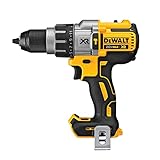
| High-torque cordless drill | Frequent holes around 1–2 inches, with occasional larger bits | More control and capacity, but heavier and often sold without batteries |
| Corded drill | Long sessions near an outlet | No battery downtime; cord limits movement and can become a snag hazard |
| Right-angle drill | Large holes in framing and confined spaces | Purpose-built control; less useful as an all-around drill |
Features worth paying for
A 1/2-inch chuck is the practical minimum for many large augers; check the bit’s shank diameter before buying. Three-jaw chucks are common and convenient, but heavy torque can loosen a poorly tightened chuck. Seat the shank fully, tighten firmly, and stop if the bit begins slipping. A keyed chuck can grip more securely, although changing bits takes longer.
Two speeds are more useful than a high advertised maximum rpm. Use low gear for large augers and let the bit cut at a steady pace. High speed creates heat, makes a bind more violent, and can pack chips into the flute. A side handle should be included or available from the manufacturer. Electronic kickback control can reduce injury risk, but it does not replace a firm grip or safe stance.
For cordless tools, a 4Ah or larger battery is a sensible starting point for sustained work. A small compact battery may run the drill, but it can sag under load and drain quickly. Extra capacity adds weight, so for a few holes overhead or in awkward positions, a smaller pack may be easier to manage.
What to buy for your workload
If most of your work is ordinary drilling and you only occasionally use a 1-inch auger, a well-built standard drill is the cheaper, more useful choice. Shop for a 1/2-inch cordless drill with a side handle rather than paying extra for a specialty tool you rarely need.
For repeated 1- to 2-inch holes, or occasional larger holes in solid lumber, step up to a high-torque cordless drill with an auxiliary handle. Match it to batteries you already own if the platform fits the job. If you bore large holes all day or work in tight framing, compare a high-torque right-angle drill. It is a specialist purchase, not an automatic upgrade for occasional DIY work.
Drill large holes without a hard bind
Clamp the work where possible and keep both hands on the drill and side handle. Stand with your feet braced and your wrists straight; do not put your face or body in the likely path of a rotating handle. Select low gear, use the drill’s clutch or anti-kickback setting if appropriate, and begin square to the surface. Feed with steady pressure rather than forcing the bit.
Pull the bit out periodically to clear chips, especially in deep holes. Packed chips increase friction and can stall the drill. If it slows sharply, stop and reverse out only if the tool supports controlled reverse operation; do not keep pulling the trigger against a jam. Inspect for nails or screws before boring. Metal contact can damage the cutting edges and turn a controlled cut into a sudden snag.
Common mistakes and failure signs
Using high gear, holding a large drill by the trigger handle alone, and forcing a dull bit are common causes of trouble. A sharp auger should advance without excessive pressure. If it smokes, squeals, or repeatedly stalls, stop: the bit may be dull, the flutes may be clogged, or the drill may be undersized for that bit and wood. Let the motor cool before resuming.
Do not use an impact driver as a substitute for a drill with a large auger. Its quick impacts are useful for fasteners, but large auger bits can bind abruptly and the driver’s chuck and control are not intended for the same sustained drilling load. Choose the tool around the largest bit you will use regularly, then buy the least expensive option that handles that job safely.