What's inside
As an Amazon Associate I earn from qualifying purchases. This post may contain affiliate links at no extra cost to you.
What we cover
Best 110V MIG Welders for Home Workshops
For most home workshops, the Hobart Handler 1000 is a sensible pick for repairs and light fabrication; choose the Lincoln Electric 90i MIG for a compact, beginner-friendly setup, or step up to the dual-voltage Hobart Handler 140 if you want more headroom and the option to use 230V. The right 110 mig welder depends less on its advertised maximum output than on how often you weld near that limit, what thickness you need to join, and whether your household circuit can support it.
Shortlist by workshop situation
- Occasional repairs, limited space: Lincoln Electric 90i MIG. Its compact inverter format is easy to store and move, though its small wire spool capacity means more frequent changes.
- Frequent household repairs and light fabrication: Hobart Handler 1000. It offers a useful balance of output, spool capacity, and 120V convenience.
- More flexibility or thicker work: Hobart Handler 140. It runs on 115V or 230V, so a suitable 230V outlet can provide useful extra capacity beyond a typical 110/120V-only machine.
- Lowest-cost occasional use: Consider a reputable entry-level 120V flux-core/MIG machine, but check whether it actually supports gas MIG. Some machines advertised as MIG welders are flux-core-only or require an extra kit for shielding gas.
110V MIG welder comparison
In North America, “110V” is commonly used as shorthand for a household 120V supply. Check the machine’s nameplate and manual: circuit requirements, input current, and output vary by model. The figures below are published specifications for the listed models; material-thickness guidance is practical context, not a guarantee. Joint design, fit-up, wire, shielding gas, and operator skill all affect penetration.
As an Amazon Associate we earn from qualifying purchases at no extra cost to you.
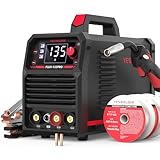


| Welder | Input and output range | Duty cycle | Wire capacity | Practical material range |
|---|---|---|---|---|
| Lincoln Electric 90i MIG | 120V; 30–90A output | 20% at 90A | 4 in. spool | Best suited to thin steel and occasional light-gauge repairs; near its upper range, work in short sections. |
| Hobart Handler 1000 | 115V; 30–100A output | 20% at 90A | 4 in. or 8 in. spool, depending on setup | Useful for sheet and light steel fabrication; thicker joints may need beveling and multiple passes. |
| Hobart Handler 140 | 115/230V; 25–140A output | 20% at 90A on 115V; 25% at 100A on 230V | 4 in. or 8 in. spool, depending on setup | On 115V, treat it as a light-fabrication machine; 230V operation gives more room for thicker work. |
Duty cycle is the share of a 10-minute period a welder can run at a specified output before cooling. A 20% duty cycle means about two minutes of welding followed by eight minutes of cooling at that rated condition. It does not mean every weld must follow that exact rhythm at lower settings, but repeated long beads can trigger thermal protection and interrupt a project.
What the specifications mean in a home shop
Output range matters more than the headline maximum
A low-end setting helps with thin sheet metal, while a higher output setting is useful for heavier brackets and frames. But a 120V machine’s maximum output is limited by the power available from the circuit. For repeated work on thick steel, a 230V welder is generally a better fit than trying to push a 110 welder MIG to its limit. A larger machine also does not automatically make thin-metal welding easier; stable low-end control matters too.
Spool size affects convenience and running cost
A 4-inch spool keeps a welder compact but runs out sooner and may limit wire choices. An 8-inch spool reduces changeovers for a regular fabricator. Before buying, confirm the machine’s supported spool diameter, wire diameter, and whether solid wire and flux-core wire both work with its drive rolls and polarity setup. Wire capacity is not just a convenience detail: switching wire types may require changing the drive-roll groove, liner, contact tip, and polarity.
Thickness claims need context
Manufacturers’ maximum-thickness claims depend on conditions. For a dependable joint, clean metal to bright steel, use a suitable bevel on thicker pieces, and make multiple passes where appropriate. A small 110 volt MIG welder is a strong match for thin sheet, automotive-style patch work, shelving, light gates, and small brackets. It is not the best choice for critical structural welds or long, continuous welds on heavy plate.
Choose by workload, not by the label
| Your situation | What to prioritize | Best fit |
|---|---|---|
| New welder, occasional small repairs | Simple setup, low-end control, compact storage | Lincoln Electric 90i MIG |
| Regular home projects, mostly steel | More wire capacity and a practical 120V output range | Hobart Handler 1000 |
| Projects may grow or a 230V outlet is available | Dual-voltage flexibility and greater output headroom | Hobart Handler 140 |
| Long welds or substantial steel sections | Higher duty cycle and 230V power | Look beyond 110 welders MIG models to a suitable 230V machine |
Before plugging in: circuit, setup, and consumables
A 110 welder MIG is only as reliable as its power supply. Follow the manufacturer’s circuit and extension-cord requirements, and avoid sharing a heavily loaded circuit with heaters, compressors, or other high-draw equipment. A long, undersized extension cord can cause voltage drop, poor arc performance, and nuisance breaker trips. If you are unsure about the outlet or circuit, have an electrician check it rather than relying on a plug adapter.
- Match the process to the job: Gas-shielded MIG is generally cleaner indoors, but requires a cylinder and regulator. Flux-core avoids shielding gas and can be useful outdoors, though it creates more spatter and slag.
- Keep consumables in good condition: Contact tips wear and accumulate spatter; replace a tip when the wire feeds inconsistently or the opening becomes visibly enlarged. Clean or replace a clogged nozzle before it disrupts gas coverage.
- Store wire dry: Rust or moisture on wire can cause erratic feeding and porous welds. Keep unused wire covered, especially in a damp garage.
- Prepare the joint: Remove paint, oil, rust, and galvanizing from the weld area. Contamination can spoil the weld and create hazardous fumes; use appropriate ventilation and respiratory protection, and never weld coated metal without understanding the coating hazards.
Bottom line
For occasional repairs, a compact 120V model such as the Lincoln Electric 90i MIG can be easier to store and manage. For a more frequent home-shop workload, the Hobart Handler 1000’s broader spool options make it a practical middle ground. If you anticipate heavier work, the dual-voltage Hobart Handler 140 is the more flexible choice—especially when you can use a properly installed 230V circuit. In each case, verify the exact model’s current manual, included accessories, input requirements, and wire compatibility before purchase, since packages and specifications can vary by market.