What's inside
As an Amazon Associate I earn from qualifying purchases. This post may contain affiliate links at no extra cost to you.
A cordless drill can mix small batches of joint compound or thinset, but it is not a stand-in for a dedicated mud mixer on every job. The useful choice depends on the material, batch size, and how long you need to mix. For occasional repairs, a sturdy 18V or 20V drill may be enough. For repeated batches of tile mortar, a purpose-built mixer is usually a better fit.
As an Amazon Associate we earn from qualifying purchases at no extra cost to you.
What we cover
What makes a drill suitable
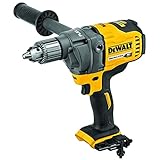
Mixing puts steady resistance on a drill for longer than driving screws or drilling holes. Look for a two-speed model with a low gear, a side handle, and a variable-speed trigger. Low speed gives you more control and helps keep powder and liquid from splashing. A side handle matters: a paddle can catch suddenly in thick material and twist the drill hard enough to strain your wrist.
For a general-purpose drill, a 1/2-inch chuck is more practical than a 3/8-inch chuck because it accepts more mixing paddles. Check the paddle’s shaft size and the drill’s chuck capacity before buying. Use the drill’s low gear, start slowly, and stop if the motor is laboring, the battery is getting hot, or the chuck is slipping. Do not use hammer mode for mixing.
Thinset versus joint compound
Thinset mortar is dense and abrasive, especially when mixed in a large bucket. It places a heavier, more sustained load on a drill than premixed joint compound. A drill that handles a small batch of drywall mud may overheat or bog down in a full batch of thinset. Follow the mortar package’s water ratio and mixing instructions; adding extra water to make mixing easier can weaken the finished material.
Joint compound is generally easier to mix, though powder-based compound still thickens as it hydrates. Premixed compound usually needs only a brief stir to loosen it. Avoid whipping air into it: excessive speed can create bubbles that show up during application. For both materials, mix only what you can use within the product’s working time.
Drill or dedicated mixer?
A heavy-duty cordless drill is a sensible buy if you also need it for drilling and fastening, and you mix small batches now and then. A dedicated cordless mud mixer is better for regular drywall work or larger batches, while a corded mixer can make sense for long sessions near an outlet. These categories are not interchangeable: a mixer is built around sustained mixing, while a drill is a compromise that earns its keep on other jobs.
Compare tools by their low-speed control, handle arrangement, and stated mixing capacity—not just voltage or a high torque figure. For a drill, choose a heavy-duty 18V or 20V drill with a 1/2-inch chuck and side handle. If mixing is the main task, look at a dedicated cordless mud mixer instead.
| Tool type | Best fit | Main trade-off |
|---|---|---|
| General-purpose cordless drill | Small batches and occasional mixing, plus everyday drilling | More likely to heat up or bog down in thick mortar |
| Heavy-duty drill with side handle | Occasional thinset and frequent general construction work | Still not designed for uninterrupted mixing sessions |
| Cordless mud mixer | Regular drywall work or mixing away from outlets | Extra cost and less useful as a general drilling tool |
| Corded mixer | Repeated or longer mixing sessions near power | Requires an outlet and cord management |
Choose the paddle and batch size carefully
Match the paddle to the material and bucket. A paddle that is too large increases the load; one that is too small may leave dry powder on the sides and bottom. Use the paddle style recommended by the material maker where specified. Keep it submerged before starting, mix at low speed, and scrape the sides and bottom with a separate tool if needed. A paddle can fling material, so wear eye protection and keep clothing clear of the shaft.
Do not assume a drill’s advertised torque means it can mix a full bucket of thinset continuously. Manufacturers may rate drills for brief bursts, and real load varies with paddle size, batch volume, and mortar consistency. If the drill stalls repeatedly, smells hot, or needs frequent cooling breaks, reduce the batch size or switch tools. For a small repair, a mixing paddle in a regular drill can be adequate; for full tile-setting days, the cheaper drill can become a false economy if it burns out.
Battery and heat management
Mixing drains batteries faster than intermittent fastening. A larger-capacity battery can extend runtime, but it also adds weight to a drill you must control. Keep a spare charged, and let a hot battery cool before charging. Heat in the tool is a warning, too: repeated thermal cutoffs or a burning smell are reasons to stop, not push through another batch. Never hold the trigger at full speed to compensate for a drill that is struggling.
A practical buying decision
For occasional joint compound and small amounts of thinset, buy a capable 1/2-inch cordless drill with two speeds and a side handle if you will use it for other work. A less expensive drill is fine for brief, light-duty mixing, particularly premixed compound; there is little reason to pay for a mixer if you rarely mix. If you regularly prepare powder compound or mortar, choose a tool built for mixing and check its recommended paddle and batch capacity. In every case, use the correct ratio, keep the speed controlled, and let the motor’s behavior—not the battery label—tell you when the load is too much.