What's inside
As an Amazon Associate I earn from qualifying purchases. This post may contain affiliate links at no extra cost to you.
The right fastener depends on the block, the rail’s load, and whether the block is solid or hollow. For a light-duty rail on sound solid concrete block, masonry screws are often the quickest choice. For hollow block or heavier loads, use a fastener system designed for hollow masonry and follow its load limits. No anchor can make a weak block face or poorly supported rail safe.
As an Amazon Associate we earn from qualifying purchases at no extra cost to you.



What we cover
Check the block and the load
First identify what the rail will hold. A short rail for light tools is a different job from a long rail carrying cabinets, storage bins, or equipment that people may pull on. Consider the total weight, how far it projects from the wall, and whether the load will be applied suddenly. Pulling and prying can place more stress on anchors than a load hanging straight down.
Concrete block may be solid, hollow, or grouted. Hollow units have thin face shells and internal webs; the mortar joints can also be weaker or less predictable than the block itself. Look at an exposed edge, plans, or an existing opening if possible. If you cannot confirm the block type, drill a small test hole in a low-risk spot and inspect the dust and depth. Stop if the block crumbles, the face shell breaks through, or the hole lands in a joint.
Fastener options at a glance
| Fastener | Best fit | Trade-off |
|---|---|---|
| Masonry screw | Sound solid block; light to moderate loads within the manufacturer’s rating | Fast installation, but needs an accurately sized, clean hole; poor choice for a thin hollow-block face shell |
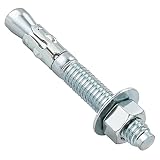
| Sleeve or expansion anchor | Solid masonry where the anchor has adequate embedment and edge distance | Strong in suitable material, but expansion can crack weak or thin block |
| Hollow-wall masonry anchor | Hollow block, when the anchor is specifically rated for that substrate | More installation steps; capacity varies sharply with block condition and anchor design |
| Through-bolt or engineered system | High loads or situations needing a verified load path | May require access to the back of the wall or professional design |
Choose by situation
For sound, solid block and a modest load, a masonry screw is usually the simplest option. These screws cut or engage threads in a correctly drilled masonry hole, so they do not rely on a plastic plug. Match the screw diameter and length to the rail holes, required embedment, and the screw maker’s instructions. A longer screw is not automatically stronger if it reaches a void or weak material.
Use an expansion anchor for concrete only where the block is solid and thick enough for that anchor’s specified embedment and edge clearance. Expansion puts outward pressure on the masonry. That can be a disadvantage in hollow block, near a block edge, or close to a mortar joint, where the face can split or spall.
For hollow block, choose a hollow-block anchor rated for masonry. Some anchors expand behind the face shell; others use a different mechanical action. Check the product documentation for hollow concrete block specifically rather than relying on a generic “wall anchor” label. If the rail carries a substantial or safety-critical load, consult the anchor manufacturer’s technical data or a qualified installer. Do not guess a capacity from the anchor’s appearance.
Drilling and installation
Lay out the rail so its fasteners land in block, not mortar, unless the rail or anchor instructions specifically permit mortar-joint installation. Keep holes away from block edges and corners; the required distance depends on the anchor, so use its published minimum rather than a universal rule. Check for pipes and wiring before drilling.
Use a hammer drill for ordinary masonry drilling, with a carbide masonry bit in the exact diameter specified for the fastener. A rotary hammer is useful for repeated holes or harder material, but it can be too aggressive for fragile block; use controlled pressure and the appropriate mode. A standard drill may work for a small number of holes in softer masonry, though it will be slower. A carbide masonry bit should be sharp and undamaged. Do not substitute a wood or metal bit.
Keep the drill square to the wall and drill to the specified depth. Use a depth stop or tape mark, allowing for the fastener’s required embedment and any dust at the bottom. Clean holes as directed by the manufacturer; dust left in the hole can prevent a screw from cutting properly or keep an anchor from seating. Wear eye protection and a dust mask, and use dust extraction where possible.
Install each fastener with the tool and torque guidance specified by its maker. For masonry screws, stop if the screw spins without tightening, binds hard before seating, or crumbles the hole: remove it and reassess rather than forcing it. For expansion anchors, do not overtighten; crushing the block or spinning the anchor can ruin the connection. Seat the rail flat, use all specified mounting points, and check for movement before loading it.
Common mistakes to avoid
Plastic plugs intended for drywall or general-purpose use are not a safe default for a rail on concrete block. Likewise, hammering a wedge anchor into a hollow unit does not turn the face shell into solid concrete. Avoid drilling through the face shell into a void unless the chosen anchor is designed to work there. If the block is cracked, soft, or damaged, relocate the rail or use a designed alternative such as a mounting board fixed across sound structural locations.
Finally, do not treat a published anchor rating as the allowable load for the whole rail. Ratings depend on substrate, spacing, edge distance, installation quality, and load direction. The rail, its holes, the block, and the fasteners all share the load. When failure could injure someone or damage valuable equipment, have the complete installation reviewed rather than relying on a rule of thumb.