What's inside
As an Amazon Associate I earn from qualifying purchases. This post may contain affiliate links at no extra cost to you.
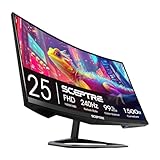
The best gaming monitors under $300 are usually 24-inch 1080p models for the highest frame rates, or 27-inch 1440p models when sharper image quality matters more than maximum speed.
What we cover
Quick picks by gaming situation
| Gaming situation | Best fit | Why it makes sense | Typical price range |
|---|---|---|---|
| Competitive shooters and limited desk space | AOC 24G4 | 23.8-inch Full HD IPS panel, 180Hz refresh rate, Adaptive-Sync support | $130–$180 |
| Fast esports at the highest frame rate | Dell G2524H | 24.5-inch Full HD IPS display with up to 280Hz overclocked refresh rate | $180–$260 |
| Single-player games and sharper desktop work | Gigabyte GS27Q | 27-inch 2560×1440 IPS panel with up to 170Hz refresh rate | $200–$280 |
| Large screen on a tight budget | LG 27GS60F-B | 27-inch Full HD IPS panel with 180Hz refresh rate | $150–$220 |
| Balanced alternative for PC and console | ASUS TUF Gaming VG249Q3A | 23.8-inch Full HD Fast IPS display with 180Hz refresh rate | $140–$200 |
These are representative market ranges rather than fixed prices. Sales, regional availability, and included stands can change the value significantly, so compare the full specification rather than choosing by price alone.
As an Amazon Associate we earn from qualifying purchases at no extra cost to you.



What matters most below $300?
Refresh rate: 144Hz is the practical starting point
A 60Hz monitor refreshes every 16.7 milliseconds. A 144Hz monitor refreshes every 6.9 milliseconds, while 180Hz reduces that interval to 5.6 milliseconds. The improvement from 60Hz to 144Hz is immediately noticeable in mouse movement, camera panning, and fast games. The difference between 144Hz and 180Hz is smaller, but inexpensive 180Hz monitors have made the faster specification common.
Refresh rate only helps when the computer can produce enough frames. If a game runs at 75 frames per second on a 180Hz monitor, the display cannot provide the full benefit of its refresh rate. For esports games such as Valorant, Counter-Strike 2, or Rocket League, a 180Hz or 240Hz 1080p screen can be sensible. For demanding new games, 1440p at 144Hz may provide a better balance.
Response time: avoid comparing inflated headline figures
Manufacturers often advertise 1ms or even 0.5ms response times, but the result depends on the selected overdrive setting and the exact transition being measured. A useful monitor has fast enough pixel transitions to avoid obvious smearing, without creating bright inverse trails behind moving objects.
Look for an IPS gaming monitor with a reputable response-time mode and several overdrive settings. Use the middle setting first. The fastest mode is not automatically best; aggressive overdrive can produce overshoot, which appears as a pale or dark halo around moving objects.
Resolution and size: choose the combination, not either specification alone
- 24 inches at 1920×1080: approximately 92 pixels per inch. This is sharp enough for gaming and keeps graphics-card demands manageable.
- 27 inches at 1920×1080: approximately 82 pixels per inch. It is spacious and affordable, but text and fine game details look softer at normal desk distance.
- 27 inches at 2560×1440: approximately 109 pixels per inch. This is the clearest all-purpose choice under $300 when your graphics card can drive it.
The Gigabyte GS27Q demonstrates why 27-inch 1440p models are attractive: it combines a physically large image with substantially higher pixel density than a 27-inch Full HD monitor. The trade-off is that rendering 1440p requires roughly 78% more pixels than 1080p, so frame rates may fall unless you reduce settings or use an upscaling mode supported by the game.
Head-to-head: 24-inch 1080p versus 27-inch 1440p
| Factor | 24-inch 1080p, such as AOC 24G4 | 27-inch 1440p, such as Gigabyte GS27Q |
|---|---|---|
| Typical refresh rate | 180Hz | 165–170Hz |
| Pixel density | About 92 ppi | About 109 ppi |
| GPU load | Lower; easier to reach high frame rates | Higher; better suited to a midrange or stronger GPU |
| Best viewing distance | Approximately 20–28 inches | Approximately 24–32 inches |
| Best use | Competitive games and smaller desks | Role-playing games, racing, productivity, and mixed use |
| Main compromise | Less workspace and detail | Higher cost and greater rendering demand |
Panel types and adaptive sync
IPS is the safest panel type in this price range. It normally offers better viewing angles and more consistent color than budget TN panels, while modern Fast IPS screens can be quick enough for competitive play. VA panels can provide deeper contrast, which is useful in dark games and movies, but some models show dark-level smearing. TN panels remain fast but are less appealing for general use because of weaker viewing angles and color quality.
Adaptive sync synchronizes the monitor’s refresh rate with the graphics card’s frame rate. This reduces tearing when performance fluctuates. AMD FreeSync is common, while many FreeSync monitors also work with NVIDIA G-SYNC Compatible mode through DisplayPort. Confirm the supported connection and range before buying; a monitor advertised as 180Hz may reach that speed only through DisplayPort, with HDMI limited to a lower rate.
Adaptive sync is especially valuable when a game moves between 90 and 150 frames per second. Without it, the monitor may show a horizontal split between two frames. With it, the refresh rate follows the output more closely, provided the frame rate remains inside the monitor’s supported range.
Which monitor should you choose?
- Choose the AOC 24G4 or ASUS TUF Gaming VG249Q3A if you want a compact, fast, IPS-based 1080p display and your priority is competitive play.
- Choose the Dell G2524H if your system can exceed 180 frames per second and you want to make full use of a very high refresh rate. Its advantage is speed, not resolution or cinematic image quality.
- Choose the Gigabyte GS27Q if you want one monitor for gaming, browsing, and detailed creative or office work. It is the strongest resolution choice here, assuming your graphics card handles 1440p well.
- Choose the LG 27GS60F-B if a large display is more important than maximum sharpness and you want to keep the purchase near the lower end of the budget.
Setup details that affect real performance
- Use the correct cable and input. Connect through DisplayPort when the monitor’s highest refresh rate requires it. Check the on-screen menu afterward rather than assuming the setting changed automatically.
- Enable the maximum refresh rate in the operating system. A new monitor can remain at 60Hz until you select 144Hz, 165Hz, 180Hz, or 240Hz in display settings.
- Turn on Adaptive-Sync in the monitor menu. Then enable the corresponding variable-refresh option in your graphics software.
- Set an appropriate frame-rate limit. A practical starting point is a few frames per second below the maximum refresh rate. For a 180Hz monitor, try 177 frames per second if the game and graphics driver allow it. This leaves a small margin for variable-refresh operation.
- Adjust overdrive one step at a time. Check a fast game or moving test pattern for halos. If bright trails appear, use a weaker setting.
Ownership realities and common mistakes
The first parts likely to cause frustration are not usually the LCD panel itself. Stands may have limited height adjustment, power supplies can be bulky, and inexpensive monitor buttons or joystick controls may feel less refined. Check whether the stand supports height adjustment and VESA mounting if your desk setup matters. A 24-inch monitor may fit comfortably on a narrow desk, while a 27-inch screen can feel too close if the viewing distance is under about two feet.
Keep the panel clean with a dry microfiber cloth or a lightly dampened cloth approved for screens. Do not spray cleaner directly onto the display, press hard on the panel, or use household glass cleaner unless the manufacturer specifically permits it. Dust around ventilation openings and avoid blocking the power adapter. These habits will not improve frame rate, but they reduce avoidable wear and surface damage.
For most buyers, the decision is simple: select a 24-inch 1080p IPS monitor at 180Hz for competitive gaming and limited space; select a 27-inch 1440p IPS monitor at roughly 165Hz when clarity, workspace, and single-player immersion matter more. Within the best gaming monitors under $300, that choice has a greater effect on satisfaction than a small difference in advertised response time.