What's inside
As an Amazon Associate I earn from qualifying purchases. This post may contain affiliate links at no extra cost to you.
Hole saws are the right tool for making clean, round openings for drain pipes, electrical boxes, cable bundles, and recessed lights. The best kit depends less on the number of pieces in the case and more on the materials you will cut, the hole diameters you need, and the drill driving the arbor.
For occasional work in drywall and wood, an inexpensive bi-metal kit is usually enough. For repeated plumbing work, thick lumber, cement board, or stainless steel, a better arbor and sharper saws are worth paying for. Before buying, check that the kit includes the sizes you actually need and that replacement saws are available.
As an Amazon Associate we earn from qualifying purchases at no extra cost to you.

What we cover
The main hole saw kit types
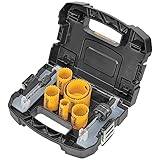
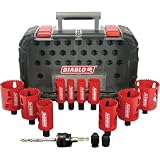
Bi-metal kits are the best general-purpose choice for wood, drywall, plastic, PVC, and thin sheet metal. Their teeth combine a flexible steel body with hardened cutting teeth, so they tolerate occasional contact with nails better than brittle carbide versions. A typical kit includes saws from about 3/4 inch to 5 inches.
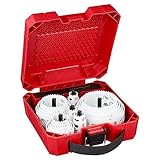
Carbide-grit kits are intended for abrasive materials such as cement board, fiberglass, brick veneer, and some masonry products. They cut differently from toothed saws and usually leave a rougher edge. They are not a substitute for a masonry core bit in concrete or block. Do not use a carbide-grit saw on high-speed settings; heat can damage the cutting surface.
Carbide-tipped kits are useful for cast iron, stainless steel, thick hardwood, and other difficult materials. They cut aggressively but are less forgiving if the saw catches or hits a hidden fastener. They also cost more, making them unnecessary for a few holes in drywall or plastic.
For most homeowners, a bi-metal hole saw kit with a quick-change arbor is the sensible starting point.
Useful sizes for plumbing and electrical work
Electrical boxes commonly need holes between 1-1/8 and 2-1/8 inches, depending on the box, cable route, and installation method. A 1-1/4-inch saw is useful for individual cables and small conduit. A 2-1/8-inch saw is common for larger cable bundles, low-voltage wiring, and some old-work box layouts, but the box manufacturer’s template takes priority.
Plumbing openings vary more. Common sizes include 1-1/4 inches for smaller drain and supply penetrations, 1-3/4 to 2-1/4 inches for larger plastic pipe, and 2-9/16 inches or more for waste lines and sleeves. Measure the outside diameter of the pipe, not the nominal pipe size. A 2-inch PVC pipe is roughly 2-3/8 inches outside diameter, so a 2-1/2-inch hole may be needed for clearance.
A kit with 3/4, 7/8, 1, 1-1/8, 1-1/4, 1-1/2, 1-3/4, 2, 2-1/8, and 2-1/2-inch saws covers many household pass-throughs. Very large plumbing penetrations often justify buying a single large hole saw instead of paying for a kit full of unused small sizes.
| Job | Best saw type | Useful range | Main caution |
|---|---|---|---|
| Drywall and wood framing | Bi-metal | 1 to 3 inches | Watch for hidden wires and pipes |
| PVC and ABS pipe | Bi-metal | 1-1/4 to 3 inches | Support the plastic to prevent tearing |
| Thin metal conduit or boxes | Bi-metal, fine-tooth | 3/4 to 2-1/2 inches | Use cutting oil and low speed |
| Cement board or fiberglass | Carbide-grit | 1 to 3 inches | Control dust and avoid high speed |
| Brick or block veneer | Carbide-grit or masonry core bit | 1 to 4 inches | Do not use hammer action unless rated for it |
Arbor design and drill compatibility
The arbor is the center shaft that holds the pilot bit and saw. A fixed arbor is inexpensive but requires a separate arbor for each saw size or a time-consuming swap. A quick-change arbor lets you release the saw without removing the arbor from the drill. That feature matters when making several different-sized openings.
Look for an arbor with a 1/2-inch shank if you will use saws larger than about 2-1/2 inches. Large saws produce substantial torque, and a 1/4-inch hex shank can slip or bend in dense wood. A 1/4-inch hex arbor is convenient for an impact driver, but an impact driver is not the first choice for large hole saws. The pulsing action can catch hard and damage the arbor, saw, or workpiece.
A variable-speed cordless drill is generally better. Use the low gear for saws above 2 inches and keep both hands on the tool. A hammer drill should have hammer mode switched off. An impact-rated arbor may survive an impact driver, but that does not make the setup safe or comfortable for every cut.
How to cut clean pass-throughs
Mark the center carefully and confirm what is behind the surface. In walls, use a stud finder with wire detection, inspect accessible areas, and shut off power before cutting near electrical wiring. Plumbing and electrical codes may require protective nail plates where a hole is too close to the face of a stud. A hole saw does not make an unsafe route acceptable.
Start at low speed with the pilot bit perpendicular to the surface. Once the pilot has established a shallow dimple, increase pressure gradually. For a clean opening in finished wood or laminate, stop when the pilot breaks through, then finish from the opposite side. This prevents the saw from blowing out a large chip around the exit.
For drywall, avoid forcing the saw. The material cuts quickly, and excessive pressure can tear the paper face or make the saw grab when it reaches a stud. For PVC, use moderate speed and clear the plastic chips often. For metal, use low speed, firm support, and cutting oil. Bi-metal saws generally last longer when allowed to cool between holes.
Clear the plug after each cut. Some kits have slot openings in the saw body for prying out the waste; others require pushing from the arbor side. A stuck plug can stop the saw suddenly and twist the drill out of your hands.
What to look for when buying
Prioritize sharp, replaceable saws, a rigid arbor, and a pilot bit that can be replaced independently. Kits with several identical arbor adapters or tiny saws you will never use are poor value. A molded case is helpful, but it should not outweigh cutting performance.
For light DIY work, a basic bi-metal kit for wood and plastic is the cheaper option worth choosing. If you need only one 2-1/8-inch opening, buying that saw and arbor individually can cost less than a 16-piece kit. For repeated metal or cement-board work, spend more on the correct specialized kit rather than trying to make a general-purpose saw do every job.
Replace a saw when the teeth are rounded, several teeth are missing, or the body wobbles on the arbor. A dull hole saw takes longer, overheats the drill, and increases the chance of a sudden grab. The right size and a controlled, low-speed cut matter more than owning the largest kit on the shelf.