What's inside
As an Amazon Associate I earn from qualifying purchases. This post may contain affiliate links at no extra cost to you.
What we cover
What the bracket needs from an anchor
A small shelf bracket may look light, but the anchors have to resist both the shelf’s weight and the leverage created when that weight sits out from the wall. A shelf 8 inches deep, loaded near its front edge, pulls harder on the upper fastener than the same load placed against the wall. Bumping the shelf or using it to hold a heavy object adds more stress.
First check whether the bracket can be fastened into a stud. A stud is the strongest, simplest option: use a wood screw long enough to pass through the drywall and bite into the framing, commonly a 2½- to 3-inch screw for typical drywall. If the bracket holes do not line up with a stud, use a suitable hollow-wall anchor. Follow the bracket maker’s stated load limits, and remember that an anchor’s package rating is not a guarantee for every wall, installation, or loading pattern.
As an Amazon Associate we earn from qualifying purchases at no extra cost to you.


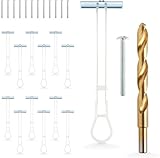
Best anchor types for a small shelf bracket
For a bracket fastened to sound, standard ½-inch drywall, a metal hollow-wall anchor or a toggle-style anchor is usually more dependable than a basic plastic expansion plug. The right choice depends on the hole size you can make, the space behind the wall, and whether you might need to remove the bracket later.
| Anchor type | Good fit | Trade-offs |
|---|---|---|
| Metal hollow-wall anchor | Light-duty bracket; clean, permanent installation | Usually needs a correctly sized hole and setting tool. Removal can leave a larger hole. |
| Toggle bolt | Loads where a broad bearing surface behind the drywall is useful | Needs open space behind the wall; the toggle can fall into the cavity if its bolt is removed. |
| Strap-style toggle | More convenient installation and removal than a traditional toggle | Costs more than basic anchors and still needs a sufficiently clear cavity. |
| Plastic expansion plug | Very light items with little leverage | Less reassuring for a projecting shelf; can loosen or pull out of drywall under repeated loading. |
A metal hollow-wall anchor kit with a setting tool is a reasonable buy if you expect to hang several small fixtures. For one bracket, a properly sized toggle may be cheaper and sufficient, provided the cavity is clear and the bracket’s holes accept it.
Choose for the load and the wall
Use the shelf maker’s load guidance if it provides one. If not, treat a small hollow-wall-mounted shelf as light duty: display items, not a stack of books, a tool battery collection, or anything breakable that could hurt someone if it falls. There is no reliable universal capacity number for “a drywall anchor.” Capacity varies with anchor design, drywall thickness and condition, hole quality, screw fit, installation, and how far the load projects from the wall.
For more margin, put at least one bracket screw into a stud and use an anchor for the other holes. If the bracket is too narrow to reach framing, consider a wood mounting strip fixed to studs, then attach the bracket to that strip. This spreads the load without asking drywall alone to carry it. If the wall is soft, cracked, damp, or already damaged around the mounting point, repair it or find a different mounting location instead of relying on a stronger-looking anchor.
A strap-style toggle anchor can be a good choice where the wall cavity has enough room for its wings and you want to take the bolt out later without losing the toggle. Check the package for the required drywall thickness and drill-hole diameter; those details vary by product.
Install without damaging the wall
Use a stud finder and check for wires or pipes before drilling. A stud finder is not a guarantee that a location is safe, especially near outlets, switches, plumbing fixtures, or radiators. If you are unsure what is behind the wall, move the bracket or get help.
Mark the bracket holes level, then confirm the anchor’s specified hole diameter against the package. Use a sharp drywall bit and drill straight, at low speed, without hammer mode. Hammer action is for masonry, not drywall; it can make an oversized, ragged hole that leaves an anchor with little material to grip. A cordless drill is enough for this work. An impact driver is generally a poor choice for setting small anchors because its repeated impacts can over-tighten or damage them.
Install each anchor exactly as directed. A metal hollow-wall anchor must be set so its sleeve expands behind the drywall; driving the screw before the anchor is properly set can spin the sleeve or crush the paper face. A toggle needs enough clearance behind the wall for its wings to open. Tighten the bracket firmly, but stop if the anchor spins, the drywall dimples, or the screw keeps turning without becoming snug. Those are signs the hole or wall is failing, not a reason to apply more torque.
Common failures and a sensible test
The most common mistake is using a plastic plug meant for solid material, such as brick, in plain drywall. It cannot expand against solid backing there and may pull out under leverage. Another is choosing an anchor by its largest advertised rating without checking whether that rating assumes a different wall thickness or a straight-down load. A shelf bracket puts force on its fasteners at an angle.
After installation, load the shelf gradually and keep the first test modest. Watch for a bracket that shifts, a screw that backs out, or drywall that cracks or bulges. Unload it immediately if any of those appear. Do not test an uncertain installation by hanging your body weight on the shelf.
For one very light shelf, a suitable plastic anchor can be the cheaper, adequate option if the shelf maker allows it and the load has little leverage. For a bracket that will hold regularly used items, a metal hollow-wall anchor or toggle offers a better fastening approach; a stud or stud-mounted strip is better still. Buy the smallest anchor that is rated and sized for the job, install it carefully, and let the wall—not the package headline—decide how much load is sensible.