What's inside
As an Amazon Associate I earn from qualifying purchases. This post may contain affiliate links at no extra cost to you.
Quick bit changes are one of the main reasons to use an impact driver instead of a drill. The right bit holder makes that advantage more useful, especially when you are switching between a Phillips bit, a nut driver, and a pilot drill during the same job. The wrong holder can add wobble, drop bits, or jam when impact force drives debris into the sleeve.
For most users, the best choice is a 1/4-inch hex quick-change holder with a locking collar and a strong magnet. If you regularly work overhead, install deck screws, or switch bits dozens of times per day, a premium holder or a compact bit-changing system can save noticeable time. For occasional household work, an inexpensive magnetic holder is usually sufficient.
As an Amazon Associate we earn from qualifying purchases at no extra cost to you.



What we cover
What to Look for in an Impact Driver Bit Holder
Impact drivers use a 1/4-inch hex chuck, but not every holder is built for impact loads. Look for the words “impact rated” or “for impact drivers.” Standard drill-driver accessories may fit the chuck but can crack, twist, or shed their retaining balls under repeated hammering.
The holder should have a machined 1/4-inch hex shank, a secure retaining mechanism, and enough clearance around the sleeve to operate it with gloves. A locking collar is generally more secure than a simple spring sleeve. The collar prevents the bit from backing out when the driver reverses or vibrates.
A magnet is useful for holding insert bits and screws, but magnet strength varies. A strong magnet helps keep a bit seated while positioning a screw, though it will not compensate for a worn bit or a poorly fitting screw head. For heavy fastening, a mechanical locking holder is more dependable than magnet-only retention.
Main Types of Bit Holders
| Holder type | Best use | Advantages | Limitations |
|---|---|---|---|
| Magnetic quick-change holder | General repairs and remodeling | Fast one-handed changes; usually inexpensive | Can release bits when pointed downward or heavily vibrated |
| Locking quick-change holder | Decking, framing, and repeated fastening | Better bit retention and impact durability | Usually costs more; collar can be stiff with gloves |
| Long bit holder, 6 inches or more | Reaching recessed screws and cabinet work | Improves access and visibility | More flex and wobble; less suitable for high-torque driving |
| Compact stubby holder | Tight spaces and electrical work | Short overall length and good control | Less clearance for fingers and bit changes |
| Bit extension with sliding sleeve | Driving screws with a depth guide | Helps prevent overdriving in softer materials | More parts to clean; sleeve may catch on edges |
Best for Most People: Impact-Rated Magnetic Holders
A standard magnetic quick-change holder is the sensible starting point for homeowners and occasional DIY work. Choose a length between 2 and 4 inches. A 2-inch holder keeps the driver compact, while a 4-inch version gives your hand more room and makes it easier to see the fastener.
Look for a holder with a sleeve that slides smoothly and a magnet recessed far enough that it does not collect metal shavings immediately. A magnet-only holder is fine for installing cabinet hardware, assembling furniture, mounting hardware, and driving ordinary wood screws. It is also a practical choice when the holder costs less than a replacement box of quality bits.
For shopping, compare impact-rated magnetic bit holders by length, sleeve design, and reviews mentioning bit retention. Do not choose solely by the magnet rating; many listings use vague marketing terms instead of a useful holding-force specification.
Best for Heavy Use: Locking Impact Bit Holders
A locking holder is the better choice for construction, repetitive fastening, and overhead work. The locking collar must be pulled forward or slid back before removing the bit, which adds a fraction of a second to each change. In return, the bit is less likely to fall out when the driver is carried around or used nose-down.
These holders are especially helpful with long screws, self-tapping screws, and fasteners driven into metal. Those jobs create more vibration than light cabinet or trim work. If a bit repeatedly pulls out of a magnetic holder, upgrade to a locking design rather than simply buying a stronger magnet.
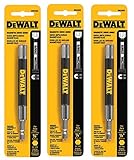
Consider a set of locking impact bit holders if you keep different bits installed in several holders. A three-piece set can be more convenient than changing bits constantly, although it adds bulk to a tool pouch and costs more than one general-purpose holder.
Length, Wobble, and Access
Longer is not automatically better. A 6-inch holder can reach screws behind shelving or inside narrow framing, but the extra length increases leverage on the shank. Even a small amount of runout becomes obvious at the tip. For precision work, keep the holder as short as the job allows.
Some wobble comes from the holder, but some comes from the bit. Test a holder by inserting a straight bit and running the driver at low speed. A slight circular movement at the tip may be acceptable for rough construction, but visible wobble is a problem for small screws, drill bits, and wall-anchor pilot holes.
For tight spaces, a compact stubby bit holder can reduce the tool’s reach by roughly 1 to 2 inches compared with a typical extension. The trade-off is a smaller operating sleeve and less room for gloved fingers.
Using and Maintaining a Bit Holder
Push the bit fully into the holder before driving. A bit that stops against packed debris may engage only partway, leaving the retaining ball or magnet under unusual load. Pull the sleeve forward and tug the bit lightly to confirm it is seated.
Clean the holder when metal shavings or drywall dust accumulate inside. Blow it out with compressed air or use a small brush; avoid flooding the mechanism with oil, which can attract abrasive dust. If the sleeve sticks, remove the holder from the driver before inspecting it.
Replace the holder when the bit develops excessive side play, the sleeve no longer returns firmly, or the retaining ball fails to hold a bit vertically. A loose holder can damage screw heads and make pilot holes wander. For most household users, a low-cost magnetic model is fine until these symptoms appear. For daily impact work, spend more on a locking, impact-rated holder and treat it as a wear item rather than a permanent part of the tool.