What's inside
As an Amazon Associate I earn from qualifying purchases. This post may contain affiliate links at no extra cost to you.
Impact-rated hex shank bits are made for the repeated twisting loads of an impact driver. They are not simply ordinary bits with a different label: the better ones use tougher steel and a torsion zone intended to flex slightly under load. That can reduce snapping when driving long screws, but it cannot make a worn bit, mismatched fastener, or excessive torque behave well.
For occasional assembly and short screws, a basic bit set is usually enough. For structural screws, deck work, or frequent driving, buy bits rated for impact use and choose the tip shape and length that fit the fasteners you actually use. A snug fit matters more than a big assortment.
As an Amazon Associate we earn from qualifying purchases at no extra cost to you.

What we cover
What “impact-rated” means
An impact driver delivers rapid rotational blows, rather than the smoother torque of a drill. Those blows can concentrate stress at the bit tip and shank. Impact-rated bits are designed to tolerate that cycling; many have a narrower torsion section that can flex and absorb some of the load. The trade-off is that the bit may be less rigid than a solid, standard bit, and no design is immune to wear or breakage.
Use a 1/4-inch hex bit holder or a bit with a compatible 1/4-inch hex shank. Check the package for an explicit impact rating. A hex shank alone does not mean a bit is suitable for impact driving. For drilling holes, use a drill bit intended for the material and tool; impact-rated screwdriver bits are not substitutes for masonry, wood, or metal drill bits.
Choose the right tip and length
Match the bit to the screw recess: Phillips, square, Torx, or another profile. Match the size, too. A tip that is too small can cam out, chew up the screw head, and damage itself. For example, a common deck screw may use a square or Torx recess; confirm the screw packaging rather than assuming all screws in a category take the same bit.
Short bits, often around 1 inch long, are a good choice for most work in a compact bit holder. They wobble less and keep the tip close to the driver. Longer bits—commonly 2 to 6 inches—reach into recessed corners and narrow assemblies, but add leverage and can flex more. Use the shortest bit that reaches the fastener. A magnetic holder can help retain a screw, but it does not correct a poor tip fit.
Bit options at a glance
| Type | Best use | Trade-off |
|---|---|---|
| Basic impact-rated bit set | General household fastening and mixed screw types | Convenient, but sets may include sizes you rarely use |
| Single or multipack of a frequently used size | Decking, framing, or repeated work with one fastener | Less versatile; usually better value if you wear out one size |
| Extended impact-rated bit | Recessed or obstructed fasteners | More flex and less control than a short bit |
| Precision or standard-duty bit | Light assembly with a drill or hand driver | Not the right choice for repeated impact-driver use unless explicitly rated |
What to buy for your work
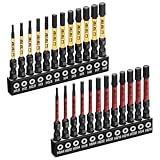
For a homeowner who drives a mix of cabinet, repair, and general-purpose screws, start with a small impact-rated hex shank bit set that includes several sizes of the profiles you use. Look for clearly marked sizes and a case that keeps bits from spilling into a toolbox. A set is less attractive if it fills space with obscure tips while providing only one of your common sizes.
If you are driving the same screws all day, buy a few duplicates of the correct size rather than relying on a large assortment. A pack of impact-rated Torx bits can make sense for a job using Torx screws; choose the size specified by the screw maker. Square-drive users should apply the same logic and keep spare bits on hand. The cheapest bits are fine for light work, but frequent driving can wear a tip quickly enough that replacing one worn bit is more convenient than stopping mid-job.
Buy a longer bit only when access requires it. If a standard bit cannot reach, choose an extended impact-rated bit in the required profile and size. For especially awkward access, a bit holder extension may be useful, but added length increases wobble and makes it easier to start a screw at an angle.
Drive without damaging bits or fasteners
Seat the tip fully before pulling the trigger. Hold the driver in line with the screw and start slowly; once the threads bite, increase speed as needed. Press firmly enough to keep the tip engaged, but do not lean so hard that you cannot correct the angle. If the bit repeatedly slips, stop. Check the size, wear, alignment, and screw head before trying again.
For long screws or dense material, drill a pilot hole when the screw manufacturer recommends one or when the material is splitting. A pilot hole can reduce driving resistance and improve control. It does not mean using a larger hole than specified: an oversized pilot can weaken the screw’s grip. In hardwood, near board ends, or close to an edge, a suitable pilot hole is often a better fix than choosing a more powerful driver.
Impact drivers can drive fasteners quickly, but they can also overdrive them. Stop when the head seats. For delicate hardware, small screws, or work requiring a consistent final depth, a drill with a clutch—or a hand driver—may offer better control. Use the impact driver’s lower speed setting if it has one, and test on scrap before working on finished material.
When to replace a bit
Replace a bit when its edges are rounded, the tip no longer seats snugly, or it slips even after you confirm the fastener size and alignment. A damaged bit can ruin multiple screw heads in one job. Also stop if a bit becomes unusually hot, twists visibly, or develops cracks. Let hot bits cool before handling; do not keep driving in the hope that a slipping tip will recover.
Keep bits dry and separate from loose metal fasteners where practical. Small chips and rust are easier to spot in a case than in the bottom of a tool bag. For heavy fastening, the useful upgrade is usually not the largest set or the longest bit: it is a correctly sized, impact-rated bit that is sharp, seated straight, and replaced before wear turns a routine job into a damaged fastener.