What's inside
As an Amazon Associate I earn from qualifying purchases. This post may contain affiliate links at no extra cost to you.
What we cover
Why magnetic bit holders help overhead
When fastening above your head, the problem is not just keeping the screw on the bit. You also need to control the driver, start the fastener straight, and avoid dropping hardware onto yourself or a finished surface. A magnetic bit holder can steady a steel screw while you position it, but it is not a guarantee against drops. A weak magnet, a dirty bit, a long screw, or a tilted approach can still let the fastener slip.
For most overhead work, a 2- to 3-inch magnetic holder with a standard 1/4-inch hex shank is a sensible starting point. It adds enough reach to keep the chuck away from the work without making the setup unwieldy. Choose one rated for impact use if you plan to run it in an impact driver; ordinary holders may wear or break under repeated impacts.
As an Amazon Associate we earn from qualifying purchases at no extra cost to you.

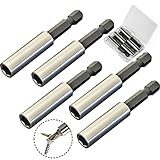

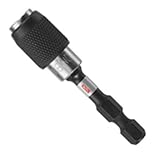
Which holder type fits the job?
| Type | Best use | Trade-off |
|---|---|---|
| Standard magnetic holder | Short screws and routine overhead fastening | Simple and inexpensive, but the magnet alone may not retain a screw during a tilted start |
| Impact-rated magnetic holder | Frequent use with an impact driver | Built for impact loading; usually costs more than a basic holder |
| Magnetic holder with sleeve | Longer screws, awkward starts, or repeated overhead work | The sleeve helps guide and support the screw but adds length and can limit access in tight spaces |
| Nonmagnetic holder with retaining collar | Fasteners that should not pick up metal debris | Mechanical retention can help, though the collar may not fit every screw head |
Choose for the driver and fastener
Check the holder’s shank and the tool’s chuck before buying. Most modern impact drivers accept 1/4-inch hex accessories, while a cordless drill’s keyless chuck can grip that same shank. An impact-rated holder is the safer choice for an impact driver, particularly if you will drive many screws or use the tool at high speed. For occasional work with a drill, a basic holder can be adequate.
Match the bit to the screw head as carefully as the holder. A Phillips bit that is slightly undersized can cam out, even if the magnet holds the screw. Use the correct driver style and size—such as Phillips, square, or Torx—and replace rounded bits. For a general-purpose upgrade, compare impact-rated magnetic bit holders. If the screw wobbles or drops as you position it, a holder with a screw-guide sleeve may be more useful than simply buying a stronger magnet.
A sleeve is especially helpful with longer screws because it supports the shank close to the work. It can also keep your fingers farther from the bit during starting. But sleeves reduce visibility and can be too bulky near a wall, cabinet, or bracket. If your work is mostly in open framing, that added guidance may pay off; for tight corners, a shorter holder often gives better access.
Set up for a controlled start
Use the shortest holder that gives adequate clearance. A longer extension increases leverage on the bit and makes it easier to start at an angle. Before raising the tool, seat the bit fully in the holder and place the screw squarely on the tip. Hold the fastener until it has caught the material by a few threads, then move your hand clear and drive at a controlled speed.
For thin sheet metal, cabinet hardware, or a screw near an edge, start slowly rather than squeezing the trigger fully. High speed can make a screw skate across the surface or strip its head before it bites. In wood, a pilot hole may prevent splitting near an edge; in masonry, select an anchor and bit sized for the specified hole rather than relying on the holder to compensate for a poor fit.
Magnets attract steel, not every fastener. Stainless screws may be weakly magnetic or nonmagnetic, depending on their alloy, and brass or aluminum fasteners will not be held by a magnet. For those, use a sleeve or a holder with mechanical retention, or start the fastener by hand. Even with steel screws, test the hold at bench height before working overhead.
Common failure modes and fixes
If the screw falls off, first clean metal filings and grease from the bit and holder. Debris can reduce contact, while an incompatible fastener may not respond strongly to the magnet. A damaged or weak magnet is another possibility. Try the screw with a clean driver bit before replacing the holder.
If the screw stays attached but starts crooked, the issue is usually alignment, excessive extension length, or a loose sleeve—not magnetic strength. Bring the tool perpendicular to the surface and let the screw catch at low speed. If the bit slips out of the head, change to the correct bit size instead of pressing harder; extra force can cam out the recess and make the next start less reliable.
Do not use a magnetic holder as a substitute for safe positioning. A screw that drops can still fall from the holder when the tool is bumped, and a long screw may be too heavy for a small magnet. Wear eye protection, keep bystanders clear, and use a platform that lets you hold the driver steadily rather than stretching from a ladder.
What to prioritize when buying
For occasional installation of a few steel screws, a basic magnetic holder is usually enough; paying extra for a sleeve or heavy-duty design may not improve the job. For regular overhead fastening, prioritize impact rating if using an impact driver, a secure bit fit, and a sleeve only when you need extra screw guidance. A small assortment of the right driver bits can matter more than the strongest magnet.
If you work with assorted screws, a magnetic holder set for impact drivers can provide different lengths for open and confined spaces. Check that the set includes the sizes you actually use and that the holders are explicitly described as impact-rated. More pieces are not an advantage if the extensions are too long for controlled overhead starts.