What's inside
As an Amazon Associate I earn from qualifying purchases. This post may contain affiliate links at no extra cost to you.
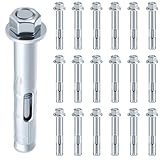
Sleeve anchors are a practical choice for fixing brackets to sound concrete when you need a through-bolt-style connection but do not need a heavy-duty concrete anchor. They expand as you tighten the nut, gripping the sides of a drilled hole. The right size depends on the bracket holes, the load, the concrete, and how much embedment you can get—not just the bolt diameter.
As an Amazon Associate we earn from qualifying purchases at no extra cost to you.



What we cover
When sleeve anchors fit
A sleeve anchor is a sensible option for light- to medium-duty brackets such as small shelving supports, conduit clips, and handrail brackets where the manufacturer permits this anchor type. It can also work in solid masonry, though performance in brick and block varies more than in concrete. For overhead loads, safety-critical work, or a bracket subject to repeated movement, use an anchor specifically rated for that application and follow its installation instructions.
Sleeve anchors are not a cure for weak concrete. A cracked edge, hollow block, thin slab, or loose surface layer can fail before the anchor does. If the bracket carries a person, guards machinery, or supports something that could cause injury if it falls, check the bracket and anchor ratings and local requirements rather than choosing by appearance.
Choose diameter and length
Match the anchor diameter to the bracket’s hole. Common sizes include 1/4 inch, 3/8 inch, and 1/2 inch, but the hole must allow the anchor to pass through without excessive slop. A larger anchor is not automatically stronger in a given installation: edge distance, concrete thickness, embedment, and installation quality all matter.
Choose a length that accounts for the bracket thickness plus the required embedment. For example, a 3/8-inch anchor that needs about 1-1/2 inches of embedment would need to be longer than 1-1/2 inches if the bracket itself is 1/4 inch thick. Use the anchor maker’s specified embedment and minimum hole depth; do not guess from the visible sleeve length. Leave enough room for the nut and washer, too.
Sleeve anchors compared with other options
| Anchor type | Good fit | Trade-off |
|---|---|---|
| Sleeve anchor | Brackets in sound concrete; moderate loads and straightforward through-hole installation | Needs a correctly sized, clean hole; less suitable near edges or in weak material |
| Wedge anchor | Higher-load fastening in sound, solid concrete when the anchor is approved for the job | Requires careful hole depth and edge spacing; generally a poor choice for hollow masonry |
| Concrete screw | Removable or adjustable fastening, including some lighter brackets | Capacity depends on the specific screw and concrete; installation torque matters |
| Plastic plug and screw | Very light-duty fixtures where failure has little consequence | Not a substitute for a rated concrete anchor under substantial loads |
For a basic bracket on good concrete, a sleeve anchor sized to the bracket hole is often enough. Stainless steel costs more but is useful in damp or corrosive locations; zinc-plated anchors are usually the cheaper choice for dry indoor work. Confirm that the material and coating suit the environment.
Drill the hole correctly
Use a hammer drill and a carbide-tipped masonry bit of the exact diameter specified for the anchor. A regular cordless drill may work slowly in soft masonry, but concrete usually calls for hammer action. If you need a tool for occasional anchor holes, a cordless hammer drill is more versatile than a dedicated rotary hammer; for many larger holes in hard concrete, a rotary hammer drills faster and with less effort.
Mark the hole through the bracket or use the bracket as a template. Check for pipes, wiring, and reinforcing steel before drilling. Keep the hole perpendicular to the surface, and drill to the depth specified by the anchor instructions—often deeper than the embedment so dust and the anchor tip do not bottom out. A depth stop or tape flag helps. Avoid drilling too close to an edge: the required edge distance varies by anchor and load, so use the manufacturer’s table rather than a universal rule.
Clear dust from the hole with a vacuum or the cleaning method specified by the anchor maker. Dust left at the bottom can prevent full seating and reduce grip. If the hole is oversized, chipped, or visibly crumbling, do not compensate by overtightening. Move the bracket if possible and drill a new hole at the required spacing.
Install and check the anchor
Place the bracket, insert the anchor through its hole, and tap it into the prepared concrete hole with a hammer until it is seated as directed. Fit the washer and nut, then tighten to the maker’s stated torque if one is given. Overtightening can strip threads, damage the concrete, or deform a light bracket; undertightening may leave the sleeve inadequately expanded. A cordless impact driver is convenient for running nuts down, but it makes it easy to exceed the proper torque. Finish with a hand wrench or a torque wrench when the specification calls for one.
After installation, check that the bracket sits flat and does not shift under a modest hand test. Do not use a loose anchor as a reason to keep tightening. Common failure signs include a spinning anchor, a nut that will not reach torque, a cracked concrete edge, or a bracket that rocks against the wall. Remove the load and reassess the hole, anchor type, and concrete before trying again.
A practical buying checklist
Before ordering, measure the bracket holes and thickness, confirm the concrete is solid, and look up the anchor’s drill-bit diameter, minimum embedment, spacing, and torque. Buy the correct count plus a few spares; a bit that wanders or a hole that catches aggregate can spoil an anchor. For a dry indoor bracket carrying little weight, an appropriately sized basic anchor is often the economical choice. Spend more for corrosion resistance or a different rated anchor only when the exposure or load calls for it.