What's inside
As an Amazon Associate I earn from qualifying purchases. This post may contain affiliate links at no extra cost to you.
What we cover
Best T-Track Hold-Down Clamps for Secure Workholding
For most router tables, drill-press fixtures, and shop jigs, the best t track hold down clamps are adjustable cam or lever clamps with a compatible sliding T-bolt, enough reach to clear the workpiece, and replaceable non-marring pads. Before choosing one, match the bolt to your track’s slot dimensions—not just its advertised track size—and check that the clamp can reach the work without bottoming out.
Quick picks by shop situation
- Frequent jig changes: Choose a lever- or cam-adjusted clamp that releases quickly and has a broad adjustment range.
- Occasional, low-cost workholding: A simple clamp with a threaded stud and hand knob is economical and easy to maintain.
- Low-clearance fixtures: Look for a compact clamp arm and a short stud; long knobs can interfere with fences or machine tables.
- Different track systems around the shop: Buy by measured slot dimensions or use a verified adapter. “Fits standard T-track” is not a reliable universal specification.
Comparison: what the numbers tell you
The figures below are practical screening ranges for common clamp styles, not guaranteed specifications for every model. Manufacturers define reach and capacity differently, and clamp force is rarely published in a directly comparable way. Confirm the exact drawing and hardware dimensions before buying.
As an Amazon Associate we earn from qualifying purchases at no extra cost to you.
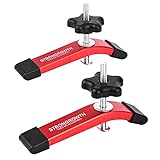
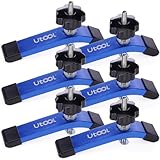


| Clamp style | Typical reach | Useful adjustment range | Track hardware | Holding and best use |
|---|---|---|---|---|
| Threaded hold-down with hand knob | About 2–4 in. (50–100 mm) | Often 1–2 in. (25–50 mm), depending on stud and arm | Sliding T-bolt or track nut; commonly 1/4-20 or 5/16-18 threads | High, controllable pressure when tightened sensibly; good for stationary setups |
| Cam or lever hold-down | About 2–3 in. (50–75 mm) | Usually a few millimeters of quick clamping travel; height set separately | Track bolt plus a cam or lever mechanism | Medium to high for repeatable work; useful when repositioning often |
| Compact low-profile clamp | About 1–2 in. (25–50 mm) | Short; best for consistent stock thicknesses | Short T-bolt or manufacturer-specific slider | Medium; minimizes obstruction around fences and machine tables |
| Long-reach adjustable fixture clamp | About 4–6 in. (100–150 mm) | Broad, often set by repositioning the arm or stud | Usually threaded hardware; check slot and bolt-head fit | Can hold larger work, but a long arm flexes more under the same load |
Reach is the distance from the track’s working edge to the contact pad, not simply the arm’s overall length. A longer arm can clear a wide workpiece, but it also increases leverage on the track and clamp. For a router table or drill press, place the clamp as close to the work as practical rather than choosing maximum reach by default.
Match the clamp to your T-track
T-track profiles vary in slot width, undercut, and depth. A clamp advertised for a 3/8-in. track may refer to the slot opening, the bolt size, or a particular track family. Those measurements are not interchangeable. Measure the slot opening and the internal channel, then compare them with the T-bolt head or sliding nut dimensions in the clamp’s drawing.
Thread size is another compatibility check. A 1/4-20 bolt will not screw into a 5/16-18 clamp assembly, even if its head slides into the track. Metric and imperial threads can look close enough to start but bind or damage the threads. Keep track-specific bolts with each fixture, and avoid forcing a bolt that catches.
For a simple fit check, slide the hardware into the track without the clamp attached. It should move without rocking excessively, and its head must remain captured when pulled upward. If the bolt head is too wide, it will not enter; if too narrow, it may twist or pull through. Check the manufacturer’s compatibility information when the track is proprietary or unusually narrow.
Choose by workpiece and adjustment needs
For repeatable thicknesses and frequent repositioning
A cam or lever hold-down is convenient when you move stops or change workpieces often. Set the clamp height for the stock, then use the lever for quick release and engagement. These are a strong choice for production-style jigs, but verify that the mechanism offers enough vertical setup range for both thin panels and thicker stock.
For varied stock thicknesses and controlled pressure
A threaded knob clamp is slower, but its pressure is easier to dial in. It suits occasional routing, drilling, sanding, and assembly fixtures where you may clamp different thicknesses. Avoid overtightening: excessive force can bow a thin workpiece, dent soft wood, or pull a poorly anchored track out of a sacrificial top.
For narrow tables and crowded fixtures
Choose a short-reach, low-profile arm if a fence, cutter guard, or machine column limits clearance. Confirm that the knob can turn through a full tightening arc. A clamp that technically fits but collides with the fence is likely to be left loose or removed when it is most needed.
For broad workpieces
Long-reach clamps can span a wider gap, but place the track close enough to the work that the arm does not act like a spring. If the arm visibly deflects while tightening, use a shorter reach, add another clamp, or move the track. A pair of well-positioned clamps is often more stable than one clamp at maximum extension.
Setup details that improve holding strength
- Position the pad over solid support. Clamping near an unsupported edge can bend thin stock rather than secure it.
- Keep the arm level or slightly angled toward the work. A steep angle can make the pad slide sideways as pressure increases.
- Use a sacrificial pad for delicate surfaces. Replaceable rubber, cork, or polymer pads help reduce marks, but they should be clean and free of embedded chips.
- Use two clamps for long or rotationally unstable stock. This reduces twisting, especially during drilling or routing.
- Keep hands clear of cutters and drill bits. Confirm the clamp cannot enter the tool’s path before switching on the machine.
For a quick sizing check, measure from the track edge to the farthest point that needs clamping. If that distance is 2 1/2 in. (64 mm), a clamp with only 2 in. of usable reach will not work, even if its arm is longer overall. Allow additional clearance for the pad and any fence or stop that sits between the track and workpiece.
Durability and ownership
On threaded clamps, the first problems are often damaged threads, a lost T-bolt, or a worn contact pad—not a broken arm. Keep threads free of sawdust and resin, and do not use pliers on hand knobs. On lever clamps, inspect the cam surface, pivot, and spring or retaining hardware for looseness. Replace worn pads before the metal arm can mark the work.
After a dusty session, brush chips out of the track and wipe the sliding hardware. Resin buildup can make a clamp feel tight while preventing its bolt from seating fully. Store loose bolts with their matching clamps; a nearly fitting replacement can damage the track or create an insecure setup.
Bottom line
For a general-purpose shop, start with a threaded hold-down clamp offering roughly 2–4 in. of reach and a replaceable pad, then buy the correct T-bolt for your actual track. Choose a cam or lever version if quick repositioning matters more than fine pressure control, and a compact clamp when clearance is tight. In every case, track fit, usable reach, and a stable setup matter more than a large advertised holding-force number.