What's inside
As an Amazon Associate I earn from qualifying purchases. This post may contain affiliate links at no extra cost to you.
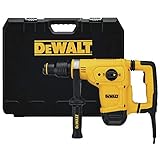
The right DeWalt SDS Max hammer drill is the one whose impact energy matches your largest recurring hole: roughly 6–8 joules for anchors up to about 1-1/4 inch, around 10.5 joules for mixed drilling and regular chisel work, and 13 joules or more for 1-1/2-inch-plus holes, coring, and sustained chipping. Buy below that band and the tool stalls on big bits; buy above it and you carry weight and cost you never use.
Two clarifications before the numbers. First, what most people casually call a DeWalt “SDS hammer drill” is technically a rotary hammer — a pneumatic piston mechanism that hits far harder than a chuck-type hammer drill. Second, in DeWalt’s cordless lineup, SDS Max lives only on the 60V MAX FlexVolt platform. Every DeWalt SDS hammer drill on 20V MAX batteries — sold as the 18V XR line outside North America — uses the smaller SDS Plus system, which we cover at the end of this article.
As an Amazon Associate we earn from qualifying purchases at no extra cost to you.



What we cover
DeWalt’s SDS Max lineup compared
The table below lines up the current SDS Max range by the three numbers that actually decide a purchase: impact energy in joules, maximum drilling diameter in concrete, and tool weight. Figures are manufacturer specs; cordless weights are bare tool without battery or bit.
| Model | Power source | Impact energy | Max concrete bit dia. | Optimal drilling range | Approx. weight | Sweet spot |
|---|---|---|---|---|---|---|
| DCH481 (60V MAX) | FlexVolt battery | ~6 J | 1-9/16″ | ~5/8″–1-1/4″ | ~10 lb | Cordless anchor drilling, occasional light chiseling |
| D25501K | Corded | ~8 J | 1-9/16″ | ~5/8″–1-3/8″ | ~12 lb | Daily anchor and rebar-dowel drilling, unlimited runtime |
| DCH614 (60V MAX) | FlexVolt battery | ~10.5 J | 1-3/4″ | ~3/4″–1-3/8″ | ~14 lb | Anchors plus real chipping duty without a cord |
| D25733K | Corded | ~10.5 J | 1-7/8″ | ~3/4″–1-5/8″ | ~14 lb | Anchor production plus weekly chisel work; anti-rotation clutch |
| DCH733 (60V MAX) | FlexVolt battery | ~13 J | 1-7/8″ | ~7/8″–1-5/8″ | ~17 lb | Big holes and coring where power isn’t available |
| D25773K | Corded | ~19 J | 2″ (cores to ~4″) | ~1″–1-7/8″ | ~20 lb | Deep doweling, coring, hardest breaking short of a demo hammer |
Read the “optimal range” column, not the max column. Every rotary hammer drills its rated maximum occasionally, but it lives inside the optimal band — that’s where blow rate (typically around 2,700–3,300 BPM on this class) and energy combine for fastest penetration and least wear on the tool holder.
Match the joules to the job
Anchors up to 1-1/4 inch: 6–8 joules
If your week is wedge anchors, sleeve anchors, drop-ins, and rebar doweling in the 3/8″–1-1/4″ range, the 6–8 J tools are the fastest option, not the weakest. The DCH481 cycles quicker on mid-size holes than the big hammers because it’s lighter to position, and the corded D25501K runs all day for production drilling. Chipping capacity at this weight class is honest but limited: thinset removal, small mortar spots, and cleanup work — not slab breaking.
Mixed drilling and weekly chisel work: ~10.5 joules
This is the sweet spot for remodelers, plumbers, and mechanical contractors. At 10.5 J — the DCH614 on battery or the D25733K on cord — you can push 3/4″–1-5/8″ holes all day and swing a scaling or bull-point chisel meaningfully: tile and mortar-bed removal, channel chasing for conduit, and knocking back pour lines and footings edges. The D25733K adds DeWalt’s anti-rotation system, which matters when a 1-1/2″ bit bites rebar — the clutch disengages instead of wrenching your wrist.
Coring, big dowels, and breaking: 13–19 joules
Once 1-1/2-inch-plus anchors, deep dowel holes, or 2–4″ cores become routine, step to the DCH733 (~13 J, cordless) or the D25773K (~19 J, corded). The D25773K is effectively a light breaker that also drills — it will remove real material on a chisel. One honest caveat: if breaking is the main job, meaning hours of chipping per day rather than per week, a dedicated SDS Max demolition hammer (DeWalt’s D25901K-class tools) will outlast any rotary hammer doing the same work. Rotary hammers are built to drill first.
When SDS Max is the wrong tool entirely
Most searches for a DeWalt SDS hammer drill on 20V — or a DeWalt 18V SDS hammer drill, which is the same platform labeled 18V XR in Europe — land on SDS Plus tools, and that’s correct for a lot of users. The DCH273 (1″ SDS Plus, ~2.1 J) and DCH293 (1-1/8″ SDS Plus, ~3.5 J) weigh around 6–7 pounds, take far cheaper bits, and handle everything up to roughly 5/8″ anchors without drama. If your largest recurring hole is under an inch and only occasionally reaches 1-1/8″, SDS Plus is the right system; SDS Max bits and chisels simply won’t fit, and adapters waste energy and wear the holder. SDS Max starts earning its weight when 3/4″+ holes or chisel work show up weekly.
One trap to avoid: DeWalt’s legacy 18V NiCad-era tools use a completely different battery mount than today’s 18V XR / 20V MAX lithium line. If you’re buying into the system now, buy lithium — and know that a FlexVolt SDS Max battery also runs your 20V tools.
Your situation, matched to a model
| Your situation | Best fit | Why |
|---|---|---|
| A few dozen anchors a month, holes ≤1″, already own 20V batteries | 20V SDS Plus (DCH273/DCH293) | Cheaper, half the weight, uses batteries you own |
| Daily 5/8″–1-1/4″ holes on sites with power | D25501K | 8 J, unlimited runtime, lowest cost per hole |
| Same holes on lifts, rooftops, or unfinished slabs | DCH481 (or DCH614 if chipping too) | 6 J cordless; steps up to 10.5 J if chisel work is weekly |
| Anchors plus tile, mortar, or channel removal every week | DCH614 / D25733K | 10.5 J handles both modes without a second tool |
| 1-1/2″+ anchors, 2–4″ cores, frequent breaking | DCH733 (cordless) / D25773K (corded) | 13–19 J; anything less stalls on core bits |
| Breaking and demolition is the primary job | Dedicated SDS Max demo hammer | Purpose-built breakers outlast rotary hammers on all-day chisel work |
Ownership realities: wear, consumables, and mistakes
- Grease is a consumable. Re-grease bit shanks every few holes on big bits. Dry shanks wear the tool holder, and a worn holder lets bits wobble and mushroom — the most common early failure on SDS Max tools.
- Corded models have replaceable carbon brushes; the FlexVolt brushless tools don’t. Corded is cheaper to keep alive for a decade; cordless trades that for battery economics — a bare tool plus two high-capacity FlexVolt packs typically adds a few hundred dollars over the corded equivalent.
- Bit costs scale with the system. A quality SDS Max bit runs roughly 1.5–2x the price of an equivalent SDS Plus bit, and chisels follow the same ratio. If your holes don’t need SDS Max, your consumables don’t either.
- Dust extraction isn’t optional for pros. OSHA silica rules require engineering controls on handheld concrete drilling — DeWalt sells onboard shrouds and extractor-ready setups for these hammers. Factor it into budget.
- Common mistakes: running a 19 J hammer on finish work (it destroys surfaces and tires you out), pushing hard instead of letting the hammer’s weight do the cutting, ignoring the anti-rotation clutch’s warnings on rebar hits, and forcing a dull bit — which transfers abuse straight into the holder.
On cost per use: a corded SDS Max in the $400–600 class, amortized over years of weekly drilling, works out to pennies per hole. Cordless is worth the premium when it replaces a generator, a 200-foot cord, or a second trade waiting on you — not as a default upgrade.
FAQ
Can a DeWalt 20V SDS drill handle 3/4-inch anchor holes?
Occasionally, yes — SDS Plus tops out around 1-1/8″, so a 3/4″ hole is within capacity but near the working edge. It will drill slower and drain batteries faster than an SDS Max in the 6–8 J class. A few such holes per job: fine. A pattern of them: buy the bigger hammer.
Are the “18V” and “20V” DeWalt SDS drills different tools?
No — 18V XR (European labeling) and 20V MAX (North American labeling) are the same lithium-ion platform with the same cells; the number differs only by how the voltage is quoted. The genuinely different system is DeWalt’s discontinued 18V NiCad/NiMH line, which uses a different battery interface.
Will SDS Plus bits fit an SDS Max hammer with an adapter?
Adapters exist, but the fit runs loose, energy transfer drops, and the small SDS Plus shank wasn’t built for 10+ joule impacts — shanks mushroom and snap. If you own both systems, keep each hammer on its own bits; that’s what the two shank standards are for.