What's inside
As an Amazon Associate I earn from qualifying purchases. This post may contain affiliate links at no extra cost to you.
A standard drill bit and a hole saw can both make holes, but they solve different problems. Drill bits cut a relatively small opening with their tip and cutting edges. A hole saw cuts around the edge of a larger circle, leaving a solid plug in the middle. Choosing between them comes down to the opening’s diameter, the material, and how clean or deep the cut needs to be.
As an Amazon Associate we earn from qualifying purchases at no extra cost to you.


What we cover
Choose by hole size and purpose
For screw holes, pilot holes, and openings up to roughly 1/2 inch (13 mm), a regular drill bit is usually the right tool. Twist bits work for many wood and metal jobs; masonry bits are made for brick, block, and concrete. Use the bit type and speed recommended for the material rather than forcing a general-purpose bit through everything.
For a larger circular opening—such as a pipe pass-through, recessed light, or cabinet hardware—a hole saw is often faster and neater than drilling a ring of small holes and trying to clean out the center. Common hole saw sizes range from about 3/4 inch to 6 inches or more. Check the saw’s actual diameter against the fitting: a pipe opening generally needs enough clearance to install the pipe, not a hole that matches its outside diameter exactly.
If you only need one large hole and already have a jigsaw, that may be cheaper, especially in thin sheet material or a panel where a perfectly round edge is not critical. A hole saw is the better choice when you need a consistent circle or have limited room for a jigsaw.
Drill bit vs. hole saw
| Factor | Drill bit | Hole saw |
|---|---|---|
| Typical opening | Small holes, commonly up to about 1/2 inch | Larger circular holes, often 3/4 inch and up |
| How it cuts | Removes material across the hole | Cuts a circular kerf and leaves a central plug |
| Best uses | Pilot holes, fasteners, small pass-throughs | Pipe, cable, hardware, and fixture openings |
| Setup | Usually just the bit | Saw cup, arbor, and usually a pilot bit |
| Main trade-off | Limited diameter | Slower, more torque, and more risk of binding |
What to buy
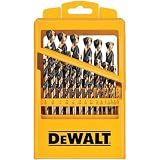
For everyday small holes, a basic set of drill bits for wood and metal covers more jobs than a hole saw kit. Match the material: wood bits often have a center point to reduce wandering, while metal-cutting bits benefit from a slower speed and cutting fluid on tougher stock. Masonry bits are not a substitute for wood or metal bits, and hammer action should be used only when the bit and material are suitable for it.
If the job calls for one or two large holes, buy the hole saw size or kit you actually need. A kit can be economical if you expect to use several diameters, but a large assortment is wasted money if one hole is all you need. Check the kit’s maximum cutting depth and whether it includes an arbor compatible with your drill. For repeated work in wood, a bi-metal hole saw is a versatile option for wood and some metals; it is not the right cutter for every masonry or tile application.
Use the drill that can control the cut
Small bits need modest torque, but large hole saws can grab suddenly. Use a variable-speed drill with a firm side handle when the saw is large or the material is thick. A cordless drill can handle occasional holes if its battery and chuck are in good condition; repeated large cuts can drain a battery quickly. An impact driver is generally a poor choice for hole saws: its short, forceful impacts make a catch harder to control and can damage the arbor or workpiece. Hammer mode is for suitable masonry drilling, not for cutting with a hole saw.
Clamp the work, wear eye protection, and keep hands clear of the saw’s path. Start at a controlled speed and keep the saw square to the surface. If it binds, release the trigger and back it out rather than twisting the drill against a stuck cup. For a thin panel, a sacrificial backing board helps limit splintering as the pilot bit and teeth exit. For a deep cut, clear chips periodically; packed chips create heat and can stall the saw.
Avoid the common failure modes
The main risk with a hole saw is kickback when its teeth catch, particularly in knots, uneven material, or a tilted cut. A drill without a side handle is harder to control. Large saws also need enough clearance behind the work for the pilot bit and saw cup; check for wiring, pipes, and framing before cutting a wall or ceiling. A basic detector can help, but it does not guarantee that a cavity is clear.
Another common problem is choosing a saw that is too shallow. The cut may stop before the plug releases, leaving a hot cup trapped in the kerf. Some hole saws have slots for clearing the plug; use them carefully with the drill stopped. For thick stock, cutting from both sides can produce a cleaner opening, but align the cuts precisely to avoid a stepped edge.
For masonry, use a cutter specifically rated for the material rather than assuming a standard wood-and-metal hole saw will work. Tile is especially easy to crack: use a tile-rated bit or saw, follow its speed and cooling requirements, and avoid hammer action. If the opening is for a wall anchor, check the anchor’s specified drill diameter instead of sizing the hole by guesswork. A hole that is too large can leave the anchor spinning or pulling out; one that is too small can split the material or prevent the anchor from seating.