What's inside
- Drill Router Attachments: What They Do and Which Fits Your Drill
- What a drill-powered router attachment can—and can’t—do
- Compare the fit before comparing the price
- Which setup fits your situation?
- Check these four points before you buy
- Setup and use: a conservative approach
- Ownership realities: what tends to wear or go wrong
- Drill Router Attachments: What They Do and Which Fits Your Drill
- What a drill-powered router attachment can—and can’t—do
- Compare the fit before comparing the price
- Which setup fits your situation?
- Check these four points before you buy
- Setup and use: a conservative approach
- Ownership realities: what tends to wear or go wrong
As an Amazon Associate I earn from qualifying purchases. This post may contain affiliate links at no extra cost to you.
What we cover
- Drill Router Attachments: What They Do and Which Fits Your Drill
- What a drill-powered router attachment can—and can’t—do
- Compare the fit before comparing the price
- Which setup fits your situation?
- Check these four points before you buy
- Setup and use: a conservative approach
- Ownership realities: what tends to wear or go wrong
Drill Router Attachments: What They Do and Which Fits Your Drill
A drill router attachment can guide a compatible drill for light edge shaping or small decorative cuts, but it is not a substitute for a purpose-built router when you need reliable speed, depth control, or sustained cutting power. Choose one only after checking how it mounts, which bits it accepts, the drill’s speed range, and whether the work is light enough to control safely.
What a drill-powered router attachment can—and can’t—do
Most attachments provide a base or guide that helps hold a drill upright while its rotating bit cuts wood. Depending on the design, it may help with simple edge profiles, shallow grooves, or small trimming jobs. Some are better thought of as drill guides with a routing-style base than as true router bases.
As an Amazon Associate we earn from qualifying purchases at no extra cost to you.
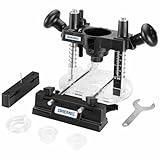
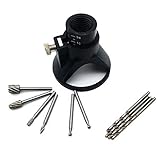

The key limitation is speed. Drills are designed primarily to turn a bit at a controlled speed with torque; routers commonly run at much higher speeds and are built to keep a cutter stable under side load. A drill attachment may therefore leave rougher edges, chatter, burn wood, or pull off course—especially in hardwood, deep cuts, or long continuous passes. It is a poor choice for large roundovers, precise joinery, deep dadoes, or repeated production work.
A router attachment for a drill is most plausible for occasional, shallow work in softwood or plywood, with a small cutter and a drill that fits the attachment securely. If the job demands a clean, repeatable profile, a trim router or fixed-base router is usually the better purchase.
Compare the fit before comparing the price
There is no universal drill-router standard. Attachments differ in clamp diameter, mounting method, base size, and collet or chuck requirements. The figures below are practical screening ranges, not specifications for every model; verify the exact attachment and drill manuals before buying.
| Check | Drill-router attachment: common range or condition | Dedicated trim router: typical comparison | Why it matters |
|---|---|---|---|
| Drill fit | Often clamps around a drill body; some designs require a particular neck or collar diameter. Measure the drill at the mounting point. | Router and base are designed as a matched unit. | A loose or mismatched clamp can let the tool tilt or shift during a cut. |
| Bit shank | Usually limited by the drill chuck or a supplied collet; commonly 1/4 in (6.35 mm) if explicitly supported. | Many trim routers accept 1/4 in shanks; some larger routers also accept 1/2 in (12.7 mm). | Never assume a drill chuck safely holds every router bit. Follow the attachment’s stated shank and bit limits. |
| Rotational speed | Common drill settings span roughly 0–500 rpm on low gear and 0–1,500 or 0–2,000 rpm on high gear; actual maximum varies. | Many trim routers operate around 10,000–30,000 rpm, often with variable speed. | Low speed can produce a poor cut, while an unsuitable bit at excessive speed can be hazardous. Use only speeds approved for the bit and tool. |
| Cut depth and control | Depth adjustment may be limited, coarse, or dependent on the drill’s position. | Typically offers a stable base and a designed depth-adjustment mechanism. | Repeatable depth is essential for grooves, flush trimming, and matching multiple parts. |
| Typical work | Occasional shallow cuts in suitable stock, if the manufacturer permits the setup. | Regular edge work, cleaner profiles, and more controlled routing. | Match the tool to the required finish and frequency, not just the lowest purchase price. |
Those speed figures are comparison context, not a recommendation to run a particular cutter at a particular rpm. Bit diameter, material, cut depth, and the manufacturer’s limits all matter. Do not compensate for a slow drill by forcing the feed; that can stall the drill or make the cutter grab.
Which setup fits your situation?
| Your situation | Better fit | Reason |
|---|---|---|
| One or two shallow cuts, tight budget, already own a compatible drill | Consider an attachment only if its manual approves your drill and the intended bit and material. | It may avoid buying another tool, but expect more limits on speed and control. |
| Beginner who wants a predictable first routing setup | A dedicated trim router with a stable base and clear depth adjustment. | Its controls and mounting are designed around routing rather than adapted from a drill. |
| Very limited storage and infrequent, noncritical work | An attachment can be a space-saving option if it fits securely. | It uses a drill you already store, but does not remove the need for suitable bits and safe workholding. |
| Frequent edge profiling, hardwood, long passes, or matching parts | A dedicated router, selected for the bit and work required. | Better speed and base stability make repeatable cuts more practical. |
| Large cutters, deep cuts, or precision joinery | Do not rely on a drill attachment; choose a router and setup rated for the task. | These jobs place greater demands on speed, bearing support, depth control, and cutter stability. |
Check these four points before you buy
- Mounting: Measure the drill where the attachment clamps, not just across the widest part of its housing. Check that the attachment can hold the drill square and cannot rotate under load. A handle, battery, or switch may also obstruct the base.
- Bit compatibility: Confirm shank diameter, maximum cutter diameter, and whether the attachment uses a chuck or collet. A drill’s chuck capacity is not proof that it is suitable for a router bit. Do not use damaged, loose, or unapproved cutters.
- Speed: Check the drill’s top speed and whether the attachment or bit maker specifies a minimum or maximum. If the drill cannot reach the required speed, skip the job rather than making a slower, heavier cut.
- Cutting control: Look for a broad, flat base, a usable fence or guide, and a repeatable depth setting. A small or unstable base is especially unforgiving at the edge of narrow stock.
Setup and use: a conservative approach
Before cutting, read both manuals and confirm the proposed combination is permitted. Unplug a corded drill or remove its battery while installing the attachment and bit. Check that the bit is seated to the specified depth, the chuck or collet is fully tightened, and the attachment cannot shift. Secure the workpiece on a stable surface; never try to steady small stock by hand near a spinning cutter.
Make a shallow test cut in scrap of the same material. Keep the base flat, use the guide as intended, and take multiple light passes rather than trying to remove a lot of material at once. Stop if the drill slows sharply, the attachment vibrates, the bit chatters, or the cut begins to wander. Wear eye and hearing protection, keep hands clear of the cutter, and wait for it to stop fully before setting the tool down.
Ownership realities: what tends to wear or go wrong
The first problems are often a loose mounting fit, a drill chuck that does not hold the bit securely under side load, or a cutter that dulls after use in abrasive sheet goods. Dust can collect around the base and adjustment parts, making the attachment harder to seat or move accurately. After use, remove dust with a brush or vacuum, inspect the clamp and fasteners, and check bits for resin, damage, or looseness. Replace damaged cutters rather than trying to sharpen or reuse them beyond their design.
A common mistake is treating the attachment as a cheaper equivalent to a router. Its value depends on the job: if it only saves money for a cut that comes out rough or unsafe, it is not a bargain. For occasional light work, a compatible attachment may be useful; for routine routing, a dedicated router is the more dependable choice.