What's inside
As an Amazon Associate I earn from qualifying purchases. This post may contain affiliate links at no extra cost to you.
What we cover
Quick Answer
For most home shops, the best grizzly router table is the one that matches your floor space first and your router second: Grizzly’s benchtop models (around 24″ x 24″ tops) suit garages and occasional trim work, while the floor-standing and sliding-table versions earn their footprint only if you’re running cope-and-stick doors, raised panels, or long rails weekly. Before comparing features, note that specs below reflect Grizzly’s published listings and can shift between production runs, so confirm dimensions on the product page before ordering.
Grizzly Router Table Comparison: Key Specs
| Model | Top Size (approx.) | Stand | Fence | Router Mounting | Best For |
|---|---|---|---|---|---|
| Benchtop router table (T1240 class) | ~24″ x 18″ | None — sits on bench | Adjustable aluminum, split faces | Insert plate, fits most fixed-base routers | Apartments, small shops, edge profiles |
| Floor-stand router table (T32016 class) | ~34″ x 13″ or larger laminate top | Steel stand, ~34″ working height | Taller extruded fence, T-track for featherboards | Plate or router lift; check insert ring size | Dedicated shop, cabinet and frame work |
| Sliding router table (H7583 style) | Larger composite top with miter slide | Floor stand with lower shelf | Fence plus sliding carriage for crosscuts | Insert plate | Coping rail ends, tenons, precision crosscuts |
| Extension wing table (T10222 class) | Adds ~27″ x 11″ to saw wing | Mounts to cabinet saw rail | Often pairs with saw’s rip fence | Insert plate | Zero-extra-footprint shops with a Grizzly table saw |
Decision Matrix: Which Situation Are You In?
| Your situation | Recommended pick | Why |
|---|---|---|
| Under 150 sq ft shop, work on a folding bench | Benchtop model | Stores on a shelf; 24″ top handles rails up to ~30″ comfortably |
| Occasional trim, round-overs, dados on weekends | Benchtop model | Lower cost per use; a floor stand at ~2 uses/month takes years to pay back in convenience |
| Building raised-panel or cope-and-stick doors | Floor-stand model with lift | Taller fence supports 3″+ stock vertically; lift lets you change bits above the table |
| Shaker-style doors: coping rail ends is the pain point | Sliding router table | The sliding carriage holds the rail square to the bit — no coping sled clamping drama |
| Already own a Grizzly cabinet saw, space is tight | Extension wing | Shares the saw’s fence rail and footprint; adds ~$0 of floor-space cost |
| Rough lumber, large panels, frequent bit changes | Largest floor model + 3 HP-class router | Bigger top supports workpiece ends so they don’t tip off mid-pass |
Tabletop Size: How Much You Actually Need
The spec that matters isn’t raw square inches — it’s front-to-back depth plus fence travel. A 24″ deep top with a fence that opens to 3–4″ handles the widest realistic cut (large raised-panel bits run 3–3.5″ diameter). Width matters for outboard support: cope-and-stick rails up to 36″ long benefit from a 30″+ wide top or a side support stand.
As an Amazon Associate we earn from qualifying purchases at no extra cost to you.
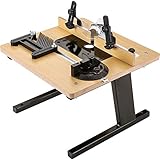

- Under 24″ wide: fine for edge profiles on stock under 24″ long; add a roller stand for anything longer.
- 24–34″ wide: the sweet spot for cabinet doors and face frames.
- Sliding tables: the moving carriage does what fence width can’t — it carries the workpiece across the bit squarely, which is the real grizzly sliding router table advantage. If door frames are your main work, this beats a bigger static top.
Fence and Lift Compatibility: Check Before You Buy
Grizzly fences are generally aluminum extrusions with movable MDF or phenolic sub-faces you cut a zero-clearance opening into — a real benefit since a tight opening around the bit reduces tear-out and chip blowback. Two checks before committing:
- T-track spacing. If you want aftermarket featherboards, miter gauges, or coping sleds, verify the track accepts standard 3/4″ x 3/8″ accessories; Grizzly’s are typically standard, but older runs vary.
- Plate vs. lift. Entry models mount your router’s fixed base directly to an insert plate — cheap and fine for 1–2 HP routers, but bit changes mean reaching under the table. A proper router lift (Grizzly and third-party lifts fit the common ~9¼” x 11¾” plate opening) pays for itself if you change bits more than once a session; plan on the lift costing as much as an entry benchtop table.
- Insert ring bore. Confirm the largest ring opening clears your biggest bit — 3.5″ panel raisers need a ring opening close to 4″.
Storage, Dust, and Assembly Realities
- Storage: Floor stands with enclosed cabinets keep bits and wrenches dust-free; open-leg stands lose that but cost less. Benchtop units hang on a wall — a genuine win in tight shops.
- Dust collection: A 2½” fence port plus a 4″ cabinet port catches most chips; fence-only collection leaves the underside spewing. Budget a shop vac minimum, a dust collector if the cabinet is enclosed.
- Assembly time: Benchtop tables go together in under an hour. Floor-stand and sliding models typically take 2–4 hours — the sliding carriage needs careful squaring, and it’s worth spending the time because a 0.5° carriage error telegraphs into visibly gap-prone cope joints.
- What wears first: MDF fence faces get chewed by the bit (that’s their job — keep spares or make them from scrap). Leveling screws on insert plates vibrate loose; check them every few months. Laminate tops last years, but moisture from cold garages can swell edges — seal raw edges when assembling.
The Cost-Per-Use Calculation
A benchtop setup (table + mid-size router, roughly $200–$400 market range) used twice monthly costs under $1 per session over ten years. A floor-stand table plus lift plus 3 HP router (roughly $700–$1,200 combined) only matches that value if you’re in the shop weekly — at that frequency, the lift’s above-table bit changes save perhaps 10 minutes per session, or ~8 hours a year, which is what justifies the spend.
Bottom Line
Match the model to your dominant project type: edge work and occasional use — benchtop; cabinets and raised panels weekly — floor-stand with a lift; lots of cope cuts on rails — the sliding version; tight shop with a Grizzly saw — the extension wing. Verify plate opening, T-track standard, and largest ring bore against your actual bits before ordering, and the table will serve you for a decade or more.