What's inside
As an Amazon Associate I earn from qualifying purchases. This post may contain affiliate links at no extra cost to you.
What we cover
Choosing the Right MillerMatic Welder: The Quick Answer
If you want a MIG welder for automotive and general shop work, the Millermatic 211 is the model most buyers should choose — it runs on either 120V or 240V power via Auto-Set, welds mild steel up to 3/8″ in a single pass on 240V, and typically sells in the $1,300–$1,600 range. For garage-only 120V work, the Millermatic 141 costs less and handles 24-gauge to 3/16″ steel. For serious shop duty and aluminum, the Millermatic 252 steps up to a true 250-amp output with a dedicated spool gun.
The right answer for your shop depends on four things: the power you have available, the thickest material you’ll weld regularly, how long you need to weld continuously (duty cycle), and whether a spool gun for aluminum is in your future. This guide maps each popular Millermatic model to those criteria.
As an Amazon Associate we earn from qualifying purchases at no extra cost to you.
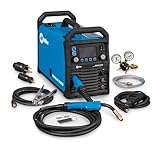

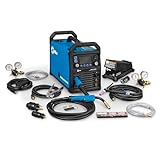

Millermatic Model Spec Comparison
| Model | Input Power | Output Range | Max Mild Steel Thickness | Duty Cycle | Weight | Typical Price Range |
|---|---|---|---|---|---|---|
| Millermatic 141 | 120V | 30–140 A | 3/16″ (single pass) | 20% @ 90A | 51 lb | $900–$1,100 |
| Millermatic 190 | 120V / 240V | 30–190 A | 5/16″ | 30% @ 130A (240V) | 44 lb | $1,100–$1,400 |
| Millermatic 211 | 120V / 240V (Auto-Set MVP plug) | 30–230 A | 3/8″ | 40% @ 150A (240V) | 38 lb | $1,300–$1,600 |
| Millermatic 220 | 240V (multiprocess: MIG/TIG/stick/flux-core) | 20–250 A | 1/2″ (MIG) | 60% @ 200A | 56 lb | $2,300–$2,800 |
| Millermatic 252 | 240V | 30–300 A | 1/2″ | 60% @ 200A | 207 lb | $3,000–$3,600 |
Duty cycle is measured over a 10-minute window: 40% at 150 amps means 4 minutes of welding followed by 6 minutes of cooling. At lower amperage, every machine on this list welds effectively continuously.
Match the Machine to Your Situation
Weekend DIYer on 120V household power
The Millermatic 141 plugs into a standard household outlet and welds sheet metal, exhaust tubing, and light frames up to 3/16″. Its Auto-Set control means you dial in material thickness and wire size, and it picks voltage and wire feed speed for you — genuinely useful for beginners. The limitation isn’t just thickness: a 15-amp household circuit can restrict output, so a dedicated 20-amp circuit is worth having an electrician install.
Home shop with 240V available (or planned)
The Millermatic 211 is the sweet spot. The MVP plug swaps between 120V and 240V in seconds — weld at a friend’s house on 120V, then come home and get full power. On 240V it handles 3/8″ steel, enough for trailer repairs, gates, and equipment fabrication. It’s also the lightest machine in its class at 38 lb, which matters if you ever carry it anywhere.
The 190 sits just below it: slightly less output, often a few hundred dollars cheaper, and a solid choice if 3/8″ capacity is overkill for your work.
Serious fabrication or small business
The Millermatic 252 is the workhorse — a transformer-class machine rated for half-inch steel and 60% duty cycle at 200 amps, meaning it will outweld your patience. It’s built to pair with the Spoolmatic 30A spool gun for aluminum. The tradeoff is weight (207 lb) and a firm 240V, 30-amp requirement.
The Millermatic 220 multiprocess is the alternative if you also need stick or TIG capability. If you’ll only ever MIG, the 252’s heavier build and longer duty cycle serve better at sustained high output.
Decision Matrix
| Your Situation | Best Pick | Why |
|---|---|---|
| Only 120V outlets; auto body, sheet metal | Millermatic 141 | Runs on household power; Auto-Set is beginner-friendly |
| 240V outlet or willing to add one; mixed garage work | Millermatic 211 | Best capacity-per-dollar; portable; dual voltage |
| Regular welding on 1/4″–1/2″ plate or production work | Millermatic 252 | 60% duty cycle at 200A; built for spool gun aluminum |
| Need MIG, TIG, and stick in one machine | Millermatic 220 | Multiprocess flexibility without multiple machines |
| Aluminum boat repairs, bicycle frames | 211 + Spoolmate 150, or 252 + Spoolmatic 30A | Spool gun feeds soft aluminum wire reliably; standard liner won’t |
What the Spec Sheet Doesn’t Tell You
- Wire and gas are real costs. MIG with solid wire requires C25 shielding gas (75% argon / 25% CO₂). A 80 cu ft refillable cylinder runs roughly $60–$90 per fill depending on region, plus the cylinder purchase or lease. Flux-core wire skips the gas but produces more spatter and slag — fine for outdoor repairs, messy for auto body work.
- Consumables wear in a predictable order. Contact tips go first — expect to replace them every few pounds of wire, and keep a dozen on hand ($10–$15 for a pack). Nozzles clog with spatter; clean them regularly. Liners last years on steel but contaminate if you run aluminum through them — dedicate a separate liner or gun.
- Auto-Set isn’t a crutch to avoid. On the 141 and 211, Auto-Set produces workable settings for standard joints. Experienced welders often fine-tune from there anyway — treat it as a starting point, not a ceiling.
- Buy the cart on day one. Even the 38 lb 211 becomes awkward with a gas cylinder attached. Miller’s running gear keeps bottle and machine together and costs less than a secondhand tip-over incident.
- The common beginner mistake is buying too small. Buyers who outgrow a 120V-only machine end up paying for two welders. If you have any path to 240V power, the dual-voltage 211 is worth the $300–$400 premium over the 141 for that reason alone.
What’s in the Box — and What You’ll Need to Add
Millermatic packages typically include the power source, a MIG gun (10–15 ft depending on model), work cable and clamp, gas regulator/flow gauge, and a sample spool of wire with contact tips. Notably not included: the gas cylinder itself, a welding helmet, gloves, and — on most models — a spool gun for aluminum.
A realistic first-day budget beyond the welder: $150–$250 for an auto-darkening helmet, $100–$200 for a gas cylinder filled, $60–$100 for gloves and jacket, and $15–$30 for extra contact tips. Add roughly $300–$500 for a spool gun if aluminum is in your plans.
FAQ
Can the Millermatic 211 really weld on a regular household outlet?
Yes — on 120V it delivers up to about 140 amps, which covers material up to roughly 3/16″. The full 230-amp output requires 240V. A dedicated 20-amp circuit is recommended to avoid nuisance breaker trips.
Do I need a spool gun to weld aluminum?
Practically, yes. Aluminum wire is too soft to push 10–15 feet through a standard liner without birdnesting. The Spoolmate 150 pairs with the 211; the 252 works with the Spoolmatic 30A. You’ll also need 100% argon gas instead of C25.
Is the Millermatic 252 overkill for a home shop?
For occasional light fabrication, yes — it’s heavy, expensive, and its advantages only show up at sustained high amperage. For trailer building, farm repair, or side-business fabrication, its duty cycle pays for itself in productivity.
Flux-core or gas-shielded MIG for a beginner?
Gas-shielded MIG produces cleaner welds and is easier to learn on indoors. Flux-core wins outdoors (wind blows shielding gas away) and on dirty or rusty material. All Millermatic machines handle both — start with gas, keep flux-core wire for farm and fence work.
Bottom Line
The Millermatic 211 earns its popularity: dual-voltage flexibility, real 3/8″ capacity, and Auto-Set simplicity at a price most serious hobbyists can justify. Step down to the 141 only if 240V is truly off the table; step up to the 252 only if sustained heavy-plate work or production aluminum welding is your reality. And whatever you buy, budget the extra $300–$500 for gas, helmet, and consumables — the welder is only half the purchase.