What's inside
As an Amazon Associate I earn from qualifying purchases. This post may contain affiliate links at no extra cost to you.
For large openings in wood, a Forstner bit and a hole saw solve different problems. A Forstner bit makes a flat-bottomed, accurately placed bore with a relatively clean rim. A hole saw cuts out a disk, so it can make a large through-hole without removing as much material as a Forstner bit. The right choice depends on the hole’s diameter, depth, finish requirements, and the drill you have.
As an Amazon Associate we earn from qualifying purchases at no extra cost to you.


What we cover
Quick comparison
| Factor | Forstner bit | Hole saw |
|---|---|---|
| Best use | Flat-bottomed bores and precise holes | Large through-holes |
| Typical practical range | About 1/4 to 2-1/8 inches | Commonly about 3/4 to 6 inches |
| Centering | Center point helps locate the cut | Pilot bit locates the cut |
| Waste | Removes the whole volume inside the hole | Leaves a wood plug to extract |
| Drill load | Can be high, especially in deep or wide bores | Often manageable, but can grab or stall |
| Bottom shape | Flat, with a small center mark | Through-cut, or a partial-depth kerf |
Choose a Forstner bit for controlled bores
Forstner bits are a good fit for shelf-pin holes, concealed hardware, shallow recesses, and other jobs where the bottom needs to be flat. Their rim-guided cutting action can also make a clean hole close to an edge, where a twist bit’s point might wander. The center point still leaves a small mark, so it is not invisible on a finished surface.
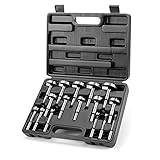
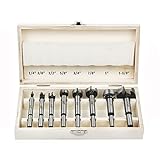
They work best in a drill press, where the bit stays square and the workpiece is secured. A handheld drill can do the job, but a wide bit is harder to keep perpendicular and may pull the drill off line. For a handheld job, clamp the stock and use a low gear, steady pressure, and a side handle if the drill has one. A Forstner bit set for wood is useful if you need several diameters; for one hole, buying a single size may cost less and avoid unused bits.
Large Forstner bits create a lot of friction because they remove the entire plug as chips. In hardwood or thick stock, clear chips frequently and avoid forcing the bit when it slows. Heat can burn the hole wall, dull the cutting edges, or make the drill twist suddenly. For deep bores, drill partway from one face, clear the chips, and finish from the other side when possible.
Choose a hole saw for large through-holes
A hole saw is usually the practical choice for a large opening through a board, countertop, or plywood panel. It cuts a narrow ring rather than turning the full disk into chips, which reduces the amount of material removed. The center pilot bit guides the saw, but it also makes a hole in the workpiece and can tear out the back as the saw exits.
To limit splintering, clamp a sacrificial backing board tightly behind the work and cut at a moderate speed. Another option is to cut until the pilot emerges, then finish from the opposite face using that pilot hole for alignment. Check that the saw’s cutting depth exceeds the material thickness; some hole saws cannot pass through a thick workpiece in one go because the plug bottoms out inside the cup.
For occasional work in softwood or plywood, a basic bi-metal hole saw kit is often enough. For frequent cuts in abrasive materials or hardwood, tooth design and durability matter more. After cutting, the wood plug can bind inside the saw; unplug or remove the battery before clearing it, and use the slot in the cup rather than prying against the teeth.
Match the cutter to the drill
Either cutter can produce enough torque to injure your wrist if it catches. A wide Forstner bit or hole saw is not a good match for a small, low-torque drill with a short battery life. Use a drill with a low-speed gear, a sound chuck, and a side handle for larger diameters. Do not use an impact driver for these cutters: impact action can cause rough cuts, loose the chuck or adapter, and make a catch harder to control.
Keep the workpiece clamped, hold the drill with both hands, and stand so a sudden stall will not pull you into the material. If the cutter binds, release the trigger before backing it out. Avoid leaning hard on the drill; excessive pressure can stall the motor, overheat the cutter, or split the work. Follow the cutter maker’s speed guidance, and reduce speed as diameter increases. If no guidance is provided, start slowly and stop if the bit smokes, burns the wood, or vibrates heavily.
Make the decision by depth and finish
For a clean, flat-bottomed recess, buy a Forstner bit in the required diameter. For a large through-hole, a hole saw is generally faster and wastes less wood. If the hole is only a one-off in softwood and the rim does not need to be furniture-clean, a cheaper hole saw may be entirely adequate. For a visible cut in veneer or finished plywood, use backing, cut from both faces, and test the setup on scrap first.
Neither tool guarantees a perfect edge if the stock is unsupported, the cutter is dull, or the drill is tilted. Measure the actual cutter diameter before laying out hardware, since nominal sizes and real cuts can differ slightly. For holes larger than your drill can safely control, use a drill press or a securely guided setup rather than trying to muscle the cutter through by hand.