What's inside
As an Amazon Associate I earn from qualifying purchases. This post may contain affiliate links at no extra cost to you.
Impact-rated bits are worth buying when you regularly drive screws with an impact driver, especially large or long fasteners. For occasional assembly or drilling with a cordless drill, standard bits are usually fine. The difference is how the bit handles repeated impacts and sudden changes in torque—not a promise that an impact-rated bit cannot break.
As an Amazon Associate we earn from qualifying purchases at no extra cost to you.



What we cover
What “impact-rated” means
An impact driver delivers short bursts of rotational force. That helps turn stubborn fasteners, but it also puts sharp, repeated stress on the bit. Impact-rated driver bits are made to flex slightly under that stress, often with a narrower torsion zone behind the tip. The zone twists a small amount and springs back instead of concentrating all the strain at the tip or shank.
Standard driver bits are generally harder and less designed for that repeated torsional shock. In an impact driver, a standard bit may chip, twist, or snap sooner. There is no universal rating that guarantees a particular lifespan, though; construction, heat treatment, bit fit, fastener condition, and technique all matter.
Compare by tool and task
| Bit type | Best suited to | Typical trade-off |
|---|---|---|
| Standard driver bit | Drills, light fastening, furniture assembly | Lower cost; more vulnerable to repeated impacts |
| Impact-rated driver bit | Impact drivers and frequent or demanding screw driving | Costs more; may wear at the tip just like any bit |
| Drill bit | Making holes in wood, metal, or masonry, as rated | Choose by material and tool; “impact-rated” on a driver bit does not make it a drill bit |
A cordless drill’s clutch and variable speed make it easier to control screw-driving force. A hammer drill’s hammer action is for drilling into masonry, not for driving screws. An impact driver uses rotational impacts for fastening. These modes are not interchangeable: use the bit and tool intended for the job, and follow the tool maker’s instructions.
When standard bits are fine
If you are assembling a cabinet, hanging a few lightweight items, or driving short screws into predrilled wood with a drill, a standard bit is a sensible choice. The loads are modest, and there may be little benefit to paying extra for a torsion-zone design. A well-fitting standard bit can outlast a poorly fitting impact-rated one.
Standard bits also make sense for drill use where the bit is not being hit with repeated rotational impacts. Do not put a screwdriver bit in a drill chuck and assume it is suitable for drilling holes, or use a drill bit as a driver bit. Match the bit type to the operation.
When to buy impact-rated bits
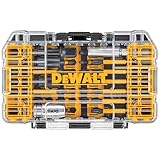
Choose impact-rated bits if an impact driver is your regular fastening tool, or if you drive long structural screws, lag screws, or many fasteners in a session. They are also a practical choice when working overhead or in awkward positions, where a broken bit means stopping to retrieve the pieces. A set of impact-rated driver bits is a reasonable upgrade for that kind of work.
Look for the right tip type and size for your fasteners, not just the impact label. A loose Phillips bit can cam out and damage both the screw head and the bit. Torx and other star-drive screws often hold the bit more securely, but the exact drive still has to match. Use fresh bits when the tip is rounded or chipped. Continuing with a worn tip increases slipping and can spoil a fastener head.
Reduce breakage and stripping
Even impact-rated bits can fail under high torque. Common causes include using the wrong size, driving at an angle, forcing a stuck screw, or letting the bit bounce out of the recess. Start slowly, keep the tool aligned with the fastener, and apply steady pressure. If a screw binds, back it out and clear the hole rather than leaning harder on the trigger.
For long screws in wood, a pilot hole can reduce splitting and driving effort. Its diameter depends on the screw and wood; check the fastener maker’s guidance rather than guessing. For wall anchors, first drill the hole to the diameter specified on the anchor package. A driver bit’s impact rating does not tell you which drill bit to use or whether an anchor is suitable for the wall material and load.
When a job needs controlled torque—such as small machine screws, delicate hardware, or fasteners that could crush a workpiece—a cordless drill’s clutch is often preferable to an impact driver. Set the clutch low, test on scrap or an inconspicuous spot, and increase it only as needed. Impact drivers can drive fast, but they give less direct control over final tightness.
Buying practicalities
A compact set with the drive sizes you actually use is often more useful than a large assortment full of duplicates. For household work, common Phillips, square, and Torx sizes cover many tasks; construction work may call for specific star-drive sizes. If bits wear quickly, inspect the fastener fit and your technique before assuming you need a premium set. A small assortment of impact-rated Torx bits can be a better buy than replacing a mixed set you rarely use.
Use standard bits for light work with a drill and buy impact-rated bits for repeated fastening with an impact driver. That split keeps costs sensible without treating every job as heavy-duty. Whichever type you choose, the correct size, straight alignment, and a sound fastener usually matter more than the label on the bit.