What's inside
As an Amazon Associate I earn from qualifying purchases. This post may contain affiliate links at no extra cost to you.
Repeatedly driving screws into wall studs is a different job from occasional furniture assembly. The drill has to deliver enough torque for long screws, control speed without overheating, and remain comfortable after dozens or hundreds of fasteners. A compact 12V drill can handle light work, but a stronger 18V or 20V drill is usually the better choice for framing, blocking, shelving, cabinets, and other stud-mounted projects.
As an Amazon Associate we earn from qualifying purchases at no extra cost to you.


What we cover
What matters most for repeated screwdriving
Torque is important, but the highest torque number on the box is not the whole story. A drill with a two-speed gearbox, a usable clutch, a comfortable handle, and two batteries is often more useful than a bulky model with an impressive specification sheet.
For screws driven into construction lumber, look for a low gear that turns roughly 0 to 500 or 600 rpm and a high gear reaching about 1,500 to 2,000 rpm. Low gear provides control and reduces cam-out when starting long screws. High gear is useful for drilling pilot holes and clearance holes.
A brushless motor is helpful for repeated work because it generally runs cooler and uses battery power more efficiently than a brushed motor. It is not essential for a small weekend project, but the price difference is easier to justify when the drill will be used for several hours or when you already own batteries in that platform.
The clutch should have enough adjustment to prevent stripping smaller screws. For structural screws or long wood screws, you will often bypass the clutch and use the drill’s maximum setting. That makes variable-speed control and a solid chuck especially important.
Which drill type to buy
| Tool type | Best use | Advantages | Limitations |
|---|---|---|---|
| 12V cordless drill | Short screws, cabinets, light shelving | Small, light, easy to control | Can stall on long screws and large bits |
| 18V/20V cordless drill | General stud work and repeated fastening | Good torque, broad bit capacity, long runtime | Heavier and more expensive |
| Compact impact driver | Many long screws and structural fasteners | High fastening power, less wrist twisting | Loud, less precise, uses hex-shank bits |
| Hammer drill | Drilling masonry as well as wood | Adds hammer mode for brick and concrete | Usually heavier; hammer mode is unnecessary in studs |
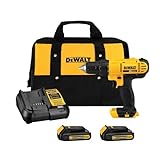
For most homeowners, the best all-around choice is an 18V or 20V brushless cordless drill kit with two batteries. A 1/2-inch chuck is useful if you will use larger wood bits, although a 3/8-inch chuck is adequate for ordinary pilot holes and screwdriving.
Choose a 12V drill if weight and access matter more than speed. It is a sensible option for mounting light fixtures, installing cabinet hardware, driving 1-1/4-inch or 1-5/8-inch screws, and working overhead. It becomes less attractive when you are driving 3-inch screws all day or drilling through several studs.
When an impact driver is better
An impact driver is often the fastest tool for repeated stud fastening. Its hammering action helps drive long screws without transferring as much reaction torque to your wrist. It also handles screws that would make a conventional drill stall or overheat.
The trade-off is control. Impact drivers are loud, and their pulsing torque can snap small screws, bury heads too deeply, or damage soft lumber. They are also not ideal for delicate cabinet screws unless you use a low speed and a light trigger. Buy one if you routinely drive structural screws, ledger screws, lag screws, or long framing screws. A compact brushless impact driver kit is usually easier to handle than a full-size high-torque model for indoor work.
If you only drive a few screws into studs each month, the cheaper option is fine: use a regular cordless drill with a good driver bit. An impact driver is not automatically better for every fastener, and buying into a second battery platform can cost more than the tool itself.
Battery size and runtime
Battery capacity is normally listed in amp-hours. A 2.0Ah battery keeps the tool light, while a 4.0Ah or 5.0Ah pack provides longer runtime and better sustained performance at the cost of weight. For overhead work, the smaller battery may be more comfortable. For repeated stud fastening, a 4.0Ah pack is a practical middle ground.
A two-battery kit prevents unnecessary pauses. One battery can charge while the other is in use, though charging speed varies widely. Avoid judging battery life by screw count alone: a 3-inch screw in dense Douglas fir uses far more energy than a short screw in soft pine.
Bits and fastening technique
Use impact-rated driver bits with an impact driver. Ordinary bits can twist, fracture, or shed their tips under repeated impact. A magnetic bit holder makes bit changes faster, but it adds length and can wobble; use a direct hex bit when access allows. For a regular drill, quality torsion bits are adequate and often cheaper.
Find the stud before drilling. Electronic stud finders can help, but confirm the location with a small test hole or by measuring from a known framing point. Most wood studs are spaced 16 inches on center, but openings, corners, and older construction frequently break that pattern.
For a clean start, set the drill to low gear and begin slowly while holding the bit square to the surface. If the screw has no self-drilling tip, drill a pilot hole slightly smaller than the screw’s solid core. A pilot hole reduces splitting and lowers the torque needed. For a 3-inch screw, remember that only about 1-1/2 inches may actually penetrate the stud after passing through drywall, trim, or a mounting board.
Common failures to avoid
Repeated stalls are hard on the motor, battery, and chuck. Stop if the drill slows sharply instead of holding the trigger until it smells hot. Pre-drill, use a shorter screw, or switch to an impact driver.
Cam-out usually comes from the wrong bit, poor alignment, inadequate pressure, or excessive speed. A damaged bit should be replaced immediately; continuing with it rounds the screw head and makes removal much harder. Do not overtighten structural screws. A crushed mounting surface can be weaker than a properly seated screw.
Finally, check for wiring and plumbing before drilling near outlets, switches, sinks, and bathrooms. A capable cordless drill can make the fastening easy, but it cannot compensate for drilling into a concealed utility line.