What's inside
As an Amazon Associate I earn from qualifying purchases. This post may contain affiliate links at no extra cost to you.
Maple is hard, dense, and unforgiving of a weak drill. An auger bit can bore through it cleanly, but only if the drill has enough low-speed torque, the bit is sharp, and you control the feed rate. A compact 12V drill may handle a small 1/2-inch auger bit, but larger bits can stall it, overheat the motor, or leave a ragged exit hole.
For most work, the best choice is an 18V or 20V brushless drill with a two-speed gearbox, a 1/2-inch chuck, and a side handle. If you only drill occasional small holes, a cheaper brushed drill can be perfectly adequate. The right drill depends as much on hole size and depth as on battery voltage.
As an Amazon Associate we earn from qualifying purchases at no extra cost to you.

What we cover
What to Look For in a Cordless Drill
Auger bits need torque rather than extreme speed. Look for a drill with a low gear around 0–500 RPM and a high gear that reaches roughly 1,500–2,000 RPM. You will normally use low gear for auger bits in maple, especially above 1/2 inch in diameter.
A 1/2-inch chuck is useful because many larger auger bits have 3/8-inch or 1/2-inch shanks, while some inexpensive bit sets use reduced shanks. A 3/8-inch chuck limits your choices and may not grip large bits securely.
Brushless motors generally run cooler and deliver better runtime than brushed motors. That matters when boring several deep holes, but it is not a requirement for one or two small holes. A good brushed drill with a fresh battery can still do the job.
- Low-speed torque: More important than maximum RPM.
- Side handle: Strongly preferred for bits over 3/4 inch.
- Electronic brake: Helpful when the bit breaks through and the drill tries to twist.
- Clutch: Useful for screws, but usually set to the drill setting for boring.
- Battery: A 2.0Ah pack is light; a 4.0Ah or larger pack lasts longer but adds weight.
The Best Drill Types for Maple
| Drill type | Best auger-bit range | Advantages | Limitations |
|---|---|---|---|
| 12V compact drill | 1/4 to 1/2 inch | Light, easy to control, inexpensive | Can stall in deep or large holes |
| 18V/20V brushed drill | 1/4 to 3/4 inch | Good value and adequate power | Shorter runtime and more heat under load |
| 18V/20V brushless drill | 1/4 to 1 inch or larger | Strong torque, better cooling, longer runtime | Costs more and may be heavier |
| Right-angle drill | 1/2 to 1 inch | Fits between joists and in cabinets | Specialized, often slower to control |
For a general-purpose purchase, an 18V or 20V brushless 1/2-inch cordless drill is the safest recommendation. It has enough reserve power for hardwood and remains useful for screws, spade bits, and larger twist drills.
A cheaper brushed 1/2-inch cordless drill is fine if you are boring only a few 3/8-inch or 1/2-inch holes. Use low gear, keep the bit sharp, and let the drill cool between holes. The money saved may be better spent on a quality auger-bit set.
Choosing Auger Bits for Clean Holes
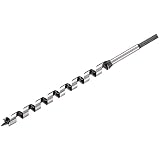
Auger bits with a lead screw pull themselves into the wood, making them faster than standard twist bits. In maple, that self-feeding action can become a problem: an aggressive bit may pull too hard, overload the drill, and chip the exit side.
Choose bits with sharp cutting spurs and a clean center screw. A spur-and-gouge design usually leaves a cleaner entry and exit than a crude, dull bit. Bit diameter should match the job rather than the drill’s maximum capacity. A 1-inch bit demands substantially more torque than a 1/2-inch bit, especially through a thick maple slab.
If appearance matters on both sides, stop when the lead screw or center point is about to emerge, then finish from the opposite side using the small pilot hole as a guide. This prevents the common blowout failure where fibers tear away as the auger exits.
How to Bore the Hole Cleanly
Mark the center with a sharp pencil or knife, then place the bit square to the surface. Select low gear and the drill setting rather than a screw-clutch setting. Start slowly until the lead screw is established, then increase pressure gradually.
Do not force the drill continuously through a deep maple hole. Withdraw the bit every few seconds to clear chips and let air reach the cutting edges. Chip packing creates friction, raises the load, and can burn the hole even when the bit is sharp. For a hole deeper than about two bit diameters, clearing chips becomes increasingly important.
Keep both hands on the drill when possible. A 3/4-inch or larger auger bit can catch suddenly when it hits dense grain or an embedded knot. A side handle gives you leverage and reduces wrist injuries. If the drill stalls, release the trigger immediately; holding it against a stalled bit overheats the motor and battery.
Common Problems and Their Fixes
Ragged exit: Finish from the opposite side, or clamp a scrap board tightly against the exit surface. A dull spur is another likely cause.
Burn marks: Reduce pressure, clear chips more often, and sharpen or replace the bit. Running a large auger in high gear is a frequent mistake.
Drill keeps stalling: Use low gear, a larger battery, or a more powerful brushless drill. If the hole is unusually deep, bore in stages and withdraw the bit repeatedly.
Bit wanders at the start: Make a small starter dimple with an awl, or begin with a short pilot hole. Do not use a large auger at full speed while it is still trying to establish its center.
For occasional cabinet or furniture work, a basic drill and sharp small auger bits are enough. For repeated 3/4-inch and 1-inch holes in maple, the extra cost of a brushless drill with a side handle is justified—not because it makes the hole automatically clean, but because it gives you the torque, control, and cooling needed to avoid the failures that ruin hardwood.