What's inside
As an Amazon Associate I earn from qualifying purchases. This post may contain affiliate links at no extra cost to you.
Concrete block looks like a simple drilling job, but its hollow cells and hard face can make anchor holes unpredictable. A compact hammer drill is usually enough for light-duty anchors; larger holes, repeated work, or dense block call for more power and better bits. The right choice depends less on the biggest number on the box than on the hole diameter, depth, and number of holes you need to make.
As an Amazon Associate we earn from qualifying purchases at no extra cost to you.

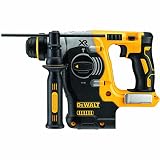


What we cover
Choose the right tool for the hole
A cordless hammer drill combines rotation with a rapid forward hammering action. That action helps a masonry bit cut block more quickly than a regular drill, but it is not the same as the much heavier impact mechanism in a rotary hammer. For typical holes around 1/4 to 3/8 inch wide and a few inches deep, a capable 18V or 20V hammer drill is a practical choice. For many large holes, long holes, or tough aggregate, a rotary hammer with an SDS-Plus bit is faster and easier on your hands.
Do not confuse a hammer drill with an impact driver. An impact driver is made to turn fasteners, not drill masonry holes. A drill-driver without hammer mode can sometimes bore a small hole in soft block with a masonry bit, but it will be slow and can overheat the bit or motor. If drilling anchors in block is a regular task, pay for hammer mode.
Cordless hammer drill options compared
| Category | Best fit | Trade-off |
|---|---|---|
| Compact 18V/20V hammer drill | A few small anchor holes; overhead or ladder work | Lighter and cheaper, but slower in larger holes |
| Full-size 18V/20V hammer drill | Regular 1/4- to 1/2-inch holes in block | More capable, but heavier and more tiring |
| Rotary hammer | Many holes, larger diameters, dense masonry | Fastest in concrete, but bulkier and often unnecessary for occasional block work |
For occasional small anchors, a compact hammer drill is often the sensible buy. Consider a compact cordless hammer drill if low weight matters more than speed. For repeated drilling or holes closer to 1/2 inch, a full-size tool gives you more reserve. Its extra weight is noticeable when working above shoulder height, so do not buy it just for a high maximum torque figure.
Features that matter in use
Look for a three-mode selector—drill, hammer drill, and driver—and a keyed or keyless chuck that accepts the bit sizes you need. Two mechanical speeds help: use low gear when a larger bit needs control, and higher gear for small holes if the tool and bit maker recommend it. A side handle is useful on powerful drills, particularly when a bit catches in a hard spot. It gives you leverage, but it does not make a jam harmless; keep both hands on the drill and avoid forcing it.
Battery capacity affects how long you can work before swapping packs. A small battery keeps a compact drill light and may be enough for a handful of anchors; a higher-capacity pack is more useful for a full afternoon. If you already own batteries in a tool platform, staying with that platform can be better value than buying a bare tool in a new system. A cordless hammer drill kit with battery and charger makes more sense if you are starting from scratch.
Match the bit to the anchor
Use a carbide-tipped masonry bit sized to the anchor maker’s instructions. The hole is often the same diameter as the anchor, but follow the specified size rather than guessing. A bit that is too small can make the anchor impossible to seat; an oversized or badly worn bit leaves a loose hole, and the anchor may spin or pull out. For plastic plugs, screw anchors, and sleeve anchors, check the product directions for both diameter and minimum embedment.
Concrete block is not uniform. The face shell can be hard, while the material behind it may be hollow or crumbly. Anchoring into a hollow cell is not equivalent to fastening into solid concrete. Use an anchor rated for hollow masonry when the hole lands in a void, and use an anchor suited to the load. For heavy loads, follow the anchor manufacturer’s requirements and consider whether the block’s condition and location can support the attachment.
Drill clean holes without damaging the block
Mark the hole and check for hidden wires or pipes before drilling. Hold the drill square to the wall, start slowly to keep the bit from wandering, then use steady pressure. Let the hammer action do the work; leaning hard on the drill can overheat the bit, widen the hole, or chip the block face. If the bit stops advancing, withdraw it to clear dust and continue. Dust packed in the hole slows cutting and can prevent an anchor from seating.
Set a depth stop if the drill has one, or mark the bit with tape. Drill to the anchor’s required depth, then clear the hole with a suitable brush or vacuum according to the anchor instructions. Eye protection and a dust mask are sensible: masonry dust is abrasive and unpleasant to breathe. Avoid drilling too close to an edge or mortar joint unless the anchor instructions specifically allow it; block can crack or spall there.
When to step up to a rotary hammer
If a hammer drill takes a long time to make each hole, repeatedly stalls, or leaves you fighting vibration and heat, the job may be beyond its comfortable range. A rotary hammer is the better tool for many holes, larger diameters, and dense material. For a small number of 1/4-inch anchor holes in ordinary block, however, buying one can be needless expense. A good masonry bit, the correct anchor, and patient drilling technique often matter more than upgrading the drill.
Choose around the work you actually do: compact for light, occasional holes; full-size for routine anchor drilling; rotary hammer for demanding masonry work. That keeps the tool manageable without asking a small drill to do a job it was not built for.