What's inside
As an Amazon Associate I earn from qualifying purchases. This post may contain affiliate links at no extra cost to you.
What we cover
Choose the anchor for the load
The right anchor depends on what the pipe does, how heavy it is when full, and whether it can move or vibrate. A light conduit clamp on a sound concrete wall is a different job from a steel pipe carrying water, a drain line that can knock, or a bracket that could hurt someone if it pulls loose.
For most ordinary pipe clamps, a correctly sized concrete screw or expansion anchor is a better choice than a plastic wall plug. Plastic plugs are intended mainly for light-duty fixings and can loosen under repeated movement. Before buying, check the clamp’s hole diameter, the pipe’s filled weight, and the anchor maker’s load ratings for the actual masonry type. Do not treat a published maximum load as a working load; edge distance, spacing, installation quality, and wall condition all reduce capacity.
As an Amazon Associate we earn from qualifying purchases at no extra cost to you.

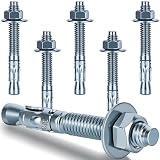


Concrete anchor types compared
| Anchor type | Best suited to | Trade-offs |
|---|---|---|
| Concrete screw | Everyday clamps and brackets in sound concrete or suitable masonry | Fast to install and removable, but needs the specified pilot hole and embedment |
| Wedge or sleeve anchor | Heavier brackets in solid concrete | Strong mechanical hold when installed correctly; needs room behind the surface and is hard to remove |
| Hammer-drive pin | Light conduit or small pipe clips | Quick and inexpensive, but offers less adjustability and is a poor choice for substantial or vibrating loads |
| Masonry screw with plastic plug | Light, low-consequence fixings where the plug is rated for the substrate | Cheap and simple, but not the first choice for a loaded pipe clamp subject to movement |
Best general choice: a concrete screw
For a typical pipe clamp on a sound concrete wall, a concrete screw is usually the easiest balance of holding power, speed, and removability. It cuts into the drilled hole rather than expanding a sleeve against the concrete, so it is useful where you want a firm fixing without a large expansion force. That does not make it suitable for every location: follow the manufacturer’s limits for concrete, brick, or block, since these materials are not interchangeable.
Choose the screw diameter to match the clamp hole and the load rating, not just what fits the drill you already own. Common concrete screw diameters are around 5–8 mm, but the correct size depends on the clamp and application. Embedment is the length that actually enters sound masonry; subtract the clamp and any washer thickness from the screw’s usable length. Use the manufacturer’s required embedment and edge distances rather than guessing.
A range of concrete screws for masonry is worth considering if you want a removable fixing for routine pipe support. For lightweight conduit, a hammer-drive masonry anchor can be cheaper and quicker, provided its rating covers the load and the clamp is not exposed to repeated knocks.
When to use an expansion anchor
Wedge and sleeve anchors grip by expanding inside a drilled hole. They are commonly used for heavier brackets in solid concrete, but require careful installation: the hole must match the specified diameter, depth, and cleaning instructions, and the anchor must be tightened to the stated torque if one is given. An over-tightened anchor can damage the surrounding concrete; an under-tightened one may not develop its intended hold.
Expansion anchors are not a universal upgrade. They need sufficient material around the hole and are generally unsuitable near a slab edge or in hollow block unless the particular anchor is rated for that use. They are also difficult to remove cleanly. If the pipe can impose a strong pull or vibration, compare rated capacities and consider getting advice from the anchor manufacturer or a qualified installer rather than sizing by appearance.
Match the anchor to the wall
Solid poured concrete gives anchors the most predictable base, assuming it is not cracked or spalled. Brick varies: avoid drilling into a mortar joint for a loaded fixing, and use an anchor specifically approved for the type of brick. Hollow concrete block has thin faces and voids, so a standard wedge anchor may crush the face or fail to grip. Use an anchor rated for hollow masonry or reposition to a suitable solid section.
Do not install into loose render, crumbling mortar, a visible crack, or a damaged wall face and expect a stronger anchor to solve the problem. A small hole that breaks out at the edge can also undermine the fixing. Respect the product’s minimum edge and anchor-to-anchor spacing; if the clamp has two holes, do not assume both screws share the load evenly.
Drilling and installation
Mark the clamp holes, then check for hidden electrical cables and plumbing before drilling. For concrete, use a hammer drill with a masonry bit of the exact diameter specified by the anchor. A standard drill can manage some softer masonry and small holes, but it is slower in concrete. A bit that wanders or is worn can leave an oversized hole, and an oversized hole can sharply reduce a screw’s grip.
Drill perpendicular to the wall and to the required depth. A depth stop or tape mark helps avoid drilling too shallow; allow for dust at the bottom of the hole. Clean the hole as the anchor instructions require—often by blowing or brushing out dust—then install the fastener without forcing it. If a concrete screw spins without tightening, stop: the hole may be too large, damaged, or dusty. Do not solve that by using a longer screw unless the manufacturer allows it.
For a hammer drill, use a carbide masonry bit suited to the hole size and material. A carbide masonry bit set is useful for occasional household work, but for repeated holes, a quality bit that stays sharp and cuts cleanly is less frustrating. Wear eye protection and hearing protection, and use dust control where practical.
Check the finished fixing
Tighten the clamp so the pipe is held securely without crushing plastic pipe or preventing required movement. Check that the clamp sits flat and the anchor is seated as intended. After the pipe is installed, apply a firm hand check to the support and look for movement, cracking, or a spinning screw. Recheck after the system has been in use, especially on a line subject to vibration or temperature changes.
If failure could flood a building, damage equipment, or injure someone, do not rely on a generic anchor recommendation. Use a support system and fasteners with documented capacity for the load and substrate, and follow applicable plumbing or building requirements.