What's inside
As an Amazon Associate I earn from qualifying purchases. This post may contain affiliate links at no extra cost to you.
For cabinet-door screws, control matters more than raw power. A drill that is too fast or heavy can bury a hinge screw, strip its head, or split a narrow stile before you have time to react. A compact cordless drill with a clutch and a low-speed setting is usually the right tool; an impact driver is useful for other fastening jobs, but is rarely the best first choice for delicate cabinet hardware.
As an Amazon Associate we earn from qualifying purchases at no extra cost to you.


What we cover
What to buy for cabinet doors
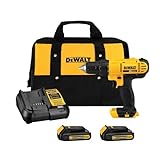
Look for a cordless drill/driver with a two-speed gearbox, an adjustable clutch, and a variable-speed trigger. A compact 12-volt drill is often plenty for hinge screws and pulls. An 18- or 20-volt drill makes sense if you already own batteries or also need to drill larger holes and drive longer screws. The larger tool may have more power, but it is typically heavier and can be harder to hold square against a door.
For a new purchase, compare a compact 12V cordless drill/driver with a standard 18V cordless drill/driver with a clutch. Pay attention to the tool’s weight with its battery installed, not just the bare-tool weight. Holding a drill overhead or at arm’s length while aligning a door makes even a modest difference noticeable.
A basic drill is fine if you only install a few knobs or replace a hinge. Brushless motors and premium battery systems can be worthwhile for regular use, but they are not necessary for this task. A clutch, a comfortable grip, and a slow trigger are more useful than a high torque figure.
Drill types compared
| Tool | Best use | Trade-off for cabinet doors |
|---|---|---|
| Compact 12V drill/driver | Hinge screws, pulls, small pilot holes | Light and easy to control; less suited to frequent large-hole drilling |
| 18V or 20V drill/driver | Mixed household drilling and fastening | More versatile, but often heavier and more powerful than needed |
| Impact driver | Long screws and repetitive construction fastening | Fast and forceful; harder to control on small cabinet screws |
| Hand screwdriver | Final snugging and very delicate hardware | Slow, but gives direct control and reduces the chance of overdriving |
Should you use an impact driver?
An impact driver turns fasteners with repeated rotational impacts. That action is useful for driving long screws into framing, but it can make a small hinge screw jump, cam out, or sink too far before you can stop. It also gives less useful feedback through the handle than a drill clutch or hand screwdriver.
If an impact driver is already in your kit, reserve it for long, larger-diameter screws or other work where speed matters more than fine control. For cabinet hardware, start with a drill/driver with an adjustable clutch. Do not assume the clutch will protect every screw: settings vary between tools, and the clutch may not engage consistently at very low resistance. Use a hand screwdriver for the last turn if a screw needs careful seating.
Set up the screw and drill
Use the correct driver bit: a Phillips bit that fits snugly, or the exact square-drive or other bit specified for the screw. A worn or undersized bit is more likely to slip and chew up the screw head. For cabinet pulls, measure and mark both holes carefully. A simple template helps keep handles level and avoids holes that are slightly out of line.
When installing a screw into solid wood, drill a pilot hole sized for the screw’s core, not its outside thread diameter. A hole that is too small raises the risk of splitting; one that is too large leaves the threads with little wood to grip. Check the screw length against the door thickness and hardware. A screw that is too long can break through the front of the door, while one that is too short may not hold securely.
Cabinet doors are not all solid wood. Many have MDF, particleboard, veneer, or a thin face over a core. Avoid overtightening in these materials: once the threads lose their grip, the hole may not hold a replacement screw well. If the door or hardware instructions call for a particular screw or pilot-hole size, follow those directions.
Drive screws without damaging the door
Set the drill to its low-speed range, hold it straight in line with the screw, and begin with light trigger pressure. On a two-speed drill, the lower gear gives better control; the higher gear is generally intended for drilling. Start the screw slowly so the bit stays engaged, then increase speed only if the fastener is tracking properly.
Start with a low clutch setting and test on an inconspicuous screw or scrap of similar material. Raise the setting only if the drill stops before the screw seats. Stop as soon as the head is snug against the hinge or pull. Do not use the drill to force a screw against the hardware: that can strip the wood, damage the screw head, or distort a hinge leaf.
Common warning signs include a bit that repeatedly slips, a screw that spins without tightening, and a door face that begins to bulge or crack. Stop rather than pushing harder. Re-seat the bit, check that the hole and screw are appropriate, and finish by hand if needed. For a stripped hole, a longer screw is not automatically the fix; first check what material lies behind the hole and whether changing screw size is safe for that door.
Battery and bit choices
A small battery is adequate for a few doors, and a spare is convenient if you are doing a kitchen’s worth of hardware. Do not buy a larger battery just to get more power for cabinet screws. It adds weight, and controlled trigger use—not battery capacity—is what prevents most damage.
A short, sharp driver bit often gives better access near hinge cups and cabinet sides than a long bit. Keep a spare of the correct type on hand; replacing a worn bit is cheaper than repairing a stripped screw head. If the job includes drilling new holes for pulls, use a sharp twist bit and a backing board behind the door where possible to reduce tear-out as the bit exits.
For occasional cabinet work, a basic compact drill and a hand screwdriver are a sensible combination. If you also drill larger holes or tackle general home repairs, an 18- or 20-volt drill/driver is the more flexible purchase. In either case, controlled speed and a correctly fitted bit matter more than maximum torque.