What's inside
As an Amazon Associate I earn from qualifying purchases. This post may contain affiliate links at no extra cost to you.
For a bracket on a concrete column, choose the anchor for the load and the concrete—not just the hole size. A light cable clip and a loaded shelf bracket are different jobs. First check the bracket maker’s instructions and the anchor’s published load data; then confirm the column is sound, thick enough, and free of reinforcement where you plan to drill.
As an Amazon Associate we earn from qualifying purchases at no extra cost to you.


What we cover
Choose by load and exposure
For a small, lightly loaded bracket indoors, a correctly sized masonry screw is often the simplest choice. For heavier loads, repeated vibration, or a bracket that could hurt someone if it pulls free, use an engineered anchor with published values for the concrete and installation conditions. Those may include a mechanical expansion anchor or a qualified adhesive anchor. Do not treat a package’s headline load as a design value: capacity depends on embedment, edge distance, spacing, concrete strength, and installation.
If you do not know the bracket load, cannot verify the concrete, or are mounting overhead or above people, get an engineer or qualified installer to specify the fastening. Anchors are not interchangeable, and a concrete column may be structural.
Anchor types at a glance
| Type | Best fit | Trade-off |
|---|---|---|
| Concrete screw | Light to moderate-duty brackets; quick installation | Removable, but performance depends on a clean, correctly sized hole and proper embedment |
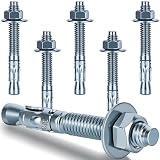
| Wedge or sleeve anchor | Suitable loads where expansion is allowed | Needs room behind the surface to expand; can crack concrete near an edge |
| Adhesive anchor with threaded rod | Specified heavier-duty or close-to-edge applications | Hole cleaning and cure time are critical; installation is less forgiving |
| Plastic masonry plug | Very light-duty attachments only, when its rating and substrate fit | Not a substitute for a structural anchor in a loaded bracket |
When a concrete screw is enough
Concrete screws avoid the expansion pressure of a wedge anchor and are convenient for smaller brackets. A concrete screw can be a sensible low-cost buy for a modest indoor attachment if its published capacity covers the job and the hole can be drilled to the maker’s specification. Many common sizes call for a 3/16-inch or 1/4-inch carbide bit, but follow the instructions for the specific fastener; the wrong hole diameter can leave a screw spinning or make it impossible to drive.
Do not use a screw just because it feels tight. A hole drilled too large, dusty, or damaged by repeated attempts can reduce holding power. If the screw turns without advancing, stop rather than forcing it. Move to a fresh approved location or use the anchor type specified for the job.
When to step up to an expansion anchor
A wedge anchor or sleeve anchor can be appropriate when the bracket and load call for a mechanical anchor and the installation meets its requirements. Expansion anchors push outward against the hole wall, so they need sound concrete and enough distance from the column’s edges. A common mistake is putting one near a corner because the bracket’s hole is there; that can split or spall the concrete.
Check the anchor’s required hole depth, minimum embedment, edge distance, and installation torque. Do not substitute a longer anchor for adequate concrete thickness. If the column is narrow, damaged, or close to an edge, an expansion anchor may be the wrong choice; use a design approved for those conditions rather than guessing.
Adhesive anchors are not a shortcut
Adhesive anchors can be useful when a specified design calls for threaded rod bonded into concrete, including some close-to-edge situations. They demand careful hole cleaning—typically brushing and blowing in the sequence stated by the manufacturer—and the adhesive must cure for the required time and temperature before loading. Dust left in the hole or a bracket hung too soon can cause failure without an obvious warning.
Buy the adhesive system as specified, including its compatible rod and dispensing nozzle. A concrete anchoring adhesive is not a general-purpose construction glue. For an important or heavily loaded bracket, use the product’s technical data and installation procedure, not an online anecdote.
Drill the hole correctly
Use a hammer drill with a sharp carbide masonry bit for most anchor holes. A rotary hammer is faster and less tiring for repeated or larger holes, but it can be unnecessarily aggressive on small work. Match the bit diameter to the anchor instructions, keep the drill square to the surface, and drill at least as deep as specified. A depth stop or tape on the bit helps prevent a shallow hole; allow room for dust at the bottom where the instructions require it.
Before drilling, check for embedded services and reinforcement with an appropriate detector or reliable site information. A column may contain rebar. If you hit steel, stop; do not keep drilling or cut the reinforcement. Shift only if the bracket layout and required edge distances still work.
Clean the hole as the anchor maker directs. For concrete screws, remove dust and drive the screw with a controlled impact or drill setting, stopping at the specified seating point. Overdriving can strip the hole or damage the bracket. For expansion anchors, tighten to the stated torque with a torque wrench when required. A cordless impact driver is convenient, but it can over-tighten an anchor before you notice.
What to buy
For one light bracket, a small pack of compatible concrete screws and the specified carbide bit may be all you need. For a loaded bracket, buy the exact anchor type and diameter specified for the application, plus the correct bit and any cleaning tools or setting tool required. Compare the anchor’s published design information—not just “maximum load”—and verify the concrete thickness, spacing, edge distance, and number of fasteners.
Do not rescue a poor location with a bigger anchor. If the concrete is cracked, crumbling, unusually thin, or the bracket has high leverage, pause and get the fastening specified. A modest, properly rated anchor in sound concrete is safer than an oversized fastener installed by guesswork.