What's inside
As an Amazon Associate I earn from qualifying purchases. This post may contain affiliate links at no extra cost to you.
Installing screws in PVC trim is not difficult, but the wrong tool can leave stripped heads, mushroomed holes, or cracked trim. A good cordless drill gives you control over the last few turns, which matters more than maximum power. For most PVC fascia, corner boards, window trim, and soffit work, a compact 12V or 18V drill with a clutch is the safest choice. An impact driver is useful for long structural screws, but it is easier to overdrive a screw with one.
As an Amazon Associate we earn from qualifying purchases at no extra cost to you.



What we cover
What to look for in a cordless drill
Choose a drill with a variable-speed trigger, a two-speed gearbox, and an adjustable clutch. The clutch is the important feature: it stops or slips when the screw reaches a selected torque level. That makes it possible to seat a screw without pulling the head through the PVC surface.
A compact drill is usually easier to control than a large high-torque model. Look for a tool weighing roughly 2 to 4 pounds with the battery installed. A brushless motor is useful for frequent trim work because it generally runs cooler and provides better battery life, but it is not essential for a one-room repair. A cheaper brushed drill is fine if it has a smooth trigger and a usable clutch.
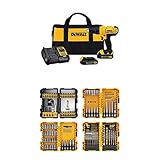
These 12V cordless drill kits are often the best fit for PVC trim. They have enough power for trim screws, are light enough for overhead work, and usually include two batteries. An 18V or 20V drill makes more sense if you also drill masonry, drive long screws, or use the same batteries for larger construction tools.
Drill driver or impact driver?
| Tool | Best use | Main advantage | Main risk |
|---|---|---|---|
| Compact drill driver | Most PVC trim screws | Clutch control and smooth starting | Can stall on long or structural screws |
| 18V drill driver | Mixed trim and general construction | More torque and longer runtime | Heavier and easier to overdrive fasteners |
| Impact driver | Long screws, dense framing, repeated fastening | High driving power with less wrist strain | Little precise torque control; can strip or crush PVC |
Use a drill driver for ordinary PVC trim screws, especially screws around 1 1/4 to 2 1/2 inches long. Set the clutch low and increase it one step at a time until the screw seats flush. Keep the drill straight and stop as soon as the head reaches the surface.
An impact driver earns its place when you are driving many long screws into wood framing or composite backing. It can also help with 3-inch or longer fasteners, where a small drill may stall. If you use one, run it at low speed and pulse the trigger rather than holding it wide open. A compact compact cordless impact driver is easier to manage than a high-powered model.
Bits and screws matter as much as the drill
Use a sharp, correctly sized bit. A worn Phillips bit cams out of the screw recess and damages both the bit and the screw head. Square-drive and Torx-style trim screws usually hold the bit more securely than Phillips screws, particularly when working overhead.
For exterior PVC trim, use corrosion-resistant exterior screws. Stainless steel screws resist rust but cost more and may have lower strength than coated structural screws. For most trim, a trim-head or small-head screw leaves a cleaner surface than a large washer-head fastener. Follow the trim manufacturer’s guidance where available, since some products specify screw type, spacing, and whether holes should be oversized.
Keep a set of impact-rated driver bits nearby even if you use a drill. They are less likely to break when the bit slips or when a screw meets a hard spot. Impact-rated bits do not make a drill an impact driver, but they are a worthwhile upgrade for either tool.
How to drive screws without damaging PVC
Mark the screw locations first. For long, straight trim runs, keep fasteners roughly 16 inches apart when attaching to typical framing, and place them closer where the manufacturer requires it or where wind exposure is high. Keep screws far enough from the edge to avoid splitting, commonly at least 3/4 inch unless the trim instructions specify otherwise.
Drill a pilot hole when the screw is near an edge, when the PVC is cold, or when the fastener is large. A pilot hole slightly smaller than the screw’s shank reduces splitting and lowers driving resistance. In cold weather, PVC becomes less forgiving, so predrilling is particularly useful. For long boards, a clearance hole through the PVC can allow seasonal movement while the screw still grips the framing; use the product instructions rather than guessing.
Drive the screw until the head is flush or just barely recessed. Do not countersink aggressively. A screw driven too deep creates a dish that can collect water and may cause the PVC to deform around the head. If the face mushrooms, back the screw out, let the material relax, and replace it in a nearby location if necessary. Do not simply bury the damaged area under filler.
Battery size and control
A 1.5Ah or 2.0Ah battery keeps a compact drill light for trim installation. A 4.0Ah or larger pack provides more runtime, but the extra weight becomes noticeable when fastening overhead. Two smaller batteries are often more convenient than one large battery because one can charge while the other is in use.
Speed control is more important than raw torque. Start slowly to seat the screw, then release the trigger as the head approaches the surface. If the drill has a mechanical clutch, begin around a low-to-medium setting and test on a scrap piece of PVC. The correct setting depends on screw diameter, trim thickness, temperature, and the density of the framing behind it.
The practical buying choice
For a homeowner installing PVC window or door trim, buy a compact drill driver kit with a clutch, two batteries, and a good bit holder. That cheaper option is entirely adequate for occasional work. Choose an 18V brushless drill if you expect regular remodeling, long fasteners, or other demanding drilling. Choose an impact driver only when speed and long-screw capability outweigh the need for delicate control.
Also budget for sharp bits and exterior-rated screws. A premium drill cannot compensate for a damaged bit, an unsuitable fastener, or excessive trigger pressure. On PVC trim, controlled driving and correct screw depth prevent more failures than extra motor power.