What's inside
As an Amazon Associate I earn from qualifying purchases. This post may contain affiliate links at no extra cost to you.
The right drill bit set depends on what you’ll actually drill. A standard twist-bit set handles many wood and plastic jobs, but aluminum calls for sharper cutting and a little more care. For occasional household work, a basic high-speed steel (HSS) set is usually enough. If you drill metal often, a better-ground set is worth considering.
As an Amazon Associate we earn from qualifying purchases at no extra cost to you.

What we cover
Choose by material, not by the biggest set
For wood, ordinary HSS twist bits work for pilot holes and general drilling. Brad-point bits are easier to keep on target and make cleaner entry holes, especially in finished boards. A set of brad points is a useful addition if neat woodworking holes matter; it is not essential for rough framing or small pilot holes.
Plastic is forgiving, but it can melt, crack, or grab if the bit gets hot or the drill is pushed too hard. A sharp HSS bit is fine for most plastics. Use a slower speed, light pressure, and a backing board when drilling thin sheet. For acrylic and other brittle plastics, a bit designed for plastic or a modified geometry is safer than a dull general-purpose bit.
Aluminum is soft, but it can clog flutes and grab the work. A sharp HSS bit is adequate for occasional holes. Cobalt bits are generally unnecessary for ordinary aluminum work; they are mainly useful for tougher metals and higher-heat drilling. For aluminum, sharpness, controlled speed, and chip clearing matter more than buying the hardest bit available.
What the common set types do well
| Set type | Best for | Trade-off |
|---|---|---|
| Basic HSS twist bits | Wood, plastic, and occasional aluminum | May wander in wood; quality and sharpness vary |
| Brad-point wood bits | Accurate, clean holes in wood | Not a general metal-drilling choice |
| Step bits | Large holes in thin sheet metal or plastic | Not suited to deep holes or thick stock |
| Cobalt twist bits | Frequent drilling in harder metals | Costs more and can be brittle if misused |
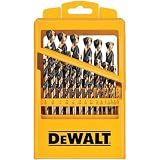
For a mixed-material home kit, start with a HSS twist drill bit set that includes the sizes you use, rather than choosing by bit count alone. A 100-piece set may contain many duplicates or tiny sizes you rarely need. Check that the set covers common sizes such as 1/8, 3/16, 1/4, and 3/8 inch, and that replacement bits are easy to find.
What to check before buying
Look for clearly marked sizes and a case that holds bits securely. A loose bit can fall out in a tool bag, and unreadable markings make it easy to choose the wrong size. Split-point tips can reduce walking on metal, but they do not replace a center punch when precise placement matters. For wood, a brad-point set can complement—not replace—a basic twist set.
Match the shank to your drill. Most ordinary sets use round shanks that fit standard three-jaw chucks. Hex-shank bits are convenient for quick changes in an impact driver, but an impact driver is not the first choice for careful drilling in aluminum: its pulsing action can make the bit chatter or catch. Use a cordless drill with a controllable trigger and a standard chuck when possible. If you need wood-specific bits, a brad-point wood bit set is a practical add-on.
For thin sheet, a step drill bit set can make clean, larger holes without switching through several twist-bit sizes. It is not a substitute for twist bits in thick material, and the workpiece still needs to be clamped.
Drill without burning or breaking the bit
Clamp the work whenever possible. Small pieces can spin dangerously if a bit catches, and thin sheet can buckle. Mark the hole first; for metal, use a center punch to keep the bit from wandering. Start slowly, then increase speed once the bit has established a cut.
In wood, back the work with scrap to reduce tear-out as the bit exits. Pull the bit out occasionally on deeper holes to clear chips. In plastic, use light pressure and pause if the material begins to soften or smear. In aluminum, use cutting fluid or a drop of light oil for larger holes, keep the bit sharp, and clear packed chips before they bind. Do not force a stalled bit: it can twist the workpiece, overheat, or snap.
Bit size also affects effort. A 1/4-inch hole is an easy job for most cordless drills, while larger holes need more torque and a steadier grip. For a hole larger than the bit set comfortably handles, use a suitable hole saw or step bit rather than leaning harder on a small drill.
A sensible kit for most users
If you mostly assemble furniture, make pilot holes, and handle occasional repairs, buy a modest HSS set and replace individual bits as they dull. Add brad points if clean wood holes are a regular task. Choose cobalt only if you routinely drill tougher metals, and choose step bits for repeated holes in thin sheet. Spending more can buy better consistency and longer life, but careful setup and a sharp bit often matter more than a large, expensive assortment.