What's inside
As an Amazon Associate I earn from qualifying purchases. This post may contain affiliate links at no extra cost to you.
Thin fiberglass panels are easy to drill badly. A standard twist bit can grab as it breaks through, chipping the surface, splitting a brittle panel or catching the back side. For clean holes, choose a bit that cuts rather than tears, support the panel, and keep the drill’s speed and pressure under control.
As an Amazon Associate we earn from qualifying purchases at no extra cost to you.


What we cover
Which drill bit works best?
For occasional holes in thin, flat panels, a sharp brad-point bit is often the simplest choice. Its center point helps keep the bit from wandering, and its cutting edges make a neater entrance than a general-purpose twist bit. Use light pressure and stop as soon as the bit breaks through.
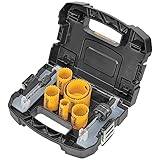
For repeated holes or a cleaner finish on both faces, a carbide-grit or diamond-grit hole saw is a better fit. These abrade the material instead of relying on toothed edges that can snag fibers. They cost more, and they cut more slowly, but they’re less likely to tear up a thin panel when used with firm backing. A standard bi-metal hole saw can work for a one-off job, but its teeth may catch or leave a rough edge.
Fiberglass is abrasive, so ordinary steel bits can dull quickly. If you’re drilling only a few small holes, buying a special bit may not be worth it. For a batch of holes, or for visible work where edge quality matters, look at carbide-grit hole saws for fiberglass or a suitable diamond-grit alternative.
Bit types at a glance
| Bit type | Best for | Trade-off |
|---|---|---|
| Brad-point bit | Small holes, roughly 1/8 to 1/2 inch | Easy to control; can still chip at breakthrough without backing |
| Carbide-grit hole saw | Clean, larger holes and repeated work | Slower and costlier; needs steady support |
| Diamond-grit hole saw | Clean cuts in hard, abrasive laminate | Usually pricier; avoid side loading or forcing the cut |
| Standard twist bit | Small, hidden holes in a pinch | Can wander, grab, and fray the exit side |
| Bi-metal hole saw | Occasional larger holes when finish is secondary | Teeth may snag thin fiberglass and cause chipping |
Prepare the panel first
Check what is behind the panel before drilling. A panel may cover wiring, plumbing, a tank or another surface you don’t want to hit. If the hole needs to fit a fastener, measure the fastener and check its required clearance rather than guessing from the label on the bit set.
Support the work on a flat sacrificial board, ideally plywood or a dense offcut. Clamp the panel gently between the board and a second piece if practical; overtightening can crack or distort it. Backing close to the hole supports the fibers as the bit exits. For a visible surface, apply masking tape over the mark and draw the center on the tape. Tape can reduce surface scuffing, but it does not replace backing.
Wear safety glasses and a well-fitting particulate respirator. Drilling can release irritating fiberglass dust; work outdoors or use dust extraction where possible. Don’t blow dust away with compressed air or brush it off your skin. Clean up with a suitable vacuum and wash exposed skin afterward.
Drill slowly and control breakthrough
Use a regular drill or drill-driver, not a hammer drill or impact driver. Impact action and hammering can crack or delaminate a thin panel, and an impact driver’s repeated blows make it harder to control a hole saw. Set the drill to its low gear if it has one and disable hammer mode.
For a small brad-point bit, start around 500–1,000 rpm and use gentle, steady pressure. For a hole saw, begin around 300–600 rpm for common 1/2- to 2-inch holes, then adjust for the bit maker’s guidance and how the cut behaves. These are practical starting ranges, not fixed rules: a hot bit, burning smell or dust packed into the cut means stop and let the tool cool. Don’t force it. A cordless drill with a side handle can give better control for larger hole saws.
Keep the drill square to the panel. With a hole saw, let the abrasive rim work; pushing hard can overheat the bit, wander off the mark or crack the panel. Once the pilot point or cutting rim is through, ease off immediately. If you can access the back, drilling from both sides until the cuts meet can reduce exit damage, but it requires careful alignment. Otherwise, backing the panel is the more practical choice.
Common failures and how to avoid them
A ragged exit usually means the panel wasn’t supported, pressure stayed high at breakthrough, or a toothed bit grabbed the fibers. A wandering hole often comes from starting on a slick surface with a plain twist bit; use a center punch only if the panel can tolerate it, or start with a small brad-point bit. A crack radiating from the hole can indicate too much clamping force, a dull bit, a hole too close to the edge or excessive pressure.
If the hole is near an edge, keep a generous margin. A practical minimum is about twice the hole diameter from the center of the hole to the panel edge, with more distance preferred on brittle or unsupported material. For a hole that must be larger than about 1/2 inch, a hole saw is usually easier to control than drilling a ring of small holes and joining them.
What to buy for the job
For two or three small holes, a sharp brad-point bit in the correct diameter is a sensible, inexpensive choice; replace it if it starts to burnish rather than cut. For multiple larger holes or a clean finished opening, buy a carbide-grit or diamond-grit hole saw sized for the panel. If you’re choosing one for a cordless drill, check the shank fits the chuck and the saw’s recommended speed is within the drill’s range. A brad-point bit set is useful for small holes in mixed materials, but a specialty hole saw is the better spend when fiberglass is the main task.
Don’t buy the most expensive option by default. For an unseen hole in a thin panel, a sharp general-purpose bit, careful backing and a slow finish may be entirely adequate. Spend more when the hole is large, repeated, close to a visible edge or difficult to repair.