What's inside
As an Amazon Associate I earn from qualifying purchases. This post may contain affiliate links at no extra cost to you.
Mixing a small batch of thinset is a tougher job for a cordless drill than driving screws. The load rises as the powder wets, and a paddle can twist the drill hard enough to strain its gearbox, battery, or your wrist. For a few pounds of mortar, a suitable 18V or 20V drill can work. For repeated batches, a corded mud mixer is usually the better tool.
As an Amazon Associate we earn from qualifying purchases at no extra cost to you.

What we cover
What makes a drill suitable
Look for a two-speed drill with a low gear, a side handle, and enough capacity for the paddle manufacturer’s recommendations. A paddle around 3 to 4 inches across is a practical size for small batches; larger paddles add drag and are easy to overload. Check the drill manual for its permitted bit size and mixing use. A model’s high torque number alone does not tell you whether it can mix mortar safely.
Use the low-speed setting, not the trigger’s highest speed. Many drills run roughly 0–500 rpm in low gear and 0–2,000 rpm in high; for thinset, stay near the low end and follow the mortar and paddle instructions. A variable-speed trigger helps, but it is not a substitute for choosing low gear. If the drill has a clutch, set it to drill mode only if the manual allows mixing there; some manufacturers prohibit mixing entirely.
The side handle matters because a paddle can catch on a lump or scrape the bucket. Keep two hands on the drill, stand securely, and use a sturdy bucket. Do not hold the bucket between your feet. Stop if the drill stalls, overheats, or the battery cuts out; repeated stalls are a sign the batch, paddle, or tool is too much.
Cordless drill options for small batches
| Tool type | Best use | Trade-off |
|---|---|---|
| Compact 18V/20V drill | Occasional, very small batches with a small paddle | More likely to stall or overheat; check manual and handle setup |
| Full-size 18V/20V drill with side handle | A few small batches, if rated for mixing | Heavier, but usually easier to control under load |
| Corded mud mixer | Multiple batches or regular tile work | Costs more and needs an outlet, but is built for sustained mixing |
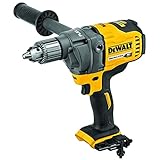
A full-size drill with a side handle is the most sensible cordless choice when the manufacturer permits mixing. Compare the 18V cordless drills with side handles by their low-speed range, included handle, and stated mixing limits—not just advertised torque. A compact drill may be fine for a patch or a small backsplash, but it is a poor bet for a full bag or a long mixing session.
If the drill manual rules out mixing, respect that limit. A drill that can spin a large hole saw is not automatically designed for continuous paddle loads. Thinset can also shorten battery runtime quickly: keep a charged spare nearby, but do not treat swapping batteries as a fix for a drill that is getting hot or stalling.
Choose the paddle and batch size
Buy a mixing paddle that fits the drill’s chuck and is intended for mortar or thinset. Avoid improvised paint stirrers and oversized paddles. A small paddle creates less resistance, but it still needs to reach the bucket bottom without striking it. Confirm the paddle’s recommended speed and direction; some designs are intended to pull material up from the bottom, while others push it down.
Start with less material than you think you need. Follow the thinset bag’s water ratio, add water and powder in the order the label specifies, and measure rather than guessing. A batch of a few pounds is more manageable than mixing a full bag with a general-purpose drill. If the drill labors, divide the batch further or use a proper mixer. Do not add extra water just to make the mortar easier to mix: that can weaken the finished bond and change the mortar’s working properties.
Mix at low speed until the powder is wetted and lumps are gone, scrape the bucket sides if needed, then let the mortar slake for the time stated on the bag. Mix again briefly as directed. Mortar that has begun to set should not be revived with water. Make only as much as you can spread within the product’s pot life, which varies by formulation and conditions.
When a dedicated mixer is worth it
If you are mixing more than a couple of small batches, tiling a floor, or working with a drill that has no side handle, a dedicated mortar mixer is the safer category to consider. A purpose-built mixer gives you a longer handle and is designed for sustained mixing loads. For most frequent tile work, a corded mixer is also a practical value: you avoid burning through drill batteries and can keep a consistent pace.
The cheaper option is reasonable when the job is genuinely small, the drill manual allows it, and you already own a low-speed drill with a side handle. Buying a new high-torque drill just for occasional thinset mixing is harder to justify. Compare its cost with a mixer—or ask whether a rental makes sense for a one-time floor job.
Common mistakes that damage tools or mortar
Do not use an impact driver. Its hammering action is meant for fasteners, not blending mortar, and it offers poor control for this task. Do not run a standard drill in high gear, mix a full bag because the label lists that yield, or force the paddle through material that has started to stiffen. These choices can overheat the motor, trip the tool’s protection, damage the chuck, or leave dry pockets in the mix.
Keep the paddle submerged before starting to reduce splashing, and lift it only when switched off. Wear eye protection and gloves; dry cement products can irritate skin and eyes. Clean the paddle and bucket promptly, following the product directions, before residue hardens. If the drill becomes unusually hot, smells burnt, or repeatedly stalls, stop and let it cool. For a larger batch, switch to a suitable mixer rather than asking a cordless drill to do a job it was not built for.