What's inside
As an Amazon Associate I earn from qualifying purchases. This post may contain affiliate links at no extra cost to you.
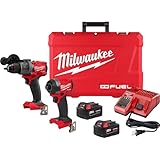
Buy the Milwaukee M12 Fuel drill/impact combo if your work is cabinets, electrical rough-in, HVAC, furniture, and fasteners under about 3 inches; buy the M18 Fuel combo if you will drill structural-size holes, drive lags or ledger screws, or build decks. The torque gap between the two tiers is roughly 4:1 on the drill and about 30% on the impact driver — that is a capability difference, not a spec-sheet detail.
As an Amazon Associate we earn from qualifying purchases at no extra cost to you.


What we cover
What the two tiers actually look like on paper
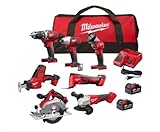
Milwaukee sells each tier as a two-tool combo with two batteries and a charger, in both brushed (budget) and brushless Fuel versions. The numbers below are manufacturer-published figures for the current-generation Fuel tools; exact specs vary slightly by kit SKU, so treat them as representative rather than exact.
| Spec | M12 Fuel 2-Tool Combo | M18 Fuel 2-Tool Combo | M18 Compact (brushed) Combo |
|---|---|---|---|
| Drill/driver peak torque | ~400 in-lbs, ½″ chuck | ~1,400 in-lbs, ½″ chuck | ~500 in-lbs, ½″ chuck |
| Impact driver peak torque | ~1,500 in-lbs | ~2,000 in-lbs, 4-mode drive control | ~1,500 in-lbs |
| Impact no-load speed | up to ~3,400 RPM | up to ~3,900 RPM / 4,400 IPM | up to ~2,750 RPM |
| Batteries typically in kit | 2 × CP2.0 (or 2.0 + 4.0) | 2 × XC5.0 | 2 × CP1.5 |
| Total kit battery energy | ~48 Wh | ~180 Wh | ~54 Wh |
| Bare tool weight (approx.) | ~2 lb each | drill ~3.2 lb, impact ~2.4 lb | ~3–3.5 lb each |
| Typical street price for kit | ~$180–$280 | ~$300–$450 | ~$150–$200 |
Two things stand out. First, the M18 kit ships with nearly four times the stored energy, because M18 kits almost always include XC batteries while the milwaukee m12 drill and impact set usually comes with compact 2.0Ah packs. Second, the brushed M18 combo is cheaper than M12 Fuel yet out-torques its drill — worth knowing if budget, not size, is your constraint.
Torque: what each tier can actually drive
Peak torque ratings describe a momentary stall number, but they map fairly predictably onto real tasks:
- Either tier handles comfortably: pilot holes up to ~⅜″, spade bits to ~1″ in softwood, pocket screws, cabinet hardware, #8–#10 wood screws to 3″, cabinet and door installs, sheet metal screws.
- M12 can do, but slowly: ¼″ lags to ~4″ (pre-drill helps), 3″ deck screws all afternoon, small hole saws in the 1¼–2″ range. Expect the tool to bog and the battery to drain noticeably faster under sustained load.
- M18-only territory: self-feed bits up to ~2-9/16″, hole saws over 3″, ship augers through doubled studs, ⅜″ and larger structural screws, ledger and timber fasteners, mixing drywall mud or thinset.
The honest dividing line is sustained load, not peak torque. An M12 impact will sink a surprising number of deck screws; it just works hard doing it, which shows up as heat and runtime, not failure. If you regularly hit the third bullet above, no amount of technique makes M12 the right tool. Conversely, if your week is cabinet boxes and EMT straps, an M18 kit spends its life running at 20% throttle while feeling twice as heavy.
Battery capacity: a quick runtime calculation
Watt-hours are the honest way to compare packs across voltages: volts × amp-hours. A Milwaukee CP2.0 M12 battery stores roughly 24 Wh, an XC4.0 about 48 Wh; an M18 XC5.0 holds about 90 Wh. Now apply that to a real task. Driving a 3″ #10 deck screw into pressure-treated pine takes on the order of 0.4–0.6 Wh per screw (varies with moisture, pilot, and battery age):
- M12 Fuel impact + 4.0Ah pack (48 Wh) ≈ 90–120 screws per charge
- M18 Fuel impact + 5.0Ah pack (90 Wh) ≈ 170–220 screws per charge
These are field estimates, not lab results — but they explain why deck builders and framers end up on M18 regardless of torque, and why an installer doing punch-list work never notices M12’s smaller tank. High Output and Forge-series M18 packs also sustain voltage better under heavy load, which is a real (if incremental) upgrade path the M12 line only partially mirrors.
Size and weight where it actually matters
The M12 Fuel tools are roughly a pound lighter each and meaningfully shorter front-to-back — enough to fit between studs, inside cabinets, and above ceilings where an M18 drill physically won’t. Overhead work is where the difference compounds: holding a 2 lb tool at arm’s reach versus a 3.2 lb tool over a full install day is the difference between normal fatigue and sore shoulders. Interestingly, torque-per-pound is nearly identical between tiers — the M18 isn’t more efficient, just bigger and stronger.
Which kit for which buyer
| Your situation | Right choice | Why |
|---|---|---|
| Apartment dweller; furniture, curtains, occasional projects | M12 Fuel combo | Never touches its torque ceiling; stores in a drawer |
| Serious DIYer with a deck, fence, or renovation in the plans | M18 Fuel combo | Structural fasteners and hole saws are the breaking point for M12 |
| Electrician, HVAC tech, cabinet/install contractor | M12 Fuel combo, add M18 later if needed | Overhead and confined-space work dominates; saves wrist daily |
| Framer, remodeler, deck builder | M18 Fuel combo | Runtime and sustained torque are the job |
| One-kit-only buyer who wants maximum coverage | M18 Fuel combo (drill + hammer drill versions cost slightly more) | It covers everything M12 does except tight spaces and overhead comfort |
| Tightest possible budget, still want 18V power | M18 compact brushed combo | 500/1,500 in-lbs outperforms M12 on paper for less money — you lose brushless life and compact size |
Ownership realities: what wears, what to buy alongside
Whichever milwaukee drill and driver set you pick, the first things to wear out aren’t the tools:
- Driver bits are consumables. Impact drivers destroy standard bits — buy a Milwaukee Shockwave Impact Duty bit set or equivalent impact-rated bits. Phillips #2 and Torx T25 wear first; a multi-pack costs little compared to extracting one snapped screw.
- The impact collet develops wobble over years of hard use — the ¼″ hex anvil and retention spring wear. It’s cosmetic until bits start dropping out.
- Batteries fade before tools. Expect meaningful capacity loss after roughly 3–5 years of heavy use. Store packs around half charge, keep them out of freezing garages and hot truck cabs, and never leave them fully discharged.
- Brushless Fuel motors need no brush service — that’s the main long-term argument over the brushed combo.
- Common mistakes: buying M12 then discovering you needed the hammer function for masonry (only hammer-drill SKUs have it — check the kit), running full trigger on small fasteners instead of using the lower drive modes, and using non-impact bits in the impact driver.
Milwaukee’s warranty runs about five years on tools and three on most XC batteries (two on compact packs), which is solid but won’t save a battery killed by storage abuse.
If you’re cross-shopping DeWalt and Makita
The same 12V-vs-18V logic applies to competitors. A DeWalt impact driver and drill set comes in two parallel tracks: the compact 20V MAX kits (like the long-running DCK240C2 tier) and the smaller Atomic-series kits, which roughly mirror the M12/M18 split — a DeWalt drill and driver set in Atomic trim is the closest analog to M12 Fuel. For a Makita drill and impact set, the 18V LXT line (such as the XT269M two-tool kit) is the M18 competitor, while the 12V CXT line plays the M12 role; Makita’s 40V XGT sits above both. A Makita drill and driver set or DeWalt kit at the same voltage tier will land within ~10–15% of Milwaukee on torque — the real decision is which battery platform you want to live inside, because batteries never cross between brands.
FAQ
Can M12 and M18 batteries be swapped?
No. The two platforms are physically and electronically incompatible — this is the real cost of choosing M12, since every future tool purchase follows the platform you start with.
Will an M12 impact driver build a deck?
It will drive hundreds of 3″ deck screws per charge, just slower and hotter than M18. Where it genuinely struggles is structural screws, lags, and anything requiring an impact wrench’s job. Occasional deck, yes; deck business, no.
Is the Fuel (brushless) upgrade worth it?
For the drill, yes — Fuel roughly doubles torque in both tiers. For occasional DIY, a brushed kit still works, but the price gap has narrowed enough that Fuel is the default recommendation in 2026.
Do I need the hammer drill version?
Only if you’ll drill brick or block. The upcharge is typically modest, and a drill/driver-only kit can’t add the function later — buy it if there’s any doubt.