What's inside
As an Amazon Associate I earn from qualifying purchases. This post may contain affiliate links at no extra cost to you.
For most home DIYers, the right Black and Decker drill machine is a 20V MAX cordless drill/driver such as the LDX120C — it covers roughly 90% of household drilling and screwdriving, and its battery clips into dozens of other POWERCONNECT tools. A Black and Decker corded drill only pulls ahead when you need all-day runtime, bits larger than 3/8 inch, or hammer action for masonry. Here is how the current lineup splits by chuck size, power, and the jobs each one actually handles.
As an Amazon Associate we earn from qualifying purchases at no extra cost to you.


What we cover
The Black+Decker drill lineup compared
Black+Decker sells its drills in two families: the 20V MAX POWERCONNECT cordless platform and a small range of plug-in electric drills. Prices move around, but these are typical market ranges in 2026:
| Model | Type | Chuck | Power / speed | Weight | Typical price | Best for |
|---|---|---|---|---|---|---|
| LDX120C | 20V cordless drill/driver | 3/8 in keyless | ~650 RPM, ≈115 in·lb torque, 11-position clutch | ~3.3 lb | $40–55 kit | Everyday drilling and driving |
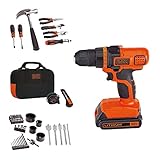
| LD120VA | 20V cordless drill/driver | 3/8 in keyless | ~650 RPM, same drill class as LDX120C | ~3.3 lb | $50–70 kit | First drill — includes a 30-piece accessory kit |
| Matrix BDCDMT120C | 20V cordless multi-tool base | 3/8 in drill head | ~800 RPM (drill attachment) | ~3 lb plus attachments | $60–80, heads extra | Growing into sander, jigsaw, oscillating tool |
| DR260C | Corded drill | 3/8 in | 5.2 A, 0–1,500 RPM | ~3 lb | $30–40 | Long sessions, mixed materials, no charging |
| DR560 | Corded drill | 1/2 in | 7.0 A, ~900 RPM | ~4 lb | $45–60 | Big auger bits, hole saws, mixing paddles |
| DR670 | Corded hammer drill | 1/2 in | ~6 A, ~2,800 RPM with hammer mode | ~4.5 lb | $50–70 | Brick, block, and mortar anchors |
What chuck size and power mean for real jobs
Chuck size is the maximum bit shank the drill can grip, and it quietly decides what a Black and Decker power drill can and cannot do. A 3/8-inch chuck accepts virtually every twist bit, driver bit, spade bit up to about 1 inch, and hole-saw arbors for saws up to roughly 2-1/8 inches — that is nearly everything a homeowner touches. You only need a 1/2-inch chuck for ship augers, large self-feed bits, mixing paddles, and hole saws over 2 inches.
- Furniture assembly, pilot holes, cabinet hardware, wall anchors in drywall — any 20V MAX cordless handles this without straining.
- Shelves into studs, 1-inch spade bits, small hole saws — a Black and Decker cordless drill copes, but keep a second battery charged.
- Mixing paint or thinset, wire-wheeling rust, boring repeated large holes — this is corded territory; the 7-amp DR560 will not fade halfway through.
- Brick, block, or mortar anchors — a standard drill just overheats a masonry bit. You need hammer action, which in this lineup means the DR670.
Speed tells a different story than torque. The corded DR260C spins to about 1,500 RPM and holds that speed under load, so it drills cleaner, faster holes in hardwood and metal. The 20V cordless drills top out near 650 RPM but add an 11-position clutch, which is what stops you from burying screw heads into softwood or stripping a Phillips drive — a feature corded drills simply do not have.
Which drill fits your situation
Match the tool to the job pattern, not to the biggest spec sheet:
| Your situation | Best pick | Why |
|---|---|---|
| Renter; a few picture-hanging and furniture weekends a year | LDX120C | Cheapest way into the 20V platform; light and simple |
| First home, no tools at all yet | LD120VA | Drill, battery, charger, and 30 accessories in one box |
| Plan to add a sander or jigsaw within a year | Matrix BDCDMT120C | One motor body and battery, bolt-on tool heads save money |
| Garage workshop, long sessions, no patience for charging | DR260C | Unlimited runtime, more RPM, cheaper than any kit |
| Deck repair, mixing, drilling joists and large holes | DR560 | 1/2-inch chuck and 7 amps for sustained heavy boring |
| Mounting anything to brick or block walls | DR670 | Hammer mode is the difference between minutes and failure |
Batteries and the Black+Decker drill charger: the hidden costs
Every 20V MAX tool runs on the POWERCONNECT battery system, so one pack serves the drill, sander, jigsaw, string trimmer, and more. Kits typically bundle the compact 1.5 Ah LBXR20; 2.0 Ah and larger packs are sold separately and roughly double your work per charge.
Charging is where listings get vague. The standard wall charger bundled with most kits is a slow unit — expect around three to four hours to refill a flat 1.5 Ah pack. The optional BDCAC202B fast charger pushes about 2 amps and cuts that to roughly 45–60 minutes. If you own only one battery, the fast charger is the best money you can spend on this platform.
Real-world runtime math: a fully charged 1.5 Ah pack drives on the order of 50–80 three-inch screws into pine before it fades — plenty for a bookshelf, tight for a deck rail. If a project regularly drains two packs, that is your signal to either buy a 2.0 Ah battery or admit the job wanted a Black and Decker electric drill with a cord.
Cost per use stays low either way. A $50 kit plus a $30 spare battery spread over five years of 25 weekend sessions a year works out to roughly 65 cents per session. Batteries are the consumable that decides whether that math holds — expect two to four years of regular DIY use, and store packs around half charge in a cool, dry spot rather than parked on the charger or freezing on a garage shelf.
One warning for longtime owners: the old Black and Decker drill 18V NiCad line is discontinued. A 20V MAX pack is the same nominal 18-volt class of power, but the mounts and chargers are physically different systems — old 18V batteries will not fit 20V tools, and vice versa. Do not spend money on replacement NiCad packs; put it toward the 20V platform instead.
Buying smart: bare tool, drill set, or bit set
A Black and Decker drill set — drill, battery, charger, and accessories in a single box — is the cheapest complete starter, and the LD120VA is the textbook example. Buying a bare tool only makes sense if you already own POWERCONNECT batteries.
Whatever kit you choose, plan on a proper drill bit set eventually, because bundled accessories cover driving better than drilling. A useful set contains:
- High-speed steel twist bits from 1/16 to 1/4 inch for metal and plastic
- Brad-point wood bits and spade bits up to 1 inch
- PH1/PH2/PH3, slotted, and Torx driver bits plus a magnetic holder
- Carbide-tipped masonry bits — but only buy these if you own or plan to buy a hammer drill
Skip the bargain 100-plus-piece sets; they pad the count with soft driver bits that cam out and ruin screw heads. A mid-tier set plus spare PH2 bits treated as consumables will outlast it. The Matrix system is the other smart route — one motor body that accepts drill/driver, sander, jigsaw, oscillating, and impact driver heads, so a single drill grows into a full kit.
Ownership realities: what wears first
- Batteries fade first. Capacity drops before the tool shows any wear — that is normal lithium-ion aging, not a defect.
- Chuck jaws glaze over. If bits keep slipping, clean the jaws and check for worn, polished shanks on cheap bits.
- Vents clog. Dust chokes the cooling slots and cooks the motor; blow the vents out with compressed air after dusty jobs.
- Bits are consumables. A dull twist bit makes you lean on the drill, which is what actually burns out small motors.
The common mistakes are predictable: drilling concrete with a non-hammer drill and blaming the bit, running a large bit at full cordless speed instead of slow and steady, never touching the clutch ring so every screw strips, and leaving a battery on the charger for months at a stretch.
FAQ
Can a Black and Decker cordless drill handle brick?
Soft mortar, yes, with a carbide masonry bit and patience. Solid brick, block, or poured concrete genuinely needs hammer action — the corded DR670 or a 20V MAX hammer drill — otherwise you will dull bits and make shallow, wandering holes.
Do old 18V Black+Decker batteries fit the new 20V drills?
No. Despite being the same nominal voltage class, the mounts are different and the chargers are not interchangeable. Treat 18V NiCad tools as end-of-life and move to the 20V MAX platform.
How long does a Black and Decker drill charger take?
The standard bundled charger needs roughly three to four hours for a 1.5 Ah pack. The 2-amp BDCAC202B fast charger brings that down to about an hour.
Is a 3/8-inch chuck enough for home use?
For about 90% of household tasks, yes. You only need 1/2 inch for bits with large shanks — big augers, mixing paddles, and hole saws over 2 inches.
Corded or cordless for a complete beginner?
Cordless. The clutch, the portability, and the shared-battery platform matter more to a new DIYer than the corded drill’s extra RPM — and a corded drill can always be a cheap second tool later.