What's inside
As an Amazon Associate I earn from qualifying purchases. This post may contain affiliate links at no extra cost to you.
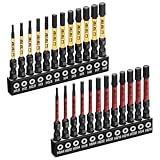
The best allen wrench bits for impact driver work are torsion-rated bits machined from S2-class tool steel with a straight-cut tip — Milwaukee’s SHOCKWAVE Impact Duty hex set is the right pick for most people, Wera’s Impaktor Hex-Plus bits last longest under daily use, and Makita ImpactX is the budget option that still survives real torque. For coverage, a metric range of 2–8 mm plus SAE sizes from 5/64″ to 1/4″ handles nearly every furniture bolt and machine screw a woodworker or homeowner will meet.
As an Amazon Associate we earn from qualifying purchases at no extra cost to you.


What we cover
What Actually Makes a Hex Bit Impact-Rated
Three things separate a bit that survives an impact driver from a hardware-store hex bit that snaps on the third bolt:
- Steel. Impact-rated bits use S2 tool steel or a proprietary shock alloy (Milwaukee uses its Custom Alloy76 blend) hardened to roughly HRC 58–62. Standard CR-V bits are hard enough for a ratchet but brittle under the repeated torque spikes of an impact mechanism — they chip at the flats or shear clean at the shank.
- Torsion geometry. Look for a narrowed waist or shoulder behind the tip — Milwaukee calls it Shockzone, DeWalt calls it FlexTorq, Wera calls it Impaktor. That section flexes a few degrees with each hammer pulse instead of transmitting the full spike into the tip.
- Tip profile. Straight-cut, full-profile hex only. Ball-end hex bits remove roughly half the metal at the working end to allow angled entry — they are hand-tool accessories and will snap almost immediately under impact torque.
A quality magnetic bit holder with its own torsion sleeve adds a second flex point and is worth the few dollars it costs; it also keeps short insert bits from wobbling in the collet.
The Sizes That Cover Furniture Bolts and Machine Screws
Flat-pack furniture is almost entirely metric, while older US-built machinery, jigs, and shop fixtures lean SAE. You don’t need a 40-piece set — you need the right ten sizes.
| Fastener | Typical Allen size | Where you’ll see it |
|---|---|---|
| M3 machine screw | 2.5 mm | Electronics mounts, small hardware |
| M4 machine screw | 3 mm | Cabinet hardware, jigs |
| M5 machine screw | 4 mm | Light furniture bolts, tool guards |
| M6 connector/furniture bolt | 4 mm or 5 mm | The standard flat-pack size |
| M8 furniture bolt | 5 mm or 6 mm | Beds, workbenches, machinery feet |
| M10 bolt | 8 mm | Heavy furniture, equipment stands |
| #8–#10 SAE machine screw | 9/64″–5/32″ | Older US machinery, fixtures |
| 1/4″-20 socket cap/button head | 3/16″ (cap) or 5/32″ (button) | Shop jigs, fences, power-tool parts |
| 5/16″ socket cap | 1/4″ | Stands, vises, heavy hardware |
Connector bolts vary by head style more than metric cap screws do, which is why a set covering both 4 mm and 5 mm matters more than the piece count on the box.
Best Allen Wrench Bits for Impact Drivers, by Situation
Best all-around set: Milwaukee SHOCKWAVE Impact Duty
The SHOCKWAVE line pairs shock-alloy steel with a pronounced torsion waist and a machined Wear Guard tip, and the hex sets are sold in both metric and SAE spreads that map almost exactly to the table above. At roughly $15–30 for a set, it is the set to buy if you want one purchase that covers furniture assembly and general shop work for years.
Best for daily, heavy use: Wera Impaktor Hex-Plus or Wiha Terminator
Wera’s 840/4-series Impaktor bits use a torsion zone plus the Hex-Plus profile, which contacts the flats of the screw socket rather than the corners — that matters on soft zinc-plated furniture bolts that round easily. Wiha’s Terminator line is the same idea at a slightly lower price, rated specifically for impact drivers. Expect $15–45 depending on set size. These are the picks if you assemble furniture or install hardware several days a week.
Best budget coverage: Makita ImpactX or DeWalt FlexTorq
Both lines are genuine impact-rated bits — machined tips, shock-resistant steel, torsion shaping — sold in small hex assortments around $10–25. They wear faster at the corners than Wera or Milwaukee under daily torque, but for weekend furniture builds they are entirely adequate and the lowest-cost way to get real torsion geometry.
Hex sizes above 8 mm: go to bit sockets, not bigger shanks
1/4″-shank hex bits top out around 8 mm or 5/16″. For 10 mm and larger — machinery feet, trailer hardware, large stand bolts — use a 3/8″-drive impact hex bit socket set from Tekton, Sunex, or GearWrench ($25–40) on an impact wrench or breaker bar. An impact driver collet was never meant to hold those sizes.
Spec Comparison at a Glance
| Set | Steel | Torsion design | Typical size range | Typical price |
|---|---|---|---|---|
| Milwaukee SHOCKWAVE Impact Duty | Custom Alloy76 shock steel | Shockzone waist | Metric 2–8 mm / SAE 5/64″–1/4″ | $15–30 |
| Wera 840/4 Impaktor Hex-Plus | Impaktor-rated tool steel | Impaktor zone + Hex-Plus flats | Metric 3–8 mm (SAE available) | $25–45 |
| Wiha Terminator impact bits | Impact-rated, coated | Torsion zone | Metric and SAE assortments | $15–30 |
| Makita ImpactX | S2-class impact steel | Torsion shoulder | Metric/SAE small sets | $10–20 |
| DeWalt FlexTorq / MAX IMPACT | Impact-ready steel | FlexTorq zone | Mixed metric/SAE | $10–25 |
| Tekton / Sunex 3/8″ hex bit sockets | S2 bits, Cr-Mo or chrome sockets | Socket-mounted (no torsion waist) | Metric up to 19 mm, SAE to 3/4″ | $25–40 |
How to Stop Snapping Bits and Rounding Bolts
- Clean the socket first. Furniture bolts arrive with finish overspray, packing lint, and paint in the recess. A bit seated on debris is a bit loaded at an angle — the number-one cause of snapped tips.
- Seat the bit fully and stay coaxial. Half the hex engaged means half the contact area. Push in until you feel the tip bottom out, and keep the driver in line with the bolt.
- Use the low-speed or assist mode. Most impact drivers deliver 1,200–1,800 in-lbs of torque; a flat-pack furniture bolt wants single-digit ft-lbs. Run speed 1, or better, use the self-tapping/assist mode many drivers now ship with.
- Finish by hand. Drive to snug with the impact, then do final seating with an L-key (Bondhus Protanium keys are the shop standard). You feel the joint close instead of shearing the bolt or crushing particleboard.
- Retire rounded bits. Once the flats show a polished, radiused edge, the bit is machining the inside of every bolt it touches. A $2 bit ruins $30 of hardware.
What Wears Out First (Ownership Realities)
- The tip corners go first — not the shank. Plan on the two or three sizes you use daily (almost always 4 and 5 mm) wearing out while the rest of the set looks new.
- Snapping happens at the retention groove on cheap bits, where the circlip notch creates a stress riser. If a bit snaps there, it was a heat-treat or machining problem — cheap sets fail at the notch; good bits wear at the tip.
- Rust is the quiet killer. S2 steel corrodes fast in a humid shop. A wipe with light oil or a silica pack in the case keeps edges crisp; rust pits on the flats act like stress risers too.
- Do the cost math: single impact-rated bits run $2–3 each at retail. A $25 set holding 15–20 bits is $1.25–1.65 per bit, and one good set typically outlives three $8 generic sets — the math favors buying once.
FAQ
Can I use ball-end hex bits in an impact driver?
No. The ball geometry removes metal exactly where torque concentrates. Ball ends are for hand-driving at awkward angles and will snap or round within seconds under impact pulses.
Do I need impact-rated bits for a regular drill/driver?
Not strictly — a drill/driver doesn’t hammer — but impact-rated bits still outlast standard ones because the torsion geometry flexes under stall torque instead of snapping. For occasional use, a good CR-V or S2 bit on a drill is fine.
Metric or SAE — which should I buy first?
Metric. Modern furniture, imported tools, and almost everything sold flat-packed uses M5–M8 hardware, meaning 4, 5, and 6 mm bits do most of the work. Add SAE when you start servicing older American machinery and shop fixtures.
Is an impact driver even the right tool for furniture bolts?
For driving, yes — it’s fast. For final torque, no — it’s far stronger than the hardware. Treat it as a speed tool and seat bolts by hand, or use the driver’s lowest assist setting if it has one.