What's inside
As an Amazon Associate I earn from qualifying purchases. This post may contain affiliate links at no extra cost to you.
What we cover
Best Hole Saw Cutters for Clean, Accurate Openings
The best hole saw cutter is the one whose diameter matches the opening, cutting depth clears the material, teeth suit the workpiece, and arbor fits your drill and saw. For occasional holes in wood, a standard bi-metal set is usually the most versatile buy; for frequent work in metal, choose a cutter designed for that metal and use a compatible arbor with a pilot bit.
Choose by job, not by the largest kit
A hole saw’s listed diameter is the nominal opening size, not a promise of a perfectly finished edge. The saw cuts a circular kerf and leaves a center plug. Allow for finishing if the opening must fit a pipe, grommet, or fitting precisely, and check the fitting manufacturer’s actual cutout requirement rather than relying on its nominal size.
As an Amazon Associate we earn from qualifying purchases at no extra cost to you.


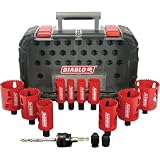
- One or two holes in wood or plastic: Buy the specific diameter you need, or a small set that includes it. A standard bi-metal cutter offers useful versatility without paying for many sizes you may never use.
- Repeated holes in lumber, plywood, or cabinet panels: Prioritize a sharp, appropriately sized cutter and enough cutting depth for the thickest piece. A pilot bit helps locate the hole, but it does not prevent tear-out on the exit face.
- Thin sheet metal or plastic: A fine-tooth bi-metal cutter can make a more controlled cut than a coarse wood-oriented design. Secure the sheet and use a backing board where practical.
- Frequent work in steel or other demanding metals: Consider a metal-cutting hole saw with teeth specified for the material and a sturdy arbor. Follow the maker’s speed and lubrication guidance; a cutter intended for wood is not a substitute.
- Deep workpieces or stacked material: Compare the saw’s usable cutting depth with the total thickness, and check whether the design lets you clear chips or remove the plug during the cut.
How the specifications affect the cut
| Specification | Example or range | What it means for the job |
|---|---|---|
| Diameter | 25 mm (about 1 in), 51 mm (about 2 in), 76 mm (about 3 in) | Larger cutters remove more material and need more torque. Match the required opening, not just the size of the fitting. |
| Cutting depth | 25 mm (about 1 in) or 38 mm (about 1½ in), depending on cutter | A cutter must pass through the workpiece. A deeper saw is useful for thick stock, but still needs chip and plug clearance. |
| Tooth material | Bi-metal teeth; carbide-tipped teeth | Bi-metal is a common general-purpose choice for wood, plastic, and suitable thin metals. Carbide-tipped designs are intended for tougher or abrasive materials when the maker approves the application. |
| Arbor shank | Commonly 6.35 mm (¼ in) or 9.5 mm (⅜ in) hex shanks | Confirm that the arbor fits the drill chuck and that its thread or locking system matches the hole saw. |
| Pilot bit | Often around 6 mm (¼ in), but varies | Centers the cutter and guides the start. Check that replacement bits fit the arbor and are long enough to engage before the teeth. |
These are representative examples, not universal specifications: diameter ranges, depth, tooth geometry, and arbor systems vary by product. Check the individual maker’s documentation before purchase, especially for large cutters, deep cuts, and metal applications.
Diameter: fit the opening and the drill
The larger the diameter, the more cutting edge contacts the work and the more resistance the drill must overcome. Big hole saws are more likely to catch if they bind, so use a drill with a suitable chuck and adequate torque, keep both hands on it, and avoid forcing the cut. If a hole is for a close-fitting component, make a test cut in scrap and check the actual fit before cutting the finished piece.
Depth: account for chips and the center plug
Cutting depth is not always the same as the maximum thickness you can cut cleanly in one pass. Packed chips create heat and drag, while a plug can become trapped inside the saw. If the stock exceeds the saw’s depth, a through-cut from both sides may work when you can accurately align the second cut. Otherwise choose a deeper cutter designed for the task or use another method.
Tooth material: match it to the workpiece
Bi-metal cutters are a practical starting point for mixed work because their tooth construction is suited to a broader range of applications than a basic coarse-tooth wood cutter. Carbide-tipped cutters can be appropriate for tougher materials, but “carbide” alone does not establish that a saw is suitable for every metal, composite, or plastic. Check the stated material list and operating instructions. For plastics, a sharp cutter and controlled feed matter: excessive heat can soften or melt the edge.
Arbor compatibility: check every connection
The arbor connects the hole saw to the drill and commonly holds the pilot bit. Verify three things before ordering: the arbor’s shank fits your drill chuck, its connection matches the cutter, and its pilot bit is replaceable or available if you expect regular use. Some cutters use a specific quick-change or threaded system, so a familiar-looking arbor may still be incompatible. A wobbly or poorly seated assembly can make an oversized opening and damage the workpiece.
A practical buying matrix
| Your situation | Best starting choice | Why |
|---|---|---|
| Beginner, occasional household holes | Single bi-metal cutter in the required size, with matching arbor | Limits unused sizes and makes compatibility easier to verify. |
| Small workshop, several common diameters | Bi-metal set with clearly stated sizes and a sturdy arbor | Convenient for varied wood and plastic jobs; confirm the set includes the sizes you actually use. |
| Frequent metal openings | Purpose-specified metal-cutting saw and compatible arbor | Tooth design, speed limits, and lubrication guidance matter more than the number of cutters in a kit. |
| Thick stock or repeated deep holes | Deep-cut model with accessible chip and plug removal | Reduces the need to improvise when the work exceeds a shallow cup’s capacity. |
Set up for a cleaner opening
- Mark and support the work. Clamp the piece so it cannot spin or lift. Put scrap backing beneath the exit face when possible; it supports fibers and helps reduce breakout.
- Check the assembled cutter. Seat the saw and arbor fully, tighten the chuck, and confirm the pilot bit projects beyond the teeth enough to locate the cut.
- Start square and steady. Begin with the pilot bit at the mark and the saw held perpendicular. Let the teeth establish a groove before applying consistent pressure.
- Clear chips before they pack. Pause periodically, especially in deep cuts or metal. Packed debris raises friction and heat and can stall the saw.
- Ease off as the cut breaks through. Reduced pressure near the exit helps limit splintering and prevents the cutter from grabbing as the center plug separates.
- Remove the plug and inspect the teeth. Disconnect power before clearing a jam. After use, brush away debris and dry the cutter; follow the manufacturer’s care directions for any coatings or cutting fluid.
For metal, follow the cutter maker’s recommended speed and lubricant instructions. For any material, stop if the saw binds, overheats, or vibrates unusually; forcing it can damage the cutter, drill, or workpiece.
What wears first—and what to avoid
In normal use, the teeth are the main consumable. Cutting abrasive material, running too fast, forcing the feed, or letting chips accumulate can dull or damage them early. Pilot bits also wear or break, particularly if the cutter catches or the work is not secured. Replace worn parts with components specified for the arbor rather than assuming a generic bit will fit.
Common causes of rough openings include using a dull or wrong-purpose cutter, cutting without support beneath the exit face, starting at an angle, and choosing a diameter based only on a fitting’s label. For accurate results, check the actual dimensions, make a test cut when fit matters, and let the cutter—not excessive pressure—do the work.