What's inside
- Makita impact wrench picks at a glance
- 1. Makita TW001G: the strongest 1/2-inch choice
- 2. Makita DTW300: best compact automotive impact
- 3. Makita DTW1002: the heavy-duty 18V compromise
- 4. Makita TW004G: the useful 3/4-inch structural option
- Head-to-head: what happens with a rusted lug nut?
- Decision matrix
- Auto-stop modes: useful protection, not a torque certificate
- Ownership details that affect the choice
- Related Guides
- Makita impact wrench picks at a glance
- 1. Makita TW001G: the strongest 1/2-inch choice
- 2. Makita DTW300: best compact automotive impact
- 3. Makita DTW1002: the heavy-duty 18V compromise
- 4. Makita TW004G: the useful 3/4-inch structural option
- Head-to-head: what happens with a rusted lug nut?
- Decision matrix
- Auto-stop modes: useful protection, not a torque certificate
- Ownership details that affect the choice
- Related Guides
As an Amazon Associate I earn from qualifying purchases. This post may contain affiliate links at no extra cost to you.
The Makita TW001G is the best choice for maximum nut-busting power, while the compact DTW300 is the better all-around automotive makita impact wrench; choose the DTW1002 for a proven 18V 1/2-inch platform and the TW004G when 3/4-inch structural fasteners are part of the job.
This comparison separates two numbers that are often confused: tightening torque, which describes how forcefully the tool drives a fastener, and nut-busting torque, which describes its ability to loosen an already seized fastener. The latter is the more useful figure for rusted lug nuts and neglected suspension hardware.
As an Amazon Associate we earn from qualifying purchases at no extra cost to you.


What we cover
- Makita impact wrench picks at a glance
- 1. Makita TW001G: the strongest 1/2-inch choice
- 2. Makita DTW300: best compact automotive impact
- 3. Makita DTW1002: the heavy-duty 18V compromise
- 4. Makita TW004G: the useful 3/4-inch structural option
- Head-to-head: what happens with a rusted lug nut?
- Decision matrix
- Auto-stop modes: useful protection, not a torque certificate
- Ownership details that affect the choice
- Related Guides
Makita impact wrench picks at a glance
| Model | Battery platform | Anvil | Max tightening torque | Max nut-busting torque | Best use |
|---|---|---|---|---|---|
| Makita DTW300 | 18V LXT | 1/2-inch square drive | 330 Nm | 580 Nm | Compact automotive and maintenance work |
| Makita DTW1002 | 18V LXT | 1/2-inch square drive | 1,000 Nm | 1,600 Nm | Heavy automotive repair and seized hardware |
| Makita TW001G | 40V XGT | 1/2-inch square drive | 1,350 Nm | 2,050 Nm | Extreme nut removal and heavy equipment |
| Makita TW004G | 40V XGT | 3/4-inch square drive | 600 Nm | 1,000 Nm | Structural bolting and larger sockets |
Torque figures are manufacturer-published maximums and can vary by market, battery, fastener condition and test method. They are useful for comparing the tools, but they are not a substitute for a calibrated torque wrench when a vehicle or structural specification requires a precise final torque.
1. Makita TW001G: the strongest 1/2-inch choice
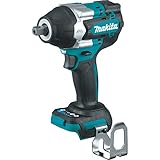
The TW001G is the answer for buyers searching for a high-output makita impact wrench 1/2. Its 40V XGT motor offers substantially more reserve than ordinary compact cordless impacts, with a claimed 1,350 Nm of tightening torque and up to 2,050 Nm of nut-busting torque.
That reserve matters when a wheel nut is corroded to the stud, a trailer fastener has been overtightened, or a machine bolt has spent years exposed to dirt and moisture. The 1/2-inch anvil keeps socket availability excellent for automotive work, while the tool’s output is high enough for many heavy-equipment applications.
Its main disadvantage is excess. It is heavier, larger and more expensive than needed for routine tire rotation or engine-bay work. On alloy wheels and smaller fasteners, the lower electronic speed settings are essential. The automatic-stop and reverse-rotation modes can reduce overrun, but they do not make it safe to final-tighten every fastener by trigger alone.
2. Makita DTW300: best compact automotive impact
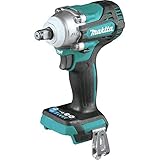
The DTW300 is the most balanced option for regular automotive users who already own 18V LXT batteries. It uses a 1/2-inch drive, produces up to 330 Nm of tightening torque and reaches a claimed 580 Nm in reverse. Its relatively short head length, roughly 144 mm, makes it easier to position inside wheel wells and around suspension components than the high-output models.
Four electronic power settings, a variable-speed trigger and automatic-stop functions give it better control than a basic three-speed impact. Depending on the selected mode, the tool can stop or reduce impact action when a fastener breaks free or approaches a controlled tightening point. These modes are useful for preventing unnecessary thread damage, but the final torque still needs verification.
Choose the DTW300 for passenger vehicles, light trucks, brake work, home maintenance and occasional rusted lug nuts. It is not the right pick for repeatedly removing severely seized structural bolts; its compact size comes with a meaningful trade-off in breakaway power.
3. Makita DTW1002: the heavy-duty 18V compromise
The DTW1002 is the strongest 18V LXT option in this group. Its claimed figures—1,000 Nm tightening and 1,600 Nm nut-busting—put it much closer to 40V XGT performance than to compact 18V tools. The 1/2-inch friction-ring anvil accepts common impact sockets, and a three-speed design provides a simpler control layout than the DTW300.
This is a practical choice for a workshop already invested in LXT batteries. You avoid buying into a second battery platform while gaining enough power for truck wheels, agricultural equipment and stubborn chassis hardware. It is also easier to justify than the TW001G when the highest output is only needed occasionally.
The compromises are size and control. It is less convenient in confined spaces, and its large torque reserve makes careless use more likely to stretch wheel studs or damage smaller fasteners. Use a low setting for installation, then finish with a torque wrench.
4. Makita TW004G: the useful 3/4-inch structural option
For readers looking specifically for a makita 3/8 impact wrench, the important distinction is that Makita’s relevant heavy-duty tool here is the TW004G with a 3/4-inch anvil, not a 3/8-inch drive. A 3/8-inch impact wrench is a smaller automotive tool category; a 3/4-inch XGT wrench is intended for larger sockets and structural or heavy-equipment fasteners.
The TW004G is rated at approximately 600 Nm tightening torque and up to 1,000 Nm for nut breaking. Its larger square drive accepts 3/4-inch impact sockets, which are better suited to large flange nuts and construction hardware than an adapter on a 1/2-inch tool.
Its automatic-stop and reverse-rotation controls are valuable when tightening repeated fasteners, but structural bolting requires an approved procedure. A cordless impact should normally bring the nut to snug or a preliminary setting; calibrated torque, tension or turn-of-nut verification may still be required by the project specification.
Head-to-head: what happens with a rusted lug nut?
For a moderately corroded passenger-car lug nut, the DTW300 is normally the sensible starting point. If it stalls, the DTW1002 supplies nearly three times the reverse torque on paper. The TW001G adds another step up, but its extra capacity is most valuable for commercial vehicles, heavy equipment and fasteners that remain immovable after penetrating fluid and mechanical preparation.
Torque does not transfer perfectly to the nut. A short battery, cold conditions, a worn socket, an adapter, rust packed into the threads or a weak battery can reduce real-world performance. A six-point impact socket is preferable because it grips the flats rather than the corners.
Decision matrix
| Your situation | Best choice | Why |
|---|---|---|
| Occasional tire changes and tight storage space | DTW300 | Shortest, lightest option with adequate automotive output |
| Frequent truck or suspension work with existing LXT batteries | DTW1002 | High breakaway torque without changing battery systems |
| Severely seized fasteners or heavy equipment | TW001G | Highest 1/2-inch nut-busting capacity in this comparison |
| Large sockets, flange nuts or structural maintenance | TW004G | Correct 3/4-inch anvil and XGT power platform |
| Lowest ownership cost when you already own batteries | Same-platform model | Battery and charger costs can outweigh a modest tool-price difference |
Auto-stop modes: useful protection, not a torque certificate
Makita’s electronic control modes can limit speed, reduce impact after a fastener breaks loose, or stop the tool after a period of reverse rotation. In forward operation, controlled-stop settings can help prevent driving a nut far beyond the intended range. They are particularly useful for wheel nuts, small brackets and repeated assembly.
Do not treat an auto-stop mode as equivalent to a calibrated torque wrench. Torque changes with thread lubrication, surface finish, bolt grade and joint stiffness. A wheel nut that stops consistently on one vehicle may achieve a different torque on another. Use the impact for removal and preliminary tightening, then check safety-critical fasteners with a torque wrench.
Ownership details that affect the choice
- Socket wear: ordinary chrome sockets can crack under impact loading. Use impact-rated, six-point sockets and replace them when the drive opening rounds.
- Anvil wear: the friction ring and retaining components wear before the motor in frequent professional use. Keep the ring clean and replace it when sockets no longer retain securely.
- Battery selection: high-output batteries generally deliver better performance under heavy load than small-capacity packs. A large XGT tool with an undersized or nearly empty battery will not represent its advertised capability.
- Cleaning: brush dust and grit away from the anvil, vents and battery contacts. Do not pressure-wash the tool or pack.
- Common mistake: using a 1/2-to-3/4-inch adapter for routine structural work. The adapter becomes a weak link and can reduce access, durability and effective torque.
For most drivers, the DTW300 is the best-value makita impact wrench. The DTW1002 is the better LXT purchase when seized hardware is routine. Move to the TW001G when maximum 1/2-inch breakaway power matters more than weight and price, and choose the TW004G when the job genuinely calls for a 3/4-inch socket system.