What's inside
As an Amazon Associate I earn from qualifying purchases. This post may contain affiliate links at no extra cost to you.
What we cover
Best impact wrenches for home mechanics: the quick answer
For most home mechanics, the best impact wrench for home mechanic use is a mid-torque, 1/2-inch cordless model with a brushless motor, at least two speed settings, and a stated breakaway torque around 600–1,000 lb-ft. It has enough reserve for stubborn passenger-car lug nuts and common suspension work without the bulk and cost of a high-torque shop tool. Choose a compact 3/8-inch model if access and lighter jobs matter more; step up to high torque for frequent work on larger vehicles or severely seized fasteners.
Good options to compare include the Milwaukee M18 FUEL 1/2-Inch Mid-Torque Impact Wrench (2962), DeWalt 20V MAX XR 1/2-Inch Mid-Range Impact Wrench (DCF891), and Makita 18V LXT 1/2-Inch Mid-Torque Impact Wrench (XWT17). Their published torque figures are not directly interchangeable: manufacturers may report fastening torque, nut-busting torque, or breakaway torque under different test conditions. Use those numbers to shortlist tools, not as a promise that a wrench will remove every rusted fastener.
As an Amazon Associate we earn from qualifying purchases at no extra cost to you.


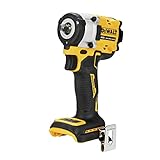
Compare the important specs
The figures below are manufacturer-published specifications for the listed tool models. Weight is typically bare tool weight; a battery adds weight and varies by capacity. Check the current regional listing before buying, since kits, model revisions, and specifications can differ by market.
| Tool | Drive | Published torque figure | Bare tool weight | Best fit |
|---|---|---|---|---|
| Milwaukee M18 FUEL 2962 | 1/2-inch friction ring | 650 lb-ft fastening; 800 lb-ft nut-busting | 5.1 lb | Regular car and light-truck work; broad control features |
| DeWalt 20V MAX XR DCF891 | 1/2-inch hog ring or detent pin, depending on version | 600 lb-ft fastening; 800 lb-ft breakaway | 3.8 lb | Mid-torque capability with a relatively light bare tool |
| Makita 18V LXT XWT17 | 1/2-inch friction ring | 520 lb-ft fastening; 740 lb-ft nut-busting | 4.8 lb | Users already invested in Makita 18V LXT batteries |
| Milwaukee M18 FUEL 2967 | 1/2-inch friction ring | 1,100 lb-ft fastening; 1,600 lb-ft nut-busting | 5.9 lb | Frequent heavy-duty jobs and larger vehicles |
These are all 1/2-inch tools, but their lengths and head shapes still differ, and a battery makes each setup larger. For clearance-critical work, compare the stated head length and test the tool against the actual access path; a slim impact socket may help, but it does not replace a lower-profile wrench when space is the limiting factor.
Choose by the jobs you actually do
- Seasonal tire changes and routine car repairs: A mid-torque 1/2-inch wrench is the most versatile starting point. It is easier to manage than a high-torque model and can handle many lug nuts and suspension fasteners, provided the fasteners are not badly seized.
- Tight engine-bay or interior access: Favor a compact 3/8-inch impact wrench or a short-head mid-torque model. A 3/8-inch drive is easier to position in confined areas, but it is not a substitute for a high-torque 1/2-inch tool on large, stubborn fasteners.
- Older vehicles, trucks, or frequent seized hardware: Consider high torque, such as the Milwaukee 2967, if the job and fasteners justify the additional size, weight, and battery demand. For an occasional stuck bolt, a breaker bar and penetrating oil may be a more economical solution.
- Already own cordless-tool batteries: Compare tools on your existing battery platform first. Buying a bare tool can reduce the cost substantially, while a new platform requires batteries and a charger as well.
What torque, drive size, and control mean in practice
Breakaway torque is not loosening certainty. Rust, thread damage, corrosion, and the fastener’s previous installation all affect removal. A quoted nut-busting figure is a test result, not a standardized guarantee across brands. If a lug nut will not move after a few seconds of impact, stop rather than holding the trigger indefinitely: verify the socket is seated, use penetrating oil where appropriate, and switch to a longer breaker bar or a more capable tool.
Drive size determines the socket ecosystem as well as access. A 1/2-inch drive has a wide range of impact sockets suited to wheel and suspension work. A 3/8-inch drive uses smaller sockets and often fits tighter spaces. Use impact-rated sockets with an impact wrench; ordinary chrome hand sockets can crack under repeated impacts.
Control matters as much as peak output. A useful home-shop wrench has multiple speed or power settings and a mode that reduces speed or stops after loosening. These features help prevent a nut from flying off and reduce the chance of over-tightening during installation. They do not make the tool a torque wrench. Run fasteners down gently, then tighten them to the vehicle maker’s specified torque with a calibrated torque wrench.
Battery runtime and total ownership cost
There is no dependable universal “lug nuts per charge” figure: battery condition, pack capacity, fastener corrosion, tool mode, and how long the trigger is held all change consumption. For occasional tire changes, a healthy 4.0–5.0 Ah battery is a practical starting point. A 5.0 Ah pack stores 90 watt-hours on an 18-volt platform (18 V × 5 Ah), but that is an energy rating, not a prediction of wrench runtime. High-torque work drains packs faster, and cold or aging batteries can reduce output.
Compare the complete cost, not only the tool price. Cordless impact wrenches commonly range from roughly $150–$300 for a bare mid-torque tool and about $250–$500 for a kit; high-torque kits can cost more. These are broad market ranges, and promotions or included batteries make them fluctuate. If you will use the wrench only a few times a year, a quality corded option or borrowing a tool may cost less than entering a new battery platform.
Safe setup for lug nuts
- Confirm the vehicle’s specified torque and socket size. Use the correct impact-rated socket, and keep the vehicle stable on level ground with appropriate wheel chocks and supports if it is raised.
- Break lug nuts loose before lifting when the vehicle maker’s procedure allows. Use a controlled setting and keep the socket square to the nut. Stop if the socket slips or the nut rounds.
- Use the wrench only to remove nuts and run them down lightly. Do not use repeated impact bursts as a substitute for final torque. Avoid lubricating wheel-stud threads unless the vehicle maker specifies it, because lubrication changes clamping force.
- Finish in the specified sequence and torque. Tighten with a calibrated torque wrench, typically in a crossing pattern for a multi-lug wheel, and follow the vehicle manual for any recheck instructions.
Keep the wrench working well
Impact-rated sockets and the drive’s retaining ring are common wear points: inspect sockets for cracks and check that they still retain securely. Keep dust out of the battery contacts, store packs away from excessive heat and moisture, and do not block the tool’s cooling vents. Brushless models avoid brush replacement, but they are not maintenance-free; heavy impacts, drops, damaged anvils, and overheated batteries can still shorten service life. When a fastener is beyond the tool’s capacity, forcing the wrench can damage the socket, fastener, or tool without solving the problem.