What's inside
As an Amazon Associate I earn from qualifying purchases. This post may contain affiliate links at no extra cost to you.
What we cover
Best Angle Drill Jigs at a Glance
The best angle drill jig for most woodworkers is an adjustable guide that locks between roughly 30° and 90° with a steel drill bushing sized to your bit — it covers pocket-hole-adjacent angles, angled doweling, and pilot holes without needing a drill press. If you only ever drill one angle (45° for mitered joinery or 90° for shelf pins), a fixed-angle block is cheaper, more rigid, and honestly more accurate. The right pick depends on which angles you actually drill, how thick your stock is, and whether the jig’s clamping footprint fits your workpiece.
What Actually Matters in an Angle Drill Jig
A drill angle jig does one job: hold a bushing at a repeatable angle so your hand drill can’t wander. That sounds simple, but four details separate useful jigs from shelf decoration.
As an Amazon Associate we earn from qualifying purchases at no extra cost to you.


Angle range and detent quality
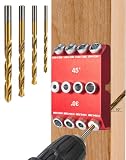
Adjustable jigs typically offer a continuous range from about 30° to 90°, or indexed stops at common settings like 22.5°, 45°, 60°, and 90°. Indexed stops are faster and more repeatable; continuous adjustment with a protractor scale gives flexibility but relies on you tightening the lock firmly — a partially seated bolt is the number one cause of mid-drill angle drift. If your work is 90% 45-degree angled holes, a fixed 45 degree angle drill jig machined from a single aluminum block beats an adjustable unit on repeatability because there’s nothing to slip.
Guide bushing sizes
The bushing inner diameter must match your bit closely — ideally within 0.005–0.010″. Sloppy fit means the bit walks and the jig becomes decoration. Look for kits with interchangeable bushings covering common bit sizes: 1/8″, 3/16″, 1/4″, 5/16″, 3/8″, and 1/2″. Hardened steel bushings outlast aluminum guides by a wide margin; if a jig lists replaceable bushings, that’s a genuine ownership advantage because bushings are the part that wears first.
Workpiece thickness and clamping stability
Most jigs clamp or butt against stock between about 1/2″ and 2″ thick. The bigger issue is the clamping footprint: a jig that references off a narrow edge needs a flat, square surface or it tilts and your “45°” hole becomes 47°. Jigs with a wide fence plus a cam or toggle clamp hold far steadier than hand-held blocks on anything under 3/4″ thick.
Build quality
CNC-machined aluminum with steel bushings is the standard worth paying for. Cast zinc and molded plastic jigs exist at the low end and work for occasional 90° holes, but plastic threads on the angle lock strip quickly under repeated torque.
Comparison: Common Angle Drill Jig Types
| Jig type | Angle range | Bushing sizes | Stock thickness | Body material | Typical price | Best for |
|---|---|---|---|---|---|---|
| Adjustable protractor jig (e.g., Wolfcraft-style guides) | ~30°–90° continuous | Single collar or 3–5 bushings | Up to ~1-3/4″ | Cast alloy + plastic base | $30–$60 | Occasional angled holes, varied projects |
| Indexed adjustable jig (e.g., Milescraft DrillMate-style) | Stops at 45°, 60°, 75°, 90° | Integrated guides, limited sizes | Up to ~2″ | Polymer + steel insert | $25–$50 | Portable work, corner and edge drilling |
| Fixed 45° doweling block | 45° only | 1/4″, 5/16″, 3/8″ hardened bushings | 1/2″–1-1/2″ | Anodized aluminum | $40–$80 | Miter joints, angled dowels, repeatable shop work |
| Multi-angle drilling block set | 30°, 45°, 60°, 90° faces | 6–10 interchangeable bushings | Clamp-dependent | Machined aluminum + steel bushings | $80–$150 | Frequent angled holes across many bit sizes |
Picks by Situation
For angled dowel and miter joinery: fixed-angle block
If you’re reinforcing mitered frames or cabinets with angled dowels, a dedicated 45° aluminum block with hardened bushings is the right tool. Single-piece construction means zero setup error: clamp, drill, done. Pair it with a sharp brad-point bit and you get clean entry holes that a twist bit guided loosely would never produce.
For one jig that does everything: indexed adjustable
An indexed jig with positive stops covers the angles a home shop actually uses — 45° for miters, 90° for shelf pins and edge drilling, 60° for lamp hardware and leaning joints. The tradeoff is bushing selection; check the included sizes against the bits you own before buying, because a drill angle jig that only fits 3/8″ bits limits you fast.
For occasional DIY use: budget drill-guide style jig
Portable drill guides that set an angle and clamp to the workpiece (or attach to the drill itself) run roughly $25–$60 and handle the “angle jig for drill” job fine at low volumes. Expect softer bushings and lighter clamping — adequate for a weekend project, frustrating if you’re drilling fifty holes.
Decision Matrix
| Your situation | Recommended type | Why |
|---|---|---|
| Only drill 45° holes, high volume | Fixed 45° block | Fastest repeatability; nothing to adjust or slip |
| Mixed angles, mixed projects | Indexed adjustable | Positive stops beat continuous scales for repeatability |
| Budget under $50, occasional use | Polymer adjustable guide | Acceptable accuracy; bushing wear is slow at low volume |
| Drilling many bit sizes | Block set with 6+ bushings | Bushing-to-bit fit is what delivers accuracy |
| Thin stock under 3/4″ | Jig with wide fence + clamp | Edge-referencing jigs tip on narrow stock |
| Already own a drill press | Tilting table instead | A jig is redundant for through-holes on flat stock |
Setup: Getting an Actually-Accurate Angled Hole
The jig is half the equation; setup is the rest:
- Mark the hole center and align the bushing over it — most angle jig drill setups fail because the hole is drilled at the right angle in the wrong spot.
- Clamp to a flat reference face. Any cup or bow in the workpiece tilts the jig. Check with a straightedge first.
- Verify the angle with a digital angle gauge or combination square on the first hole of a batch, not after the tenth.
- Use a bit that fits the bushing closely. A 1/4″ bit in a 3/8″ bushing wanders regardless of jig quality.
- Drill at moderate speed and clear chips frequently. Packed chips in the bushing score the bit and enlarge the bushing bore over time.
- Back up the exit side or drill to a taped depth line to prevent tear-out on through-holes.
Ownership Realities
Bushings wear first — expect a hardened steel bushing to stay accurate for thousands of holes, and an unhardened one to show measurable slop within a few hundred. Replacement bushings cost a few dollars each; buy a jig where they’re available separately. Angle-lock bolts and cam clamps are the next wear point; keep threads clean, since sawdust packed into a protractor scale’s lock mechanism causes the drift most users blame on the jig. Common mistakes include trusting the printed angle scale without verifying, using twist bits where brad-points belong, and skipping the clamp “to save time” — which is how you get oval holes.
Frequently Asked Questions
Can I drill a 45-degree hole without an angle drill jig?
You can eyeball it or use a speed square as a visual reference, but accuracy rarely lands within ±3°, and there’s no bushing to prevent bit wander. For a single non-critical hole it works; for joinery, use a 45 degree angle drill jig.
Will an angle jig work with any drill?
Clamp-on and hand-held jigs work with any corded or cordless drill. The limitation is bit length — check that your bit reaches through the bushing and still has enough flute length for the hole depth you need.
Fixed-angle or adjustable — which is more accurate?
A fixed-angle block is more accurate because it can’t slip. An adjustable jig with positive indexed stops is a close second. Continuous-adjustment jigs are the least repeatable because they depend on how firmly you lock the pivot.
What bit should I use in a drill-at-angle jig?
Brad-point bits for clean entry in wood; the center point stays seated in your mark while the bushing controls the angle. Match the bit diameter to the smallest bushing it fits.