What's inside
As an Amazon Associate I earn from qualifying purchases. This post may contain affiliate links at no extra cost to you.
The best pocket drill jig for most woodworkers is the Kreg 320 for occasional, portable work, while the Kreg K4 or K5 is the better choice for frequent cabinet and furniture assembly; choose a Milescraft PocketJig 200 when low cost matters more than maximum refinement.
A pocket-hole jig is a positioning tool: it guides a stepped drill bit at a fixed angle so the screw enters one workpiece and pulls it against another. The useful buying differences are not just hole spacing. Material-thickness range, guide wear, clamping speed, portability, screw compatibility, and repeatability determine whether a jig remains pleasant to use after a few projects.
As an Amazon Associate we earn from qualifying purchases at no extra cost to you.



What we cover
Quick comparison of the leading pocket-hole jigs
| Model | Material range | Guide and body | Clamp approach | Portability | Typical market range |
|---|---|---|---|---|---|
| Kreg 320 | 1/2, 3/4, and 1 1/2 in settings | Hardened-steel drill guide; reinforced polymer body | Separate face clamp or bar clamp | Very high; compact, about 1 lb | About $35–$55 |
| Kreg 520PRO | 1/2 to 1 1/2 in, with fine adjustment | Steel guide with durable polymer housing | Integrated Automaxx-style clamp | High; roughly 2–3 lb | About $100–$150 |
| Kreg K4 | 1/2 to 1 1/2 in | Three hardened-steel guides; heavy polymer base | Front-mounted hand clamp | Medium; benchtop-friendly, roughly 4 lb | About $90–$130 |
| Kreg K5 | 1/2 to 1 1/2 in | Three hardened-steel guides; larger support wings | Front-mounted ratcheting clamp | Medium-low; roughly 6 lb with supports | About $130–$180 |
| Milescraft PocketJig 200 | 1/2, 3/4, and 1 1/2 in settings | Metal drill guide with polymer jig body | Separate clamp or integrated-compatible clamp | High; compact benchtop or jobsite tool | About $30–$50 |
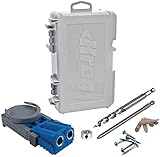
Dimensions and included accessories can vary by kit, so treat the figures as buying benchmarks rather than substitutes for the current package contents. A kit may include a stepped bit, depth collar, square-drive bit, screws, clamp, or material-thickness gauge—or sell some of those separately.
Best pocket drill jig by situation
Best for occasional repairs and small spaces: Kreg 320
The Kreg 320 is the easiest recommendation when the jig must live in a drawer rather than on a dedicated workstation. Its removable drill-guide block can be positioned for one or two-hole layouts, and the compact body works well on narrow rails, face frames, shelves, and repairs where a large jig is awkward.
Its limitation is clamping. The jig does not provide the same built-in speed as a larger benchtop model, so you must use a compatible clamp or hold-down arrangement. That is a minor inconvenience for ten holes, but noticeable when assembling a bookcase with dozens of joints. It is also less convenient for repeating a long sequence unless you mark a consistent reference edge and use a stop block.
Best portable upgrade: Kreg 520PRO
The 520PRO bridges the gap between a compact pocket drill jig and a production-oriented fixture. Its integrated clamp applies pressure quickly and accommodates changing stock thickness without the repeated fiddling required by a simple screw clamp. That makes it a strong choice for a mobile workshop, renovation work, or a woodworker who builds several projects each month but does not want a large benchtop station.
The trade-off is cost and bulk. For occasional use, the clamp mechanism may not repay the premium. Inspect the clamp pad and adjustment mechanism periodically; packed dust or a loose adjustment can reduce clamping pressure and allow the jig to shift.
Best for repeatable cabinet work: Kreg K4
The K4 is a particularly sensible dedicated-workbench choice. Its three drill guides let you create consistent paired or triple-hole patterns without repositioning a single guide block, and its front clamp is accessible even when the jig is near the back of a bench. The removable spacer supports thinner stock and helps establish a repeatable offset from the edge.
It has a simpler, more traditional clamp than the K5. That can be an advantage for ownership: fewer moving parts, easy access, and less dependence on a ratchet mechanism. If your projects mainly involve 3/4-inch plywood, solid-wood rails, and face frames, the K4 supplies most of the practical capability of a larger jig at a lower market price.
Best for high-volume assembly: Kreg K5
The K5 earns its place when speed and support matter more than compact storage. Its ratcheting clamp is quick to adjust, and the extended support wings make wide panels and long boards easier to balance. The built-in storage areas also reduce the chance of misplacing the drill bit, driver, or thickness gauge between operations.
It is not automatically more accurate than the K4. Accuracy still depends on a square reference edge, correct depth-collar setting, a firm clamp, and consistent board positioning. The K5 is the better production tool because it makes those repeated operations faster and less tiring—not because a pocket screw becomes stronger merely by using a larger jig.
Best low-cost alternative: Milescraft PocketJig 200
The PocketJig 200 is worth considering for beginners and occasional furniture repairs. It provides the essential metal guide and common thickness settings while generally costing less than a fully equipped premium system. It is suitable for joining plywood, dimensional lumber, and many face-frame components when used with the correct screw length and a stable clamp.
Before buying, check which accessories are included. A lower kit price can disappear if you still need a clamp, stepped bit, depth collar, driver bit, and screws. The system also uses its own accessory ecosystem, so confirm that replacement bits and compatible screws are readily available in your area.
How the key buying criteria change the choice
Material thickness range
Most general-purpose jigs cover approximately 1/2 to 1 1/2 inches. That covers common 1/2-inch and 3/4-inch sheet goods, 1-inch boards, and nominal 2-by material whose actual thickness is about 1 1/2 inches. Thickness settings refer to the actual measured stock, not the lumber’s trade name.
Measure plywood with calipers when the fit matters. A panel sold as 3/4 inch may be 18 or 19 millimeters, and that small difference affects both drill depth and screw penetration. For unusual stock, use the jig’s thickness gauge or manufacturer’s setting chart rather than guessing.
Guide durability
The drill guide is the wear point. A bare polymer guide can enlarge or become rough after repeated drilling, especially when the bit is dull, the drill is tilted, or chips are not cleared. Hardened-steel guide bushings resist this wear far better. Polymer bodies are not inherently a problem: they keep the tool light and do not normally bear the cutting load.
Replace a stepped bit when it becomes difficult to feed, burns the wood, or leaves a ragged shoulder. Continuing with a damaged bit can make a good guide appear worn. Do not lubricate the guide with oily spray; it can attract abrasive dust. A dry wipe and compressed air used cautiously are usually better.
Clamp design and repeatability
A jig that shifts by even a small amount can leave a screw too close to an edge or cause the joint to open. Integrated clamps are fastest, while separate face clamps provide flexibility on awkward parts. For repeat work, make a simple stop block: position it from the jig’s reference edge, clamp it to the bench, and slide every board against the same stop.
Use the same face of the board against the jig each time. Mark a reference face and edge before drilling. This prevents mirrored holes and keeps visible seams aligned, particularly when parts have slightly varying widths.
Screw compatibility
Pocket-hole screws are not interchangeable merely because they share a drive shape. Select screw length for the actual material thickness and choose coarse-thread screws for softwoods and plywood, with fine-thread versions generally preferred for hardwoods. Outdoor projects require an appropriately corrosion-resistant screw; ordinary interior screws are not a substitute.
Square-drive bits are common in pocket-hole systems, but bit length and driver size can differ. Keep the supplied bit or a confirmed compatible replacement with the jig. Using a generic bit with the wrong shoulder or length can damage the guide or leave the screw head improperly seated.
A practical setup that prevents most failures
- Measure the workpiece and set the jig and drill-collar depth for the actual thickness.
- Choose the screw length from the jig’s chart, then verify that the screw will not break through the receiving face.
- Place the reference edge against the jig’s registration surface and clamp firmly.
- Drill at full speed with steady pressure, withdrawing once or twice to clear chips in deep or resinous stock.
- Drive the screw until the joint closes; stop when the head seats rather than applying maximum torque.
- Check one joint on scrap before drilling an entire batch.
As a rough planning example, a project with 24 joints and two holes per joint requires 48 pocket holes. If a compact jig takes about 20 seconds to reposition and clamp for each pair, that is roughly 8 minutes of positioning alone. A built-in clamp and a stop block can reduce this repetitive time substantially; that is where a more expensive jig earns its value.
Final buying recommendation
Choose the Kreg 320 if storage space, portability, and a modest budget dominate. Choose the Milescraft PocketJig 200 when you want a low-cost complete starting point and have confirmed the accessory contents. Choose the Kreg 520PRO for mobile work that still demands quick clamping. Choose the Kreg K4 for dependable benchtop repeatability, or the K5 when wide workpieces and frequent assembly justify its larger footprint.
Whichever pocket drill jig you buy, prioritize a hardened-steel guide, an appropriate clamp, readily available replacement bits, and clear thickness settings. Those ownership details matter more than the number of holes in the jig body, and they are what turn pocket joinery from a quick shortcut into a consistent assembly method.