What's inside
As an Amazon Associate I earn from qualifying purchases. This post may contain affiliate links at no extra cost to you.
The best Craftsman router table for most shops is the benchtop folding design in the mid-tier price range—it accepts nearly any router with a compatible insert plate, sets up in minutes, and stores flat against a wall, which matters more than raw table size for anyone working in a garage or shared space. That said, the right pick depends on how often you route, what you already own, and whether portability or rigidity matters more to you.
As an Amazon Associate we earn from qualifying purchases at no extra cost to you.



What we cover
What Actually Matters When Comparing a Craftsman Router Table
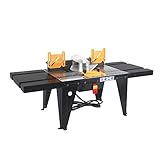
Craftsman’s router table lineup has consolidated over the years into a small set of benchtop units—typically the standard benchtop table (around 16″ x 24″ surface) and the larger deluxe benchtop model (roughly 18″ x 27″). Both use an aluminum insert plate and a split fence with dust collection ports. Rather than chasing model numbers, compare these decision factors:
- Table size and mass: Larger tops support wider panels (raised panel doors, box sides) without an outfeed support. Smaller tops store easier but flex more under heavy cuts.
- Insert plate compatibility: Craftsman plates accept most fixed-base and some plunge routers, but hole patterns matter. Verify your router base diameter—plates typically fit routers up to about 6″ base diameter, and some larger routers (3+ HP fixed bases) may not match the predrilled pattern.
- Fence adjustment: Craftsman uses a split fence with sliding faces, so you can zero-clear the bit opening. Look for whether the fence uses a single clamp point or two—two-point fences hold alignment better but are slower to adjust.
- Dust port size: Most Craftsman fences use a 2-1/2″ port. If your shop vac is 1-1/4″ or your dust collector is 4″, budget for an adapter.
- Legs vs. benchtop: Benchtop units sit on sawhorses or a workbench—cheaper, but you supply the stand. A dedicated stand adds $80–$150 in equivalent value if you’d otherwise build one.
Craftsman Router Table Comparison
| Feature | Compact Benchtop | Deluxe Benchtop | Table + Stand Combo |
|---|---|---|---|
| Table surface (approx.) | 16″ x 24″ | 18″ x 27″ | 18″ x 27″ |
| Insert plate | Aluminum, predrilled | Aluminum, multiple patterns | Aluminum, multiple patterns |
| Fence | Split faces, single clamp | Split faces, dual clamp | Split faces, dual clamp |
| Dust port | 2-1/2″ | 2-1/2″ | 2-1/2″ |
| Weight (approx.) | 25–30 lbs | 35–40 lbs | 55–65 lbs assembled |
| Miter slot | Yes, 3/4″ T-slot | Yes, 3/4″ T-slot | Yes, 3/4″ T-slot |
| Assembly time | 15–30 min | 30–45 min | 60–90 min |
| Typical price range | $100–$140 | $150–$200 | $220–$300 |
Router Compatibility: The Detail Listings Gloss Over
The single most common post-purchase complaint is a router that doesn’t bolt to the plate. Craftsman plates are predrilled for common base patterns—older Craftsman fixed-base routers fit directly, and most 1-3/4 to 2-1/4 HP fixed-base routers from other brands can be mounted if you drill your own holes (the plates are soft aluminum and drill cleanly with a step bit).
Two realities to know:
- Plunge routers work but lose plunge function. That’s fine—table routing doesn’t use plunge anyway. Just lock the depth and use the height adjuster.
- Above-table height adjustment exists on newer Craftsman plates via a hex key hole, but only if your router has a compatible adjuster shaft. Check before assuming.
- Bits over 3″ diameter (raised panel bits) need a variable-speed router and clearance under the plate—verify the opening diameter on your plate accepts the cutter, and run large bits at 10,000–12,000 RPM, never full speed.
Decision Matrix: Which One Fits Your Shop?
| Your situation | Best choice | Why |
|---|---|---|
| Occasional edge profiles, garage shop, stores on a shelf | Compact benchtop | Lightest to move; 15-minute setup means you’ll actually use it |
| Regular cabinetry, drawer joinery, raised panels | Deluxe benchtop | Dual-clamp fence holds alignment across repeated setups; bigger top supports panels |
| No workbench, routing several times a month | Table + stand combo | Building a stand costs similar money and half a day of shop time |
| Dedicated routing station planned, large panels | Skip Craftsman—buy an MDF-fence cast-top or build a router cabinet | Craftsman tops max out around 27″ wide; big panel work wants 32″+ and better fences |
Cost Per Use: A Quick Reality Check
If you route twice a month for five years, that’s ~120 sessions. A $170 deluxe benchtop unit costs about $1.40 per session—trivial compared to a $40 router bit you’ll burn through faster. The meaningful cost isn’t the table; it’s the setup friction. A table that’s annoying to assemble effectively costs you an hour each session, which is why the compact model often outperforms the combo for occasional users despite the smaller top.
Ownership Realities and Common Mistakes
- What wears first: The MDF fence faces and the phenolic insert rings. Faces get chewed by bits—budget a few dollars a year for sacrificial replacement faces cut from scrap.
- Table sag: MDF-core tops can sag if stored leaning on edge in humid garages. Store flat or vertically with both edges supported.
- Plate leveling: The most-skipped assembly step is leveling the insert plate to the surrounding top using the set screws. An unleveled plate catches workpiece edges and causes tear-out at the start of a cut.
- Common mistake: Feeding right-to-left on the front edge (climb feeding) because the fence orientation was flipped. The fence goes behind the workpiece; feed left to right on the near edge.
- Cleaning: The under-table cavity traps chips around the router motor vents. Vacuum it after every session—a router running hot in a chip-filled box is the most common router-killer in benchtop setups.
FAQ
Will my existing router fit a Craftsman router table?
Most fixed-base routers up to about 2-1/4 HP fit the predrilled patterns or can be mounted by drilling the aluminum plate. Large 3+ HP routers and some compact trim routers need drilling or an adapter plate.
Is a benchtop router table stable enough for raised panels?
Yes, if clamped to a rigid bench. The limiting factor is usually bit size and router power, not the table. Run large bits at reduced speed and take multiple shallow passes.
Do I need a router lift with a Craftsman table?
No. You adjust bit height by reaching under and turning the router’s own adjuster, or through the above-table hole if your router supports it. A lift is a convenience, not a requirement.
Bottom Line
Buy the compact benchtop if routing is occasional and storage is tight, the deluxe benchtop if you route regularly and want a fence that holds alignment, and the stand combo only if you genuinely lack bench space. Verify your router’s base pattern before purchase, level the plate during assembly, and keep the cavity clean—those three things matter more than any spec on the box.