What's inside
- Best Insulated Screwdrivers for Electrical Work
- Quick comparison: choose by task
- What the voltage marking does—and doesn’t—tell you
- Choose the right insulation and tip for your situation
- Buying checklist: compare more than the handle
- Worked example: why tip fit matters
- Care, inspection, and replacement
- Bottom line
- Best Insulated Screwdrivers for Electrical Work
- Quick comparison: choose by task
- What the voltage marking does—and doesn’t—tell you
- Choose the right insulation and tip for your situation
- Buying checklist: compare more than the handle
- Worked example: why tip fit matters
- Care, inspection, and replacement
- Bottom line
As an Amazon Associate I earn from qualifying purchases. This post may contain affiliate links at no extra cost to you.
What we cover
- Best Insulated Screwdrivers for Electrical Work
- Quick comparison: choose by task
- What the voltage marking does—and doesn’t—tell you
- Choose the right insulation and tip for your situation
- Buying checklist: compare more than the handle
- Worked example: why tip fit matters
- Care, inspection, and replacement
- Bottom line
Best Insulated Screwdrivers for Electrical Work
The best insulated screwdrivers for electrical work are individually insulated tools rated and certified for the voltage and standards required by your job—not ordinary screwdrivers with colored handles. For most professional work, choose a VDE- or otherwise appropriately certified set marked for 1,000 V AC, with insulation extending close to the tip and the tip styles and sizes that fit your equipment. That rating is a tool specification, not permission to work on energized circuits: de-energize and verify whenever possible, and follow applicable electrical-safety rules.
Quick comparison: choose by task
These are established product lines and common configurations. Exact contents, dimensions, and availability vary by set and region, so check the manufacturer’s current specification before buying.
As an Amazon Associate we earn from qualifying purchases at no extra cost to you.


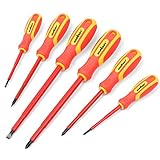
| Product line | Voltage / certification to verify | Typical tip coverage | Best fit | Ownership consideration |
|---|---|---|---|---|
| Klein Tools 1000V Insulated Screwdriver sets | Models are marked for up to 1,000 V; verify the specific tool’s certification and markings | Common sets cover slotted and Phillips; configurations differ | North American electricians seeking familiar individual drivers or a basic set | Replace a driver if its insulation is cut, cracked, loose, or otherwise damaged |
| Wiha SoftFinish electric slimFix | Many versions carry VDE/IEC 60900 markings and a 1,000 V AC rating; confirm on the tool | Slim-shaft options help reach recessed terminals; slotted, Phillips, and other profiles depend on set | Control cabinets and recessed terminals where access is tight | Slim insulation is useful for access but still needs careful handling and inspection |
| Wera Kraftform Kompakt VDE sets | Selected sets use individually tested VDE/IEC 60900 components rated to 1,000 V AC | Interchangeable insulated blades provide multiple profiles in a compact kit | Technicians who value a portable kit and regularly switch tip styles | Keep the handle and approved insulated blades together; do not substitute ordinary bits |
| Facom Protwist VDE insulated drivers | Check the specific model for VDE/IEC 60900 certification and voltage marking | Individual drivers commonly cover slotted and Phillips; set selection varies | Buyers who prefer dedicated drivers rather than interchangeable blades | A set can take more space, but there is no blade-changing step at the job |
What the voltage marking does—and doesn’t—tell you
A 1,000 V AC marking is common on insulated hand tools made for electrical work. For example, IEC 60900 covers insulated hand tools for live working up to 1,000 V AC and 1,500 V DC. In Europe, VDE certification is a familiar independent mark associated with testing to relevant standards; look for the actual certification and standard markings on the tool, not just “insulated” in a product name. Requirements and accepted marks vary by jurisdiction and employer.
Voltage rating alone does not show the tool’s condition, prove that a counterfeit or unmarked product is safe, or make energized work appropriate. A damaged driver can no longer be relied on as insulated, even if its handle still looks mostly intact. Follow your workplace procedures, use suitable protective equipment, and isolate and verify circuits whenever practicable.
Choose the right insulation and tip for your situation
For frequent panel and cabinet work
Prioritize a certified 1,000 V AC driver with insulation extending down the shaft close to the working tip. A slim-profile insulated shaft can reach recessed terminal screws that standard insulated shafts may not. Slim does not mean indestructible: avoid levering against terminal edges or scraping the insulation along sharp enclosure openings.
For occasional repairs or a first set
Buy fewer, commonly used sizes rather than a large assortment you will rarely carry. A practical starting point is a small set of slotted and Phillips drivers selected for the fasteners in your equipment. Check the screw head and manufacturer’s service information; a nearly fitting tip can cam out, damage the screw, or slip toward adjacent parts.
For compact tool bags and varied fasteners
An interchangeable-blade VDE kit can reduce bulk and provide useful tip variety. Confirm that each blade is an approved insulated component for that specific handle system. A standard bit inserted into an insulated handle is not a substitute for a certified insulated blade.
For Torx or other specialized screws
Match the exact profile and size specified by the equipment manufacturer. Insulated Torx and other less-common profiles exist, but availability varies by brand and region. Do not force a Phillips driver into a Pozidriv screw, or use a slotted blade that is too narrow: poor fit increases slipping and fastener damage.
Buying checklist: compare more than the handle
- Markings: Look for the applicable standard, certification mark where relevant, and voltage rating on the tool itself. Verify documentation for the exact model or set.
- Coverage: Prefer full shaft insulation that stops close to the tip. The exposed working end is necessary for engagement, but excessive exposed metal can increase the chance of accidental contact.
- Tip range: List the screw profiles and sizes you actually encounter, then compare them with the set contents. A larger assortment is not automatically more useful.
- Access: Choose slim-shaft insulation for recessed terminals only when the application calls for it; check whether shaft thickness and blade length will reach the fastener without contacting neighboring parts.
- Grip and control: Handle shape affects comfort and torque control. Avoid treating an insulated driver as a torque-measuring tool; use a specified torque tool when the connection calls for one.
- Set versus individual tools: Dedicated drivers are ready to use and avoid blade changes. Interchangeable systems save space but depend on using only the matched, certified components.
Worked example: why tip fit matters
Suppose a terminal uses a slotted screw with a 5 mm-wide slot. A blade substantially narrower than the slot contacts less of the screw head, concentrating force and making it easier to twist out. A blade wider than the slot may not seat fully. Select the closest manufacturer-recommended blade width and thickness that seats fully, then apply steady axial pressure. This is a fit check, not a reason to work on an energized terminal.
Care, inspection, and replacement
Insulated screwdrivers wear in ways that can be easy to miss. Before each use, inspect the full insulation for cuts, punctures, cracks, swelling, contamination, or separation from the shaft. Check the tip for rounding, chips, and deformation; a worn tip slips more readily and can damage the fastener. Clean tools according to the manufacturer’s instructions, and avoid solvents, heat, grinding, or modifications that could compromise the insulation.
Take a damaged or suspect tool out of service rather than covering the defect with tape or treating a small nick as harmless. Store drivers so sharp tools and loose metal parts do not abrade the insulation. Use tools only within their marked rating and intended application, and follow your organization’s inspection and retirement rules.
Bottom line
For general professional use, start with a manufacturer-documented set of individually insulated drivers marked for 1,000 V AC and certified to the standard required where you work. Choose slim insulation for recessed access, dedicated drivers for immediate readiness, or an approved interchangeable-blade kit when compact storage matters. The best insulated screwdrivers electricians carry are the ones whose markings, condition, tip fit, and access all match the job—not simply the set with the most pieces.